 Getting Started
Electric fences are commonly used in agriculture. Where as standard fences are constructed to form a physical barrier, electric fences are constructed to form a psychological or mental barrier. The mental barrier is accomplished by introducing an electric shock through the fence wire that both repels the animal and makes them less likely to contact the fence again. Once the animal has been electrically shocked it will remember the discomfort and learn to avoid the fence.
Electric fences may be less robustly constructed using lower cost materials than nonelectric fences, but to be effective they must have:
• the physical structure (i.e. the posts and wire)
• the electric circuit (i.e. a complete path for the current)
• proper maintenance to ensure the circuit is not “shorted out”
There are two types of electric fences; temporary and permanent. Both require a fence controller to energize the fence.
Advantages of Electric Fences
Electric fences have a number of advantages over nonelectric fences, including:
• a possible improvement in livestock control
• a possible lower construction costs (materials and labour)
• temporary fence designs are easily moved (i.e. for grazing control)
• they may be effective in controlling wildlife and predators
• they can be used to extend the life of existing nonelectric fences
• they may reduce the livestock pressure on other farm fences (even those fences which are nonelectric)
Disadvantages of Electric Fences
The following points should be considered when choosing to use an electric fence:
• the fence is (or may be) ineffective if the power is off or grounded out
• more frequent inspections and maintenance may be required
• special designs are required in dry, frozen or snow covered soil conditions
• animals require training to become familiar with, and gain respect for, the fence (this should be done prior to turning the animals out)
• fence line weed control may be important to reduce shorting the electrical circuit
• it may be difficult to convert to a nonelectric fence (if lightweight materials were used)
• usually not suitable for confined areas or where animals are crowded together
Permanent Electric Fences
There are two main uses of permanent electric fences:
• for additional livestock control (one or more electrified wires added to a nonelectric fence design), or
• for low cost basic livestock control (for example in fixed grazing subdivisions)
Neither of these take advantage of the portability of electric fences but use the psychological deterrent ability to either improve control or reduce costs for a permanent fence.
Temporary Electric Fences
These take full advantage of the portability features of electric fences by using light steel wire or a polyethylene/steel composite wire material (cord, tape or netting) along with lightweight, hand installed posts. Easily moved and setup, these fences are used for temporary holding, rotational grazing or other similar situations.
Understanding Electricity
To properly install and maintain an electric fence, an understanding of the principles of electricity is important. The following is a simplified look at electricity.
Electricity is the flow of electrons; in the case of a fence that flow may be in a wire or in the earth between grounding points. This flow cannot be seen but can be felt!
Comparison to Water Systems
It is often easiest to “visualize” electricity in terms of water. Both need a conduit to move (water in a pipe/electricity in a wire); both can be stored (water in a tank/electricity in a battery); and neither can be compressed (meaning if you increase the pressure at one end of a system you get the increased pressure at the other end).
Figure 1, further illustrates these similarities. The water system has water from a tank pumped under pressure through a pipe. The electrical system has electrons from a battery or utility lines being forced down a wire by the controller.

Figure 1 Comparison of Electrical and Water System Terms
Amperage, Voltage, Wattage and Joules
Using a comparison of terms, the water flow is equivalent to electrical amperage and the water pressure is equivalent to electrical voltage. Whereas the rate of water flow times pressure equals the pump mechanical (horse)power, amperage times voltage equals the controller electrical power (wattage). Controllers are commonly energy rated by their wattage per second or joule output.
Fence Electrical Circuit
The electrical circuit on a fence is normally “open”; that is electrical energy is present but not flowing. The only time we want the circuit to “close” is when an animal touches the fence and completes the circuit (and thereby receives a shock). However in reality, there are sometimes small leakages (short circuits) caused by grass touching a wire, etc.
Short Circuits
A short circuit allows some electrical current to flow a “short” return route to ground.
Using the water comparison, just as a pipe with holes will have a reduced flow and pressure at the outlet, similarly a wire with short circuits will have a reduced flow and pressure of electrons.
A dead short circuit is a short circuit where all the current is shorted to ground. We know that if water is pumped from the tank into an open ended pipe, the tank may be soon emptied. So too, if a dead short circuit develops, the controller may “pump” the battery “dry” (or cause a large utility bill). An example of a dead short would be a metal pipe laying on the energized fence wire and touching the ground.
Other types of short circuits require regular inspection of the fence to locate and remove. To prevent short circuits between the wires and the posts, energized fence wires are insulated with various plastic or ceramic insulators. While uninsulated electric fences may be constructed, the controller will be limited to energizing a limited length of fence.
Resistance to Current Flow
The resistance to flow is also easy to compare to water systems. A small diameter pipe and/or a long pipe will have a large resistance to flow; so too will a small diameter wire or a long length of fence. The greater the resistance, the greater the pressure (voltage) required to have a flow (current). The shock intensity to an animal from the electric fence is related to the current produced, so high fence resistance to current flow is not beneficial.
Materials for Electric Fences
The three basic materials for electric fences (posts, wire and controller). The many other components in electric fencing can be divided into:
• materials to construct the electric circuit
• materials for lightweight, movable fences
Electric Circuit Materials
Because the fence uses uninsulated wire (livestock must make contact with a “hot” wire), all points of contact between the wire and any point of possible grounding must be insulated. If this is not done, poor shock intensity will result (or only a very short length of fence will be energized).
Some moveable electric fences use insulating posts (fibreglass, polyethylene, etc.) but most fences require an insulator for each “hot” wire on every post. Insulators are also required at tie off points and other points of possible grounding.
Line Post Insulators
Some moveable electric fences use insulating posts (fibreglass, polyethylene, etc.) but most fences require an insulator for each “hot” wire on every post. Insulators are also required at tie off points and other points of possible grounding.
These insulators have the following requirements (refer to Figure 2). They:
• nail or screw onto wooden posts (1 or 2 attachment points)
• clamp onto steel posts
• are usually made of plastic (polyethylene or polypropylene) but porcelain is available (more expensive)
• must be able to resist deterioration from the sun (ultraviolet damage is a concern with many plastics)
• must have sufficient separation between the post attachment point and the fence wire to prevent electrical leakage
• must have sufficient surface distance along the insulator between the wire and the post to prevent electrical leakage (between 1 to 1 1/2 inches as measured along the surface)
• must be able to maintain resistance to electrical leakage (wet conditions and dry)
• must have the physical strength to withstand the wire tension loads and the high voltages of fence controllers.
In addition, line insulators should have the following features. They:
• should allow installation of the fence wire after the insulator is attached to the post
• should be reusable
• should not require accurate nailing to prevent damage
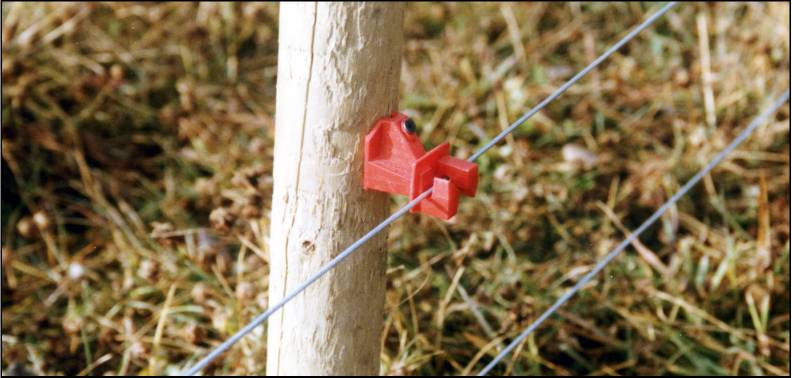
Figure 2 Typical Line Post Insulator
Offset Insulators
Special line post insulators are used to offset an electrified wire from the main fence (i.e. on an old nonelectric fence to extend its life). They will set the “hot” wire up to 6 inches out from the fence to ensure the animals being controlled will contact it before the main fence. These insulators are either all plastic and attached as standard line post insulators, or they are a steel bracket attached directly to the fence wire or post with an insulated eye for the “hot” wire; see Figure 3, below.

Figure 3 Typical Offset Line Post Insulator
Tie Off Insulators
These insulators have many of the same requirements as line post insulators but require additional strength, as they must resist the entire fence wire tension. These insulators (refer to Figure 4, below):
• are used at fence change of direction or tie off points
• are made of porcelain or high grade plastic and wire tied to the post
• are made of steel reinforced plastic tubing which the fence wire is threaded through and then wrapped around the post (do not use ordinary plastic pipe for this purpose).

Figure 4 Typical Tie Off Insulator
Miscellaneous Circuit Materials
There are a number of special items for the construction, testing and maintenance of electric fences;
• various special insulating materials for unique situations
• insulated wire tensioners that can be tied onto posts
• digital volt meters for system checking
• lightning protection devices
• insulating posts with built-in wire attachment points
• indicator lights for distance monitoring of fence circuit
• various cutout switches for isolation of fence sections (refer to Figure 9)
• various devices for permanent or movable connections
• insulated spring handles for simple gates
Movable Fence Materials
One of the main uses of electric fences is for movable, temporary fences. To make frequent fence moving practical, special materials are available (Figure 5):
• lightweight, insulating posts that can be hand set
• lightweight plastic/steel material in a wire, tape or netting form that is easily dispensed and retrieved
• various reel devices to unwind and rewind the wire
• netting available with insulating posts in a ready-to-use roll
• lightweight dry cell fence controllers

Figure 5 Movable Grazing Control Electric Fence
Gates
The width of gate openings may have to be larger than normal to overcome the animals tendency to stay back from the electric fence.
Electrical Circuit Considerations
The test of any electric fence is how well it is wired, i.e. are you getting the most out of the fence controller and is the shock sufficient to control the animals? A single fence, originating at the controller that runs for a short distance, is the simplest and easiest to install successfully. However, many fence installations are far more challenging. The following discussion covers a number of electrical circuit problems.
Wire Joints
There are two basic types of joints in a electric fence (refer to Figure 6, below):
• permanent joints - these must be physically clamped or under some pressure (bolted clamps, crimped sleeves, etc.)
• temporary joints - these are used when the joint is to be “opened” frequently, as in the use of a flexible connector for isolating the bottom wire from growing weeds that will short the fence

Figure 6 Electric Fence Wire Joints - Permanent or Temporary
Every wire joint is a potential source of electrical resistance and therefore joints must be kept to a minimum. For instance, whenever possible, leave a long wire “tail” at tie off points to allow the “hot” wires to be easily connected with only one clamp.
Looking at Figure 7, below, the left diagram is wrong because twisting wires together makes a poor, high resistance joint and this has far too many joints. The center diagram is also wrong because of the number of joints (also a waste of clamps!). The right diagram is correct - only one joint (clamped) is required when long wire “tails” are left at the post tie offs.

Figure 7 Minimizing the Number of Wire Joints
Joining Wires of Dissimilar Metals
Whenever wires of dissimilar metals are joined in an electric fence, electrolysis can occur. This is a rapid form of corrosion and can quickly become a point of high electrical resistance. Different combinations of metals have different rates of electrolysis; a steel/copper joint has high electrolysis potential. For this reason these two common wire materials should not be used in electric fencing if they will be joined together (i.e., do not be tempted to use ordinary house insulated copper wire buried under a gate as it must be connected to the steel fence wire).
Excluding the moisture from a joint will help control electrolysis. However, this is often not effective in fence conditions, even with joint sealing compound; avoidance of dissimilar metal joints is advised (note, the copper ground wire-to-steel ground rod connection is made using a brass clamp to prevent copper/steel electrolysis).
Leadout Wiring
Often a utility powered fence controller is chosen even when the utility supply is not close to the fence. A leadout is the supply wire that connects the fence controller to a fence or fences some distance removed from the utility. The concern is proper wire sizing, to avoid restricting electrical flow that would reduce the shock intensity, and (on long fences), wire “matching”, to reduce pulse or surge problems.
First of all, any unwanted current flowing in the leadout must be kept to a minimum. This means any short circuits, faulty insulators or vegetation must be eliminated to ensure the leadout wire(s) are carrying only current as a result of an animal contacting the fence.
Secondly, the electrical resistance of the leadout wire must not overly restrict the current flow (and thereby impair the effectiveness of the shock). Two types of leadouts are common: fence section or single wire leadouts.
Fence Section Leadout. A leadout can be a section of fence (two or more strands) from the controller to the main fence being electrified. If the same number and size of wires are on this “leadout fence” as on the main fence, this will be a good match. This arrangement is also the best when more than one fence radiates out from the leadout. It ensures a low voltage drop both along the leadout and where the main fences start (same number of wires in the leadout & branch fences). This junction point of a number of fences to a leadout can be a location of voltage loss.
Single Wire Leadout. A leadout can be a single wire. If so, it must be sized for low resistance:
- as discussed in the water/electricity analogy, a larger diameter wire has less electrical resistance
- choose a wire diameter for low resistance (one gauge larger has 1/3 less resistance; two gauges larger has 1/2 less; and three gauges larger has 2/3 less)
The length of the leadout and the length of the fence being energized are considered in choosing this wire gauge.
Thirdly, on long fences, a concern arises from the pulse action of the current traveling in the wire. Although the theory is complicated (“surge impedance”), what is important is a single leadout wire may not be able to properly supply a multistrand fence if the total leadout and fence are very long (over five km). The general rule is that several standard gauge wires (with the required current resistance) are preferred over one large wire (that may have the equivalent current resistance but would not be able to handle the pulse in the same manner). This is easily achieved by using a leadout fence rather than a single wire.
Reducing Electrical Resistance
As discussed above, electrical resistance can be reduced by using more wires or wire of a larger diameter. Another method to reduce the resistance in an electric fence is to lay it out so the end of the fence is connected back to itself or some energized portion of the fence. This looping effectively reduces the fence length (note that it may also complicate electrical faultfinding).
Wiring at Gates
Where a gate is required in an electric fence, the circuit must be continued, either:
• over the gate. This is often awkward to construct and maintain and may be in the way of large equipment (requires suitably sized posts or post extensions)
• under the gate. This is usually the simplest method but requires good insulation and mechanical protection of the wire; refer to Figure 8.
For an underpass, the electrified wire may be a fence wire threaded into a polyethylene or similar plastic pipe (note the pipe ends must be bent over to prevent the entry of water). However, this may lead to short circuits which are difficult to repair. A double insulated wire is a preferable solution (also inside a pipe).
If the grounded wire is to be continued, bury a stainless steel wire or a fence wire in a plastic pipe (to reduce wire corrosion). Use a separate pipe from the “hot” wire pipe. In either case, bury the wires at a depth sufficient for protection from vehicle traffic (usually two feet).
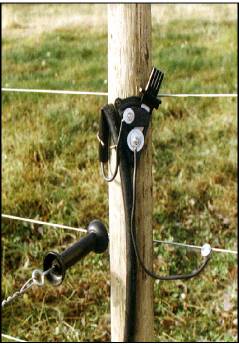
Figure 9 Typical Cutout Switch
Figure 9 Typical Cutout Switch
Cutout Switches
These are installed to switch off parts of the fence to isolate electrical faults or to permit unused fences to be disconnected (ensuring a lower power requirement from the controller). They are especially important for trouble shooting system faults.
A convenient switch location is where a number of fences join or at a gate under or over pass. These switches must be designed for outdoor use or be protected from the weather. Simple plastic fence switches are available; as shown in Figure 9.



