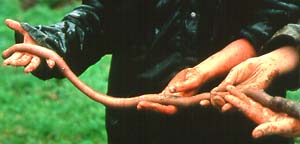
Megascolides
THE ENVIRONMENT OF EARTHWORMS
The worms’ natural environment is the soil of the earth. They do will there and know it well, because it is their natural home and they have made a very significant contribution to its structure, stability and sustainable fertility. Healthy soil is a living organism, and worms are an integral part of it. The absence of worms is a good indicator of terminal disease. Aristotle called worms The Intestines of the Earth’, He believed that the soil of this planet was a living holistic organism and understood the role of earthworms in its maintenance.
Soil without worms is noticeably less productive than soil with worms and far more prone to wind and water erosion, Such soil requires the constant application of fertilisers to maintain productivity, Eventually, it dies.
It was once thought that, because worms were found around plant roots, they ate these living roots, retarding growth and even destroying plant life, For this reason, even as recently as the late 1800s, it was recommended that worms in the soil be killed. It was not until Charles Darwin’s book The Formation of Vegetable Mould Through the Action of Worms with Observations on their Habits was published in 1881 that the earthworm was exonerated. But various experts continued to argue against them for some years- The Country Gentleman of Albany, New York, in February 1581 reviewed Darwin’s book and rejected it as nonsense on the grounds that worms damaged plants in flowerpots. Professor Ewald Wollny by, the most widely recognised soil scientist in Germany at the time, set about proving Darwin wrong through a number of planned and widely publicised experiments. In every one of his experiments, without exception, the growth of the plants was greater when earthworms were present. In 1890, he published his results as follows, . the position which the earthworms take in the soil with regard to plant growth is a useful and noteworthy one.’ However, his experiments had been carried out on vegetables in pots, so that he attempted to save face by suggesting this might not be the case in open field conditions_ He added, want to advise every farmer . to convince himself about the harmlessness of these animals.’
Wollny was, of course, using soil and not one of the modern potting mixes. These frequently have no food suitable for worms, so the presence of worms in a container indicates that they have found food in the mix you are using. Some gardening experts recommend removing the worms. on the grounds that they cause the potting mix to ‘slump’ through eating some of the contents, and thus could expose some of the root system to the air. If you want to keep the worms and enjoy their benefits, you will have to top up the potting mix from time to time.
100 years of Research
Darwin’s book heralded the beginning of systematic investigation into earthworms. Because barely a hundred years have passed since then interrupted by two world wars and there are at least three thousand five hundred different species of worms in the world, all of them with differing characteristics, we can understand why so little is known about them. On the other hand, it is equally true to say that it is remarkable that so much has been learned!
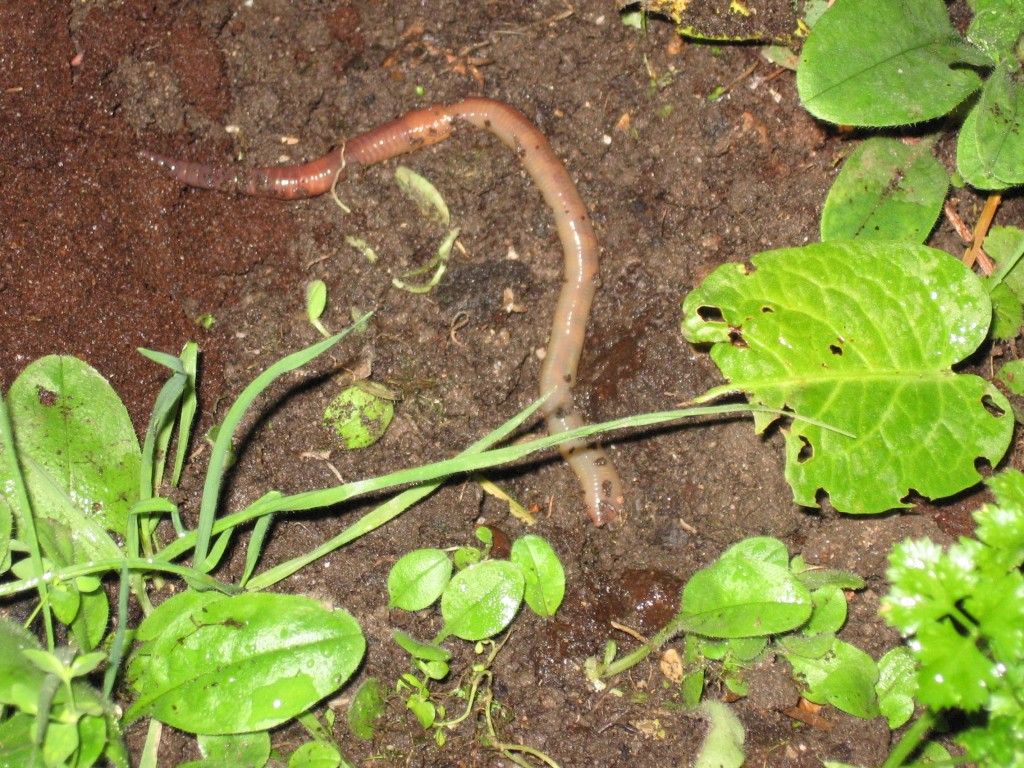
Lumbricus Terrestris
Diseases.
Worms are subject to so few diseases you can virtually say they catch none at all, and for very good reasons. The bacteria fostered in their gut and excreted with their castings are benevolent and produced in such overwhelming numbers that disease-producing bacteria find life very difficult in an earthworm environment. Their numbers are so reduced as to be proportionally insignificant. Furthermore, antibiotics are usually found in the environment created by earthworms. Streptomycin was once thought to be an earthworm secretion but, as is now known, it is the production of soil (fungi-like) bacteria named actinorriycetes, which seem to be fostered in the environment created by earthworms. However, actinornycetes are also found in wormless soil, but research has shown that their numbers are greatly increased by the presence of worms. (Source: Park, J. N., The effect of earthworms on soil micro-organisms’.) The names of other antibiotics such as Terramycin and Erithromycin, to specify just two, will be familiar to you. These antibiotics were originally discovered in the soil and are now artificially manufactured
Most disease-producing bacteria require an oxygen-free (anaerobic) environment, whereas the environment created by earthworms is oxygen-rich (aerobic), so that life around worms becomes very difficult for these nastier_ This is the reason why true worm castings are usually very low in disease-producing bacteria. By ‘true’ worm castings, I mean castings which have been thoroughly worked over by the worms so that they are free of uneaten food. This is called vermicast_ The worms don’t necessarily have to pass the disease-producing bacteria through their gut for their numbers to be reduced, substantial reduction can occur simply as a consequence of the environment created by the worms.



