 No comparison can be drawn between castings and superphosphate or any other fertiliser.
Any such claim would be made in ignorance and irresponsibility and be entirely without basis.
Castings, because of their unique biological and organic composition, stand completely alone as a soil conditioner.
At Maryborough (Victoria) where I live just about all the land was thoroughly dug over by the miners in the 1850s. Our ground consists of about 12 mm of top soil over a mixture of clay and crushed quartz. It supports very little growth. We rotary hoed our veggie patch out of this ground. It was so hard that the bushes in the hoe shafts needed replacement after I had dug just about four-fifths of the area. (I should have ripped it first!)
I treated the patch with a quantity of castings calculated at 125 kilos per hectare. I broadcast it by hand, turned it in and watered the area well. There was so little that you couldn’t really see it. My wife planted vegetables cabbage, lettuce, carrots, capsicum and tomatoes, Around Maryborough, if you have home grown tomatoes by Christmas it is regarded as something of a triumph.
Twelve tomato seedlings were planted on 28 September and we had an abundance of tomatoes by 15 December. In fact, those plants kept producing fruit until mid April. We were able to fill our cupboards with preserved tomatoes, chutney and sauce. None of our friends missed out either. The cabbages were almost 900 mm across, the outer leaves and the heads about the size of a basketball.
Each year, that same piece of ground has been treated with castings and the soil continues to become deeper and more fruitful. (Now, we plant only two tomato seedlings each year.)
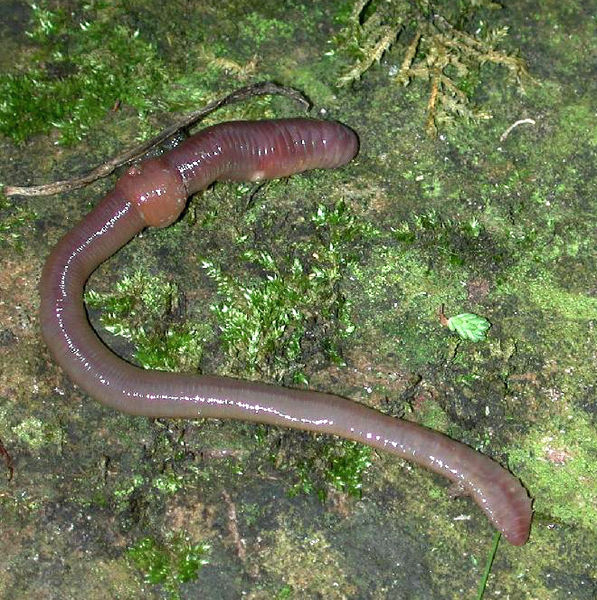
Because we have created in the veggie patch an environment suitable for earthworms, we have an abundance of worms working there for us. There are at least five species and they are spreading out from there in all directions. We have identified A. caliginosa, A. trapezoida, M. dubius, and some Blues and Reds with M dubius predominant.
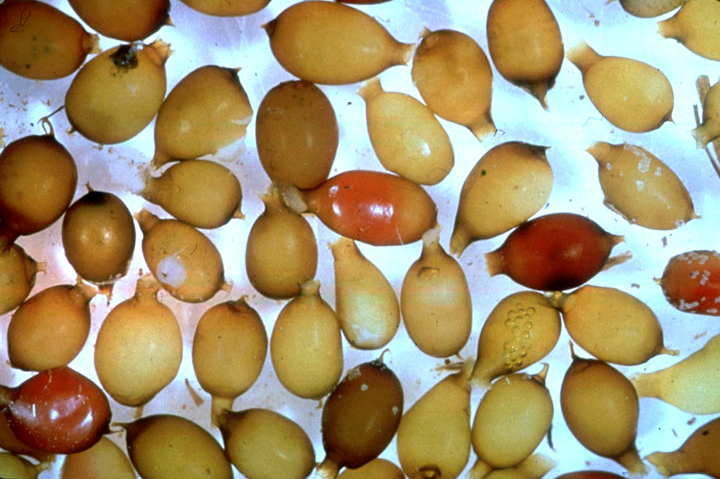
Earthworm L. terrestris cocoons
On another patch 12 metres x 20 metres, I spread castings far more liberally at an estimated 10 tonnes per hectare. I rotary-hoed the castings in with a tractor to a depth of about 150 mm and did nothing more with the ground. That is to say, I planted no grasses. This was done in January 1992 at the height of summer. Our first rains came in April. By the end of June, I had 300 mm of thick lush grass totally different to the lank native grasses growing alongside, where no castings had been applied. None of the native grasses appeared. Three sheep and a horse made no impression on the grass in two months. The ground was, and continues to he, soft and springy beneath our feet.
In July, I dug some sample patches to see what changes had occurred. The top 150 mm was still loose and friable and the grass had established a strong rich root system which was reaching down into and breaking the clay below.
There were no capsules in the castings I had used on this plot and I was at that time duly unable to find any worries in the new soil. At the time of writing, exactly twelve months after commencing treatment with the castings, a dig in the soil has revealed worms of the same species as in the vegetable garden. The Blues and Reds may well have come from our own worm beds about 100 metres away, but I can’t explain where the others came from. An easy explanation is that they were there already, but in much reduced numbers.
Applying (Spotting) Capsules
As an alternative to spreading vermicast, you can inoculate your soil with worms. For this you need an entirely different technique as you must continually harvest fresh castings (vermicompost) containing capsules from your beds. The castings should be buried around your pastures or garden in holes no deeper than 200 mm and no more than ten paces apart, less if possible.
The best time to do this is before your rainy season. When the soil has been moistened through rain or irrigation the capsules will hatch and, provided you follow the rules, they will thrive. Reds and Blues are not ideal pasture worms, but provided there is enough feed for them they will create an environment which will encourage the more valuable agricultural worms to take up residence. Tigers do not usually do well in pastures.
For the production of capsules, you will need to construct beds which are shallow and at the same time quite densely populated, say 20,000 worms (or 5 kilos) to the square metre Beds similar to the fishing worm grower beds are suitable and a Speedy Breeder will really come into its own for this purpose.
As you harvest the capsule laden bedding through the year, the castings can be stored until you are ready to use them. This is best done by putting it in woven bags hung in the air so that it can dry evenly and slowly the capsules will not suffer and be brought out just after, or before rain. After may be better than before, because then you know for sure you will have the necessary moisture for hatching. After all, if we could accurately predict when it would rain, we’d all be millionaires!
Work with the worms and become one!



