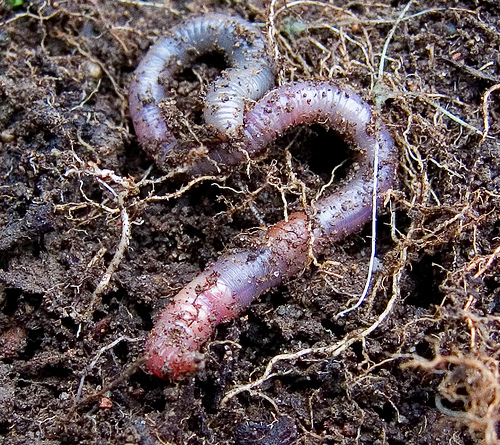
Earthworm Attribution pfly
Changing Farm Practices
While Australian farm soils are generally low in worm numbers, researchers have shown that it is possible to increase populations significantly with ‘conservation farming’ practices. Reducing cultivation with direct-drill seeding and retaining stubble after harvest will encourage additional earthworm activity, through minimal soil disturbance and a surface mulch which provides essential worm food, and helps retain soil moisture. In turn the worms ‘cultivate’ the soil, providing better aeration, infiltration, water-holding capacity, improved fertility and higher productivity.
In trials under cereal crops, where stubble was retained rather than removed by burning, earthworm numbers increased significantly. Where stubble was doubled with additional straw mulch on the surface, earthworm activity increased even further. This was accompanied by reduced rainfall loss as run-off and a reduced loss of surface soil by erosion. Soil structure was improved and earthworm activity increased where crops were sown with ‘minimal’, rather than conventional cultivation.
Field trials with a rainfall simulator conducted by the Department of Primary Industry in South Australia showed up to 60 per cent of a 30 mm fall of rain was lost as surface run-off in areas where stubble residue had been removed and the soil supported only about 100 worms per square metre. The CSIRO has shown that earthworm numbers doubled and run-off was halved with a cover of 2.3 tonnes per hectare of cereal crop residue. (Run-off declined to about 30 per cent on soils with 240 worms per square metre.)
With 5 tonnes per hectare stubble residue, earthworm numbers increased to 260 per square metre and just 20 per cent of rainfall was lost as run-off. At the same time, loss of surface soil by erosion was reduced from 1000 kg to 200 kg per hectare.
Topsoil losses to water erosion were found to be least where earthworm numbers were greatest. In addition, soil structure was improved and earthworm activity noticeably increased where crops were sown with ‘minimal’, rather than ‘conventional’ cultivation.
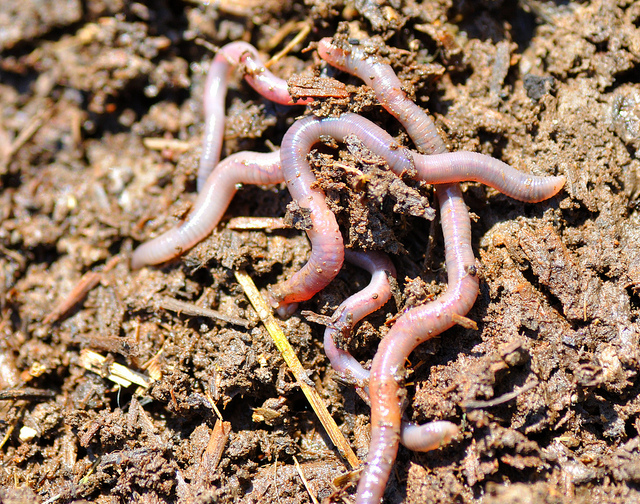 A Moisture Trial
In another trial, this time in Tasmania by the Department of Agriculture, two plots were selected and the worm population per square metre counted. Then one plot was irrigated for twelve months and, at the end of that time, the populations of the plots were counted again_ The irrigated plot was found to have a reduced population and that of the non-irrigated plot had not altered. From this it can be concluded that sufficient moisture, well short of saturation, is what is required. Even worms can have too much of a good thing.
Providing Plenty of Worm Food
In Australia our farming practices have caused severe soil structure decline in some areas. There is a complete absence of worm food and a loss of the aggregates (page ) which are the prime requisites for establishing fertile and stable soils. The most obvious result: unfettered erosion and the need to buy and apply fertiliser constantly.
In order to fertilise and recondition the soil quickly we need 10 apply nutrition with aggregates and both of these arc contained in vermicast. Through the application of sufficient vermicast, I have found personally that there is an immediate increase in fertility, and so productivity. Furthermore, I have found this productivity is sustained and I believe this to be the result of the bacterial content and capsules in the vermicast. An proportion of these capsules will hatch and given rain and warmth, providing there is food for them, the young worms will establish a biomass in the soil, or if a biota exists already it will be much enhanced.
Worm Transplants
A technique of worm transplanting was developed in New Zealand by Dr S. M, Stockdill and has been used extensively with a great deal of success in Tasmania. Turf blocks about 250 mm square and 100 mm thick are cut from pasture which is rich in worms and moved to one which is worm deficient_ The blocks are then placed upside down on the new location with gaps of 10 metres between blocks; exposure to the sun and weather forces the worms to burrow into their new home. Stockdill found that, as the worms became established, the increase in pasture production was as high as 70 per cent, falling however to 25 to 30 per cent as the individual worm colonies spread out to join up with each other. Because this method involves a change from like habitat to like habitat, it is successful with mature worms It is the change in habitat which holds the key to success or failure in worm transplants. A rapid change from a nutrient-rich environment, such as a manure-fed worm bed, to a relatively nutrient-poor environment like soil will kill mature worms



