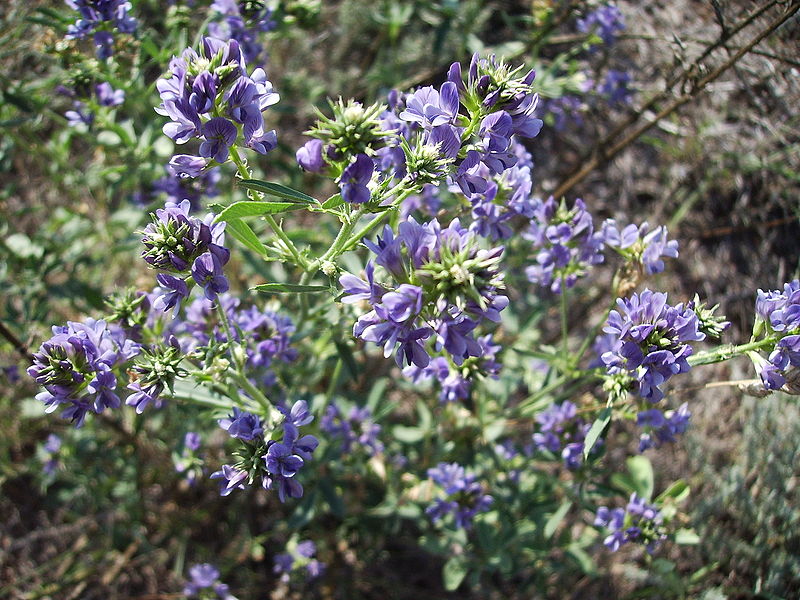
Alfalfa/Lucerne
Alfalfa/Lucerne
KEY POINTS
- Lucerne grows in a wide range of environmental conditions and soil types throughout Western Australia.
- Lucerne can produce feed with a quality and quantity equal to or better than subclover, and will provide green feed for a longer period.
- Green feed is generally available from April to December and at various periods throughout summer and autumn depending on moisture availability.
- Lucerne has produced growth rates for one-year-old sheep of 1.3 to 1.75 kilograms per head per week.
- The use of lucerne offers an opportunity to finish meat sheep out of season for premium markets.
Costs of establishment
Establishing lucerne in the Western Australian wheatbelt has been commonly quoted at costing between 80 to 100 dollars per hectare. This cost can be spread over the life of the lucerne stand, or the length of the lucerne phase in a lucernecrop rotation.It is often accepted that the costs of lucerne establishment can be spread over the period for which benefits are derived within the cropping phase. Therefore, in a four-year lucerne phase, the cost of establishment can be calculated to be 20 to 25 dollars per year of the rotation.The cost of establishing lucerne is comparable to that of establishing a good legume based annual pasture.
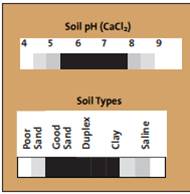
Figure 1. Soil suitability for lucerne.
Figure 1. Soil suitability for lucerne.
Where to grow lucerne
Lucerne requires at least 250 millimetres annual rainfall to persist. Data from Pingrup (320 millimetres rainfall) found that lucerne produced 4 to 6 tonnes per hectare of dry matter per year, which was equal to or greater than that for a subclover pasture. The level of production achieved with an annual rainfall less than 320 millimetres has not been well defined. Lucerne grows on a range of soil types and pH (see the bold in Figure 1), but is best suited to well-drained soils with a pH between 4.8 and 8.0 (CaCl2).
Lime should be applied at one to two tonnes per hectare where soil pH is between 4.8 to 5.2.
It should be noted that Figure 1 is only a guide to where lucerne performs best and there are cases where lucerne is growing outside these recommendations for soil type and pH.
Winter active varieties of lucerne are preferred for dryland sowing in Western Australia. They have good fodder qualities and the persistence of the stand is adequate for a four to five year lucerne pasture phase.
Lucerne will grow on moderately saline soils. However, production is affected at relatively low levels of soil salinity, especially when it is compared to a crop such as barley (see Table 1). Barley has more salt tolerance than wheat and is often grown by farmers on soils that are marginal for grain crops due to salinity levels. This knowledge will help when deciding where to grow lucerne.
As a comparison, lucerne can have a loss in production of more than 50 per cent at a soil conductivity of 90 milliSiemens per metre compared to a loss in barley production of five to ten per cent.
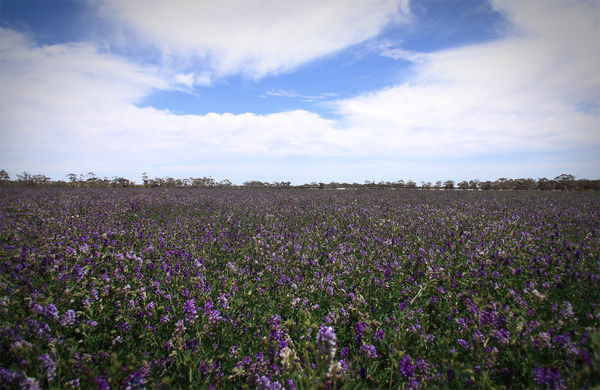
Lucerne paddock in flower.
Lucerne paddock in flower.
Grazing management strategies for lucerne
For best results, lucerne should be rotationally grazed if it is to persist in a grazing system. For sheep, the grazing rotation can vary from a three paddock system (lucerne grazed for three weeks and rested for six weeks), to a six paddock system (lucerne grazed for one week and rested for five weeks). Stocking rates are adjusted so that the dry matter is reduced to similar levels by the end of each grazing period (grazed to a height of one to two centimetres or about 400 kilograms dry matter per hectare). The resting or ungrazed period enables lucerne to replenish its root reserves, helping to maximise production and allowing the pasture to survive over the dry summer months.
Extending the grazing periods and reducing the resting periods are possible under some favourable growing conditions and at lower stocking rates, or where there is additional feed available in the paddocks from other pasture species (although this may be at the expense of total production). However, adopting this practice in less favorable conditions may severely affect the lucerne production by reducing plant numbers or weakening plants (with subsequent plant growth reduced for the following six to 12 months).
Availability and quantity of feed produced in a season
For an average rainfall season, lucerne will provide green feed earlier in winter and extend the availability of green feed at the end of the growing season compared to annual pasture. In the medium rainfall regions of the central wheatbelt, it is common to graze lucerne into December during a season with average rainfall.
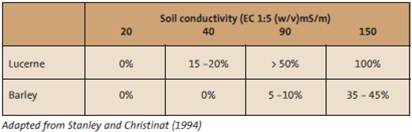
Table 1. Production losses (per cent) in lucerne and barley with increased levels of salinity
The amount of summer (January to April) feed production depends on moisture availability from either summer rain or from stored soil moisture. Lucerne can rapidly convert summer/autumn rainfall into high-quality green feed whereas summer rain will reduce the quality of dry feed and can cause a “false break” of annual pastures.
The quality of feed available from lucerne remains relatively constant throughout the year. A typical pattern of lucerne availability in the 350 millimetres rainfall zone is shown in Figure 2. This depicts the rotational grazing pattern suggested for a paddock of lucerne. The solid lines show the cumulative amount of pasture dry matter available in kilograms per hectare of feed (on offer) for an average season. During the months between January and April the level of feed on offer is extremely variable with significantly more feed in a year with a wet summer, or when soil moisture is not limiting.
The broken line in Figure 2 represents a two-week period of grazing where the total feed available in the paddock is reduced to about 400 kilograms dry matter per hectare. A consequence of this rotational grazing pattern is the requirement for a number of lucerne paddocks or alternative sources of good quality feed, to maintain production levels.
Lucerne pastures are capable of producing levels of total biomass comparable to or better than good annual pasture (eg. sub-clover) over a 12-month period. But the lucerne plant material is considered to be of much higher feed value due to its summer/autumn production.
Farmer experience in the wheatbelt suggests that the total carrying capacity on lucerne pastures is equal to, if not better than, good cloverbased annual pastures. The difference is that the longer period of green lucerne feed during the late autumn/early winter and late spring/early summer periods, can achieve growth rates for sheep as high as those obtained during the winter green feed period. In addition, the summer/autumn production greatly increases in response to summer rainfall. The significance of these attributes to sheep meat production is the flexibility to turn stock off into high priced markets either early or late in the normal growing season.
Lucerne feed quality
Lucerne provides high quality feed for grazing animals. It is highly digestible (about 65 per cent) and is a reliable and economic source of crude protein (12 to 24 per cent) with good levels of metabolisable energy (8 to 11 megajoules per kilogram dry matter).
Stocking rates
Trials in the wheatbelt have demonstrated that lucerne can support average district stocking rates while providing additional green feed after annual pastures have matured. Farmer experience shows that lucerne is a high quality source of green feed as long as it is grazed for short periods of two to six weeks. Set stocking is not advisable for dryland lucerne because sheep will constantly select and graze the lucerne plants, thus reducing their vigour.
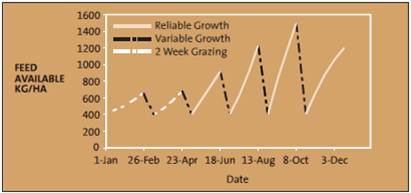
Figure 2. Predicted feed availability profile for an established stand of lucerne in the 350 to 400 mm annual rainfall zone.
Sheep have been successfully grazed on farms at Morawa and Mingenew on a three-paddock system for three-weeks-on and six-weeks-off (see Morawa case study at the end of this section). Other farmers with only one paddock of lucerne have used two to four times the normal stocking rates for one to three weeks at a time. The main issue is to rest the lucerne from the intensive grazing because sheep will selectively graze the lucerne plants due to their high digestibility and palatability.
Sheep growth rates
Growth rates of more than one kilogram per week can be expected from sheep grazing on dryland lucerne. Growth rates of 1.13 to 1.75 kilograms per head per week have been measured at three wheatbelt sites in Western Australia (Table 2). The sites all had a three-paddock system. Stocking rates have been averaged over the three paddocks.
Thirty-four 12-month-old Merino wethers were used at the Morawa Lucerne Research Site (see the following case study) where they were grazed on a rotational basis in a three-paddock system (three weeks on, six weeks off). They were grazing from 2 June 1999 until 15 January 2000 at an average stocking rate of almost six head per hectare over the entire site (17 per hectare for three weeks at a time). However, their weight was only measured from 7 September (after they were shorn) to 30 November. A growth rate of 161 grams per head per day (1.13 kilograms per week) was measured for the period.
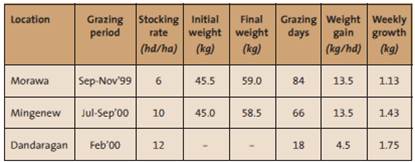
Table 2. Sheep growth rates on dryland lucerne at three sites in the wheatbelt using a three-paddock system
On a farm near Mingenew, the same rotation produced a growth rate for one-year-old mixed sex Merinos of 204 grams per head per day (1.43 kilograms per week) measured from July to September 2000. At a third site near Dandaragan, 12-monthold Awassi ram lambs were grazed on lucerne from 11 to 29 February 2000, and a growth rate of 250 grams per head per day (1.75 kilograms per week) was measured for this period.
Economic value of lucerne
A high value animal feed such as lucerne should be matched to a high value grazing enterprise such as prime lamb production. The green feed from lucerne can be saved, by destocking for extended periods while the lucerne dry matter increases, until the early summer period (October/December), late autumn (April/May) or whenever considerable summer rain is received.
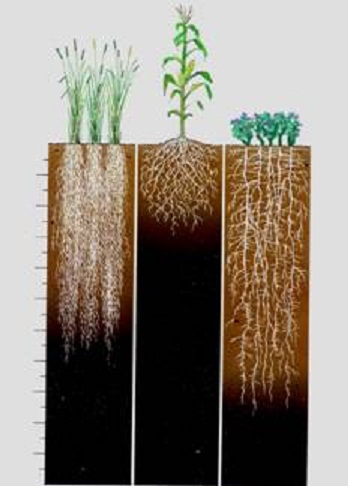
Relative root lengths of switchgrass (left), corn (center), and alfalfa (right)
Relative root lengths of switchgrass (left), corn (center), and alfalfa (right)
Landcare considerations
Lucerne is a herbaceous perennial plant that develops a deep root system and has a greater ability to dry out the soil profile than an annual crop or pasture species. For this reason lucerne is being evaluated as an option for farmers as a part of a “low recharge farming system” that will help to reduce recharge to water tables and the subsequent development of secondary salinity.
It is expected that the area of lucerne currently being grown in Western Australia will increase over the next five to ten years. AGWEST lucerne researchers Roy Latta and Keith Devenish have estimated that almost 400 farmers seeded lucerne in 2000, many for the first time. The indication is that the area established to dryland lucerne in Western Australia is at least 50, 000 hectares and could be as high as 75, 000 hectares. The increase in the area of lucerne has grown at about 50 per cent each year since 1995, when there were only 5000 hectares established to lucerne.
Other special considerations
- Bloat in sheep grazing dryland lucerne stands in Western Australia has not been commonly reported (see section on animal health); it is mostly associated with cattle.
- Enterotoxaemia (Pulpy Kidney) may cause animal losses on dryland lucerne as is the case on many other high quality feeds or grain supplements. Cattle and sheep should be vaccinated against enterotoxaemia.
- Red gut and nitrate poisoning are minor problems that may occur on lucerne, but they have not caused significant problems on dryland lucerne in Western Australia.
CASE STUDY - MORAWA DRYLAND LUCERNE TRIAL
Keith Devenish, Department of Agriculture, Northam
- Lucerne provided an extra three months of green sheep feed after the end of spring.
- Sheep gained weight at 1.13 kilograms per week between September and November.
- An opportunity exists to finish prime lambs on lucerne for the December/January market.
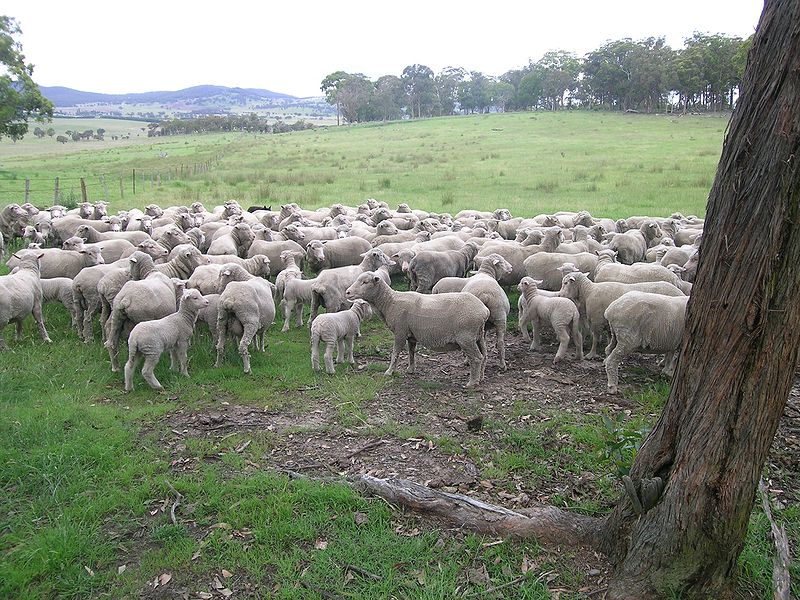
Merino ewes and lambs
Merino ewes and lambs
Site details
A lucerne trial was established at the Morawa Agricultural College in 1998 to evaluate the potential of lucerne in the low rainfall region of the northern wheatbelt. Pioneer L69 lucerne was sown on 2 June at five kilograms per hectare. During the first 12 months the lucerne was crash grazed for short periods in October, December, March and April. The six-hectare area was then fenced into three, two-hectare plots.
Grazing details
Thirty-four Merino wether hoggets (12 months old) were grazed on the site during the second year from 2 June 1999 to 15 January 2000 on a rotational system of three-weeks-on and six-weeks-off. The stocking rate during the grazing period was 17 sheep per hectare, producing an average stocking rate over the entire site of almost six sheep per hectare.
The sheep were shorn in September and then weighed every three weeks until 30 November. However, the site was grazed until 15 January. A significant fall of rain (37 millimetres) was received at the end of January 2000 so the sheep were grazed on the lucerne again for four weeks in February. More rain was received in March (79 millimetres) and the plots were ready for grazing by the beginning of April. The summer of 1999/2000 was abnormally wet and so in a more normal summer the availability of feed would be lower.
Results
The average liveweight after shearing was 43 kilograms, condition score 2.9. By 30 November the average weight had increased to 59 kilograms and the condition score to 4.6 (this is an exceptionally high condition score and suggests that the stocking rate was too low). The growth rate during this period was 161 grams per day (1.13 kilograms per week). The annual species component of the pasture had senesced by early September.
Conclusions
This was one of the first trials of sheep grazing lucerne to be conducted in Western Australia. The results indicate that lucerne can provide green feed for several weeks longer than annual pastures in late spring/early summer. They also indicate that farmers can expect sheep to grow at a minimum of one kilogram per head per week while grazing lucerne. Merino wether hoggets grazing lucerne at the Morawa Agricultural College in March.
Further reading
Devenish, K.L.; Rogers E.S. and Rogers, D.A. (2000). Agriculture WA,“Trial and Demo Reports 2000”, Northern Agricultural Region”, pp 195 – 196.
Farmnote No.4/98. Dryland lucerne – establishment and management.
Stanley, M. and Christinat, R. (1994). “Success with dryland lucerne”, 1.2-6. Printed by Open Book Publishers, Adelaide.



