
Queen Bee
Introduction
Queen bees providing drones to the queen mating apiary play an important role in the production of commercial queen bees. The overall standard of commercially reared queen bees can be improved by greater attention to the selection of queen bees to head drone mother colonies and by improved management of drone mother colonies.
The importance of the genetic quality of drones used in artificial insemination and isolated mating area programs to produce breeder queen bees is well documented and recognised by experienced queen bee breeders. Less attention is given to the health, welfare and the genetic quality of drones used in mating apiaries producing commercially reared, untested queen bees for general commercial use. For each worker bee produced, the genetic input of the drone into the desired working ability and behavioural traits of that bee is the same as the genetic input from the queen bee. Queen mother and drone mother selection are equally important in the production of untested queen bees to head commercial colonies.
Genetic variation of drones
Through processes that occur in the ovaries of a queen bee during the development of eggs before laying, a queen bee can produce many genetically different kinds of eggs and therefore many genetically different kinds of drones, some similar to the genetic material supplied by the queen’s mother, some similar to the genetic material supplied by the queen’s father, and some containing various combinations of both of these sources of genetic material. Each drone produces up to 10 million sperm cells which are all genetically identical with each other and are the same as the egg from which the drone developed.
Drone Bee
Health and welfare of drones
Drone mother colonies require inspection and management on a regular basis, e.g. weekly. Inspect to determine that drone brood and adults are being maintained in sufficient numbers and carry out management as required. Preparation of disease-free colonies for drone mother colonies commences in autumn with management practices being carried out to identify Nosema disease, European foulbrood and Chalkbrood and to reduce problems with them in the following spring. Detailed inspection and sampling of drone mother colonies for bee diseases are required when the colonies are being set up at the start of the season and again half-way through the season.
Diseases requiring attention are:
- Nosema disease
- European foulbrood
- Chalkbrood
- Sacbrood and other virus infections.
Colonies displaying symptoms of disease are expected to produce drones with a reduced ability to mate and will continue to contribute disease susceptible genetic material into the commercial honey bee population. Colonies displaying disease should not be used as drone mother colonies.
Drones from some genetic lines and drones subjected to disease and low nutritional diets can be expected to have reduced sperm counts. A sample of mature adult drones from a suspect genetic line may be examined in a laboratory and sperm counts made to determine if the line is suitable for use in a mating apiary. Providing a sample of mature drones derived from a known queen mother requires specialised management practices by the beekeeper, and extraction of semen and sperm counts for the drone sample need to be carried out in a laboratory by people skilled in these practices.
Published data on the average number of sperm produced by one drone vary considerably and numbers ranging from 5.7 million to 7 million, and up to 10 million sperm have been reported. A drone mother line producing a sample of drones averaging less than 5 million sperm/drone would require the queen bee breeder to question the suitability of that line as a source of drone bees.
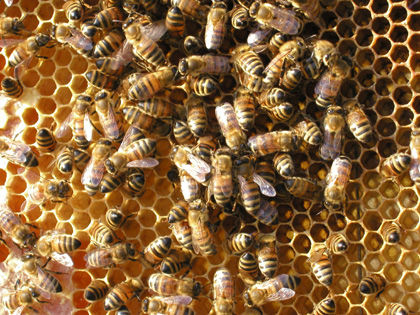
Bee Colony
Selection of drone mothers
Little information, if any, is available to suggest that selection criteria for queen bees to head drone mother colonies should differ from criteria used for the selection of breeder queen bees for the production of commercial queen bees. It is important to consider that honey bees may be bred for a variety of purposes. Commercial beekeepers require the qualities of good honey production, the ability to pollinate certain crops, good temperament, ability to resist disease, fast colony growth, wax production, over-wintering ability, non-swarming and non-absconding behaviour, quietness on the comb and longevity of workers.
Hobbyist beekeepers, on the other hand, may only be interested in such characteristics as being quiet to handle, non-swarming and the colour of the bee. Geographical differences can be important in how beekeepers in different areas perceive the same line of bees, for example tropical versus temperate climate or coastal versus inland conditions. Queen bees from the same line of bees which perform well in one area of Australia may not perform as well in another area. Due to the small size of the Australian beekeeping industry and the commercial queen bee market it is not economically feasible for large numbers of specialist lines of bees to be produced.
As a result, beekeepers requiring bees for different purposes may be using daughter queen bees from the same breeder queen: for example, the characteristics required by a honey producer usually differ from those required by a crop pollinator. Other factors to consider when selecting queen bees to head drone mother colonies are that colonies with an old or failing queen bee build more drone comb, and that young queen bees, before their first over-wintering, rarely lay drone eggs. Readiness to lay drone eggs increases with age of the queen.
Queen bee breeders who maintain a number of genetic lines of breeding stock are able to provide drone mother colonies headed by queen bees produced from a breeder queen which is compatible with the queen line present in the mating apiary. The success of the compatibility of the two lines for the purpose for which the queen bees are being produced needs to be evaluated under commercial conditions. Beekeepers who purchase queen bees from commercial queen bee breeders are able to discuss their requirements and experiences with particular lines of bees with the queen bee breeder producing those lines of bees. Queen bees heading commercial colonies which are performing above average in some way can be caught by the beekeeper when the hives are being re-queened and returned to the queen bee breeder for assessment of their suitability to head drone mother colonies.
This practice will assist queen bee breeders in producing commercial queen bees consistent with the requirements of commercial beekeeping and provide medium to long term benefit to both queen bee breeders and commercial beekeepers.
Bibliography
Laidlaw, H.H. 1979. Contemporary queen rearing, Dadant and Sons Inc., Journal Printing Co., Carthage, Illinois, USA.
Nguyen, N.V. 1999. ‘Effects of protein nutrition and pollen supplementation of honey bee Apis mellifera colonies on characteristics of drones with particular reference to sexual maturity’, The Australasian Beekeeper, 100 (9), 374-376.
Rinderer, T. (et al) 1985. ‘A comparison of Africanised and European drones : weights, mucus gland, and seminal vesicle weights, and counts of spermatozoa’, Apidologie, 16 (4), 407-412.
Rinderer, T. 1986. Bee genetics and breeding, Academic Press, Orlando, Florida, USA. Ruttner, F. 1983. Queen rearing, Apimondia Publishing House, Bucharest.
The information contained in this publication is based on knowledge and understanding at the time of writing (November 1999). However, because of advances in knowledge, users are reminded of the need to ensure that information upon which they rely is up to date and to check currency of the information with the appropriate officer of New South Wales Department of Agriculture or the user’s independent adviser.
Author
J. Rhodes Livestock Officer, Apiary Products, Tamworth


