Ruminants such as cattle, sheep and goats are herbivores with a unique digestive anatomy. A prominent feature of ruminant dental anatomy is that they lack upper incisors, having instead a “dental pad”, as shown in the image to the right of a goat.
To a first approximation, the dental anatomy of all ruminants is similar. There are some exceptions to this statement, for example, the fighting teeth in llamas. The examples of ruminant dental anatomy depicted here are all from cattle.
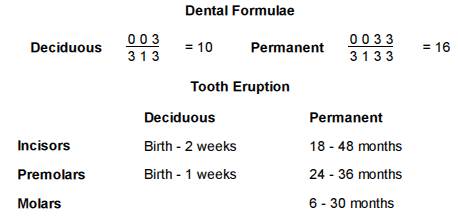
In the dental formulae shown above, cattle are depicted as having 3 incisors and 1 canine tooth. Some authors prefer to state that they have 4 incisors, with the canine tooth refered to as the fourth or corner incisor.
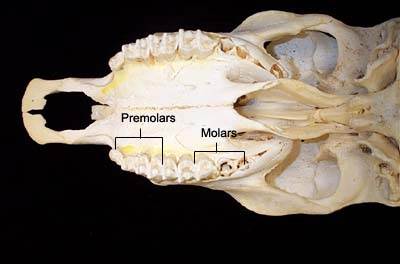
Maxillary Arcade Note the lack of incisors.
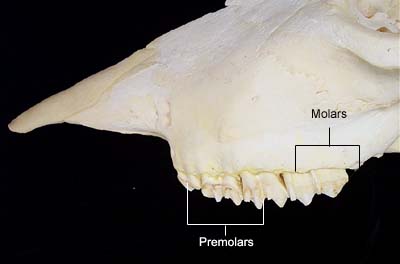
Maxillary Arcade lateral view
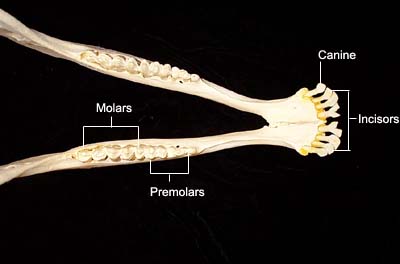
Mandibular Arcade

Mandibular Arcade lateral view. The wide gap that seperates the incisors (or dental pad on the maxilla) from the premolars is called the diastema.


