Description:
Date (Phoenix dactylifera; Arecaceae)
Fruit styles are usually graded into 3 groups:
- Soft – soft flesh, high moisture, low sugar content.
- Semi-dry – firm flesh, low moisture, high sugar content and
- Dry – dry flesh, very low moisture, high sugar content.
Some rare varieties have the unique characteristic of being sweet and edible when only semi-ripe. This fruit stage is known as ‘khalaal’. (Biser or doka in some cultures) Fruit is crunchy, firm and juicy with relatively low astringency. It has a short shelf life. Barhee is one of the more famous producers of this semi-ripe khalaal fruit.
Features and Facts:
Global date production is about 5.4 million metric tonne of fruit per year.
The five largest producers are Egypt, Iran, Saudi Arabia, Pakistan and Iraq – accounting for about 70% of total production.
Approximately 93% of dates harvested are consumed within the country of origin.
The date palm is a traditional crop in the old world and in recent decades has gained popularity. It is now grown in 40 countries including the USA, South Africa and more recently Australia.
Main importers of dates are India, United Arab Emirates, Pakistan, Malaysia and the European Community.
Male Palm
Australia imports over 5000 tonne of date fruit per year. 85% of this is low quality cooking or manufacturing grade.
Australia currently has less than 50 hectares of mature fruit bearing date palms
Date palms are dioecious. Male pollen is required to be harvested and applied in a timely manner to the female flowers. One male palm is sufficient to pollinate 20-25 female palms.
Date palms can be grown from seed however the quality of the resulting plant is likely to be commercially undesirable.
Date palms can be grown from offshoots or suckers which generate from the base of existing palms. These offshoots are genetically identical to the parent palm and therefore reliable in the characteristics displayed from the parent palm.
Date palms can also be generated through micropropagation techniques. In recent decades tissue culture plants have emerged as an efficient way of mass producing large volumes of desirable variety types.
Varieties:
The following are the dates most commonly grown:
- Barhi
- Dayri
- Deglet Noor
- Halawi
- Halawy
- Hayany
- Khadrawy
- Khastawi
- Maktoom
- Medjool
- Saidy
- Sayer
- Thoo
- Zahdi
The date palm is well recognized for its ability to withstand environmental stress.
It has proved a valuable plant in combating desertification.
It creates a unique understory microclimate which allows other plant species to survive in the mottled sunshine that penetrates through the canopy of the date palms.
This shade-house effect reduces evapotranspiration rates and increases humidity which facilitates a secondary food production system by introducing other plant species which would not otherwise succeed if exposed to the full extremes of a harsh climate.
The following, with brief comments, are the dates most commonly grown:
‘Barhi’— introduced into California in 1913 from Basra, Iraq; nearly cylindrical, light amber to dark brown when ripe; soft, with thick flesh and rich flavor; of superb quality. For shipment needs refrigeration as soon as picked, then curing and special packing.
‘Dayri’ (the “Monastery Date”)—introduced into California from convent grounds in Dayri, Iraq, in 1913; long, slender, nearly black, soft. Palm requires special care. Not grown extensively in California.
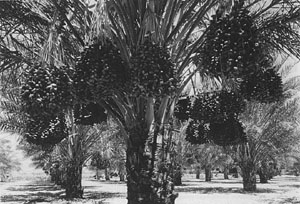 |
| Fig. 1: An 8-year old-’Deglet Noor’ date palm in a private garden near Indio, California Photo’d by Avery Edwin Field, Oct. 1924. In: W.T. Swingle, Date Growing: a new industry for Southwest States U.S. Dept. of Agriculture Yearbook 1926. |
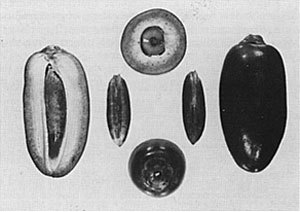 |
| ‘Deglet Noor’ |
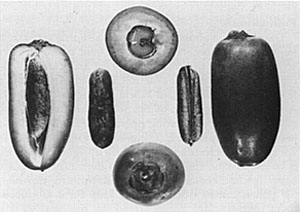 |
| ‘Halawi’ |
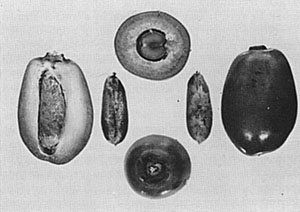 |
| ‘Zahdi’ |
| Fig. 2: ‘Deglet Noor’, (top) a semi soft date. ‘Halawi’, (center) a leading export date of Iraq. ‘Zahdi’, (bottom) a small date from northern Iraq. In: D.W. Albert and R H. Hilgeman, Date growing in Arizona. Bull. 149, U. Arizona, Agr. Exper. Sta., Tucson, Ariz. May 1935. |
‘Deglet Noor’—a leading date in Algeria and Tunisia; and in the latter country it is grown in inland oases and is the chief export cultivar. It was introduced into California in 1900 and now constitutes 75% of the California crop. It is semi-dry, not very sweet; keeps well; is hydrated before shipping. Much used for cooking. The palm is high yielding but not very tolerant of rain and atmospheric humidity.
‘Halawy’ (‘Halawi’)—introduced into California from Iraq; soft, extremely sweet, small to medium; may shrivel during ripening unless the palm is well-watered. It is especially tolerant of humidity.
‘Hayany’ (‘Hayani’)—the cultivar most extensively planted in Egypt; but not exported. Introduced into California in 1901, and is sold fresh; is not easy to cure. The fruit is dark-red to nearly black; soft. The palm is one of the most cold-tolerant.
‘Khadrawy’ (‘Khadrawi’)—important in Iraq and Saudi Arabia, and is grown to some extent in California and Arizona. It is the cultivar most favored by Arabs but too dark in color to be popular on the American market, though it is a soft date of the highest quality. It is early-ripening; does not keep too well. This cultivar is the smallest edible date palm grown in the United States and it is fairly tolerant of rain and humidity.
‘Khastawi’ (‘Khustawi’; ‘Kustawy’)—the leading soft date in Iraq; sirupy, small in size; prized for dessert; keeps well. The palm is large and vigorous and produces its offshoots high on the trunk in California. The fruit is resistant to humidity.
‘Maktoom’—introduced into California from Iraq in 1902; large, red-brown; thick-skinned, soft, mealy, medium sweet; resistant to humidity.
‘Medjool’—formerly exported from Morocco; 11 off-shoots imported into California from Bou Denib oases in French Morocco in 1927; is now marketed as a deluxe date in California; is large, soft, and luscious but ships well.
‘Saidy’ (‘Saidi’)—highly prized in Libya; soft, very sweet; palm is a heavy bearer; needs a very hot climate.
‘Sayer’ (‘Sayir’)—the most widely grown cultivar in the Old World and much exported to Europe and the Orient; dark orange-brown, of medium size, soft, sirupy, and sometimes some of the sirup is drained out and sold separately; not of high quality but the palm is one of the most tolerant of salt and other adverse factors.
‘Thoory’(‘Thuri’)—popular in Algeria; does well in California. Fruit is dry; when cured is brown-red with bluish bloom with very wrinkled skin and the flesh is sometimes hard and brittle but the flavor is good, sweet and nutty. Keeps well; often carried on journeys. The palm is stout with short, stiff leaves; bears heavily, and clusters are very large; somewhat tolerant of humidity.
‘Zahdi’(‘Zahidi’)—the oldest-known cultivar, consumed in great quantity in the Middle East; introduced into California about 1900. Of medium size, cylindrical, light golden-brown; semi-dry but harvested and sold in 3 stages: soft, medium-hard, and hard: very sugary; keeps well for months; much used for culinary purposes. The palm is stout, fast growing, heavy bearing; drought resistant; has little tolerance of high humidity.
Among the less well-known cultivars in California are:
‘Amir Hajj’—introduced from Mandali Oasis in Iraq in 1929. The fruit is soft, with thin skin and thick flesh; of superior quality but little grown in the United States.
‘Iteema’—offshoots from Algeria were introduced into California in 1900. The fruit is large, oblong, light amber, soft, very sweet. Much grown in Algeria but not rain resistant and little grown in California.
‘Migraf’ (‘Mejraf)—a very popular cultivar in Southern Yemen. Fruit is light golden-amber, large; of good quality.
In inland oases of Tunisia, in addition to the ‘Deglet Noor’, there is ‘Ftimi’ (‘Alligue’) which is equally subject to humidity, less productive and less disease-resistant.
‘Manakbir’ has a large fruit and ripens earlier but has the disadvantage that the palm produces few offshoots and its multiplication is limited.


