Breeding farm rabbits:
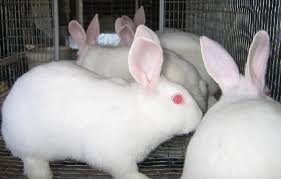
New Zealand White Rabbit
The most commonly farmed rabbit in Australia at present is the New Zealand White. This rabbit has good growth characteristics and is capable of attaining a slaughter weight of approximately 3 kg within 12–14 weeks of age. The rabbit carcase dressing percentage is about 50% to 54% of live weight.
Breeding stock should be purchased from reputable breeders who use estimated breeding values (EBVs) in their breeding program and/or provide reproduction performance data of breeding stock. Accurately assessing reproductive performance is critical to overall enterprise profitability. Excess high-quality breeding stock can be sold to other rabbit enterprises according to demand. To replace breeding stock, an average doe should be culled after weaning seven litters, which is about every 56 weeks. For a 100 doe rabbitry, this can be achieved by selecting four rabbits every 2 weeks to replace culled does. Accurate recording of doe performance is alsocritical to improving genetic progress.A large rabbitry will need a computer-based system to cope with records for the large population of rabbits. The use of a hand-held computer system that will scan bar-coded ID tags on rabbits would be an advantage.
Reproduction:
Does are ready for mating at about 16 weeks of age and bucks mature at 18–20 weeks. Does are often restless when ready for mating and are taken to the buck’s cage. Does are fertile 24 hours after kindling (giving birth) and best conception occurs up to 5–6 days after kindling, and again after another 21 days. Good management will allow up to eight litters per doe per year; however, rabbits marketed can vary between 20 and 40 per doe depending on climatic conditions and rabbitry health status.
Evaluation of equipment for breeding does housed under Australian meat rabbit farming conditions:
In an abstract written by Dr Sandra Eady; Two experiments yielded practical recommendations on design of cage equipment (mats and nest boxes) that can potentially improve the welfare and productivity of breeding does. The results show that, in the environment experienced by the experimental rabbits, sore hocks (pododermatitis) can be reduced in breeding does from an incidence of 4% down to less than 1%, by the provision of suitable pressure mats. The difference between the highest and lowest performing nest boxes, in terms of number of kittens weaned, translates into a difference in enterprise gross margins of A$52.35 per doe per annum, or an increase of 36% in profit from the use of the best performing nest box compared with the worst. Farmers can use the results as a guide to choosing or constructing nest box equipment, and should be encouraged to objectively compare different designs under their own environmental conditions.
The Crusader Rabbit Project conducted by CSIRO:
In 1999, CSIRO Livestock Industries began a research program, aiming to develop an improved strain of meat rabbits for the Australian industry. Funded by the CSIRO and Rural Industries Research and Development Corporation (RIRDC), the Crusader meat rabbit breeding program produced superior livestock for the industry, as well as management and husbandry information on rabbit reproduction and the Crusader Enterprise Model for estimating gross margins.
The CSIRO study into farming rabbits for meat in Australia offers assistance to farmers seeking to capitalise on a rapidly growing industry. CSIRO’s ‘Crusader’ meat rabbit breeding program, was a three-year research project supported by Rural Industries Research Development Corporation, with the first phase of its research results identifying some of the best breeds for meat rabbit farming.
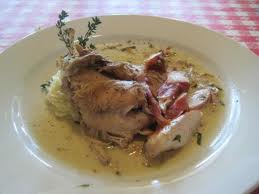 “Rabbit meat increasingly is becoming a part of Australian cuisine,” said Dr Kishore Prayaga, from the ‘Crusader’ program at CSIRO Livestock Industries. “Currently, rabbit farms are providing the bulk of the product required by the restaurant trade, but supply to both Sydney and Melbourne cannot keep up with the growing demand.”
With restaurant demand for rabbit meat outstripping supply, new profitable market opportunities are being created for regional Australian farmers.
“Farmers who are looking to diversify their income are able to the enter the rabbit meat industry with relatively low entry costs as many farms in temperate Australia already have in place the necessary infrastructure,” said CSIRO project leader Dr Sandra Eady.
The ‘Crusader’ program evaluated the three major breeds of commercial rabbits - the new Zealand White, Flemish Giant and Californian. The results showed a consistent strong performance from the New Zealand White and there was no added benefit from hybridisation between species.
The project also showed that there is a large variation between breeding does (females) for litter size and this variation can be exploited to substantially increase rabbit birth rate.
“Our research shows that there are distinct advantages in breeding for increased litter size” said Dr Prayaga.
“Selective breeding for rabbit meat producers will enable them to meet consumption demands and importantly yield a positive impact on their earnings.”
“We also need to provide better management for increased litter sizes, and in particular look at improved nest box design, better nutrition and first-rate health care. We know that larger litters mean lighter kittens which, without extra care, don’t survive as well,” said Dr Prayaga.
In 2004 the Crusader breeding program was commercialised resulting in approximately 25 per cent of the industry using Crusader rabbit breeding stock.
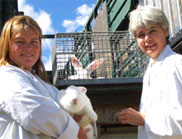
Dr Sandra Eady (right) passes a Crusader rabbit to Ms Kathleen Bowerman of the Snowy Mountains Gourmet Rabbit Company
The meat rabbit industry in Australia grew from production of 106 tonnes of meat in 1999 to an estimated 250 tonnes in 2003. Production is expected to reach 594 tonnes by 2015.
The Crusader breeding project has improved rabbit production by: 9% for the number of kittens weaned and 17% for growth rate.
The Snowy Mountains Gourmet Rabbit Company:
The Snowy Mountains Gourmet Rabbit Company participated in the Crusader Rabbit Project by managing the rabbits, running the breeding program and also by providing technology to the industry through the sale of Crusader rabbits and workshops. The CSIRO continued its involvement with the project until 2007, focusing on improving the disease resistance of the Crusader rabbits, which is vital to efficient production. Scientific advances were made in selection for disease traits in grower rabbits, helping to lift gross margins from an estimated A$174 to A$242 per doe per annum. Crusader rabbits are available for purchase from the Snowy Mountains Gourmet Rabbit Company.
Source: Dr Sandra Eady Geneticist Livestock Industries, Dr Kishore Pryaga Livestock Industries.