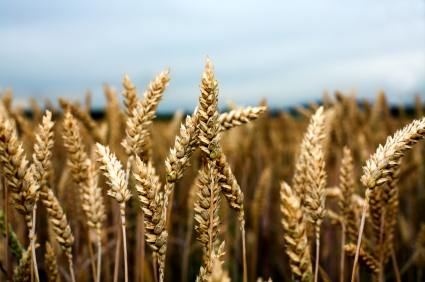
 WHAT IS WHEAT?
Wheat (Triticum spp.) is a grass, originally from the Fertile Crescent region of the Near East, but now cultivated worldwide. Wheat was a key factor enabling the emergence of city-based societies at the start of civilization because it was one of the first crops that could be easily cultivated on a large scale, and had the additional advantage of yielding a harvest that provides long-term storage of food.
Wheat grain is a staple food used to make flour for leavened, flat and steamed breads, biscuits, cookies, cakes, breakfast cereal, pasta, noodles, couscous and for fermentation to make beer, other alcoholic beverages, or biofuel.In 2007 world production of wheat was 607 million tons, making it the third most-produced cereal after maize (784 million tons) and rice (651 million tons).
Globally, wheat is the leading source of vegetable protein in human food, having a higher protein content than either maize (corn) or rice, the other major cereals. In terms of total production tonnages used for food, it is currently second to rice as the main human food crop, and ahead of maize, after allowing for maize’s more extensive use in animal feeds.
Wheat is planted to limited extent as a forage crop for livestock, and its straw can be used as a construction material for roofing thatch. The husk of the grain, separated when milling white flour is bran. Wheat germ is the embryo portion of the wheat kernel. It is a concentrated source of vitamins, minerals and protein and is sustained by the larger, starch storage region of the kernel - the endosperm
Articles on WHEAT
in INFORMED FARMERS
Agronomic Characteristics and Disease Resistance in Wheat
Commercial Use - Production and Consumption of Wheat
Crop Development, Diseases and Pests
Crop Management for Durum Wheat
Crop and Weed Management - Marketing of Wheat
Durum Wheat Varieties in Queensland
Growing Wheat - Wheat Quality in Victoria
Harvesting and Quality of Wheat
Major Cultivated Species of Wheat
Management of Diseases in Wheat - Rot and Smuts
Management of Diseases in Wheat - Rusts and Yellow Spot
Management of Diseases in Wheat - Wheat Steak Mosaic and Nematodes
Managing Insect Pests in Winter Cereals - Aphids
Managing Insect Pests in Winter Cereals - Armyworms
Managing Insect Pests in Winter Cereals - Helicoverpa
Managing Insect Pests in Winter Cereals - Mites and Cutworms
Nutrition - Harvesting- Grain Storage and Disposal of Durum Wheat
Paddock Selection - Seedbed Preparation - Sowing of Wheat
Physiological disorders in Wheat - Black Point and Melanism
Planting of Wheat - Crop Establishment, Weeds and Irrigation
Planting of Wheat - Depth Control and Deep Moisture
Queensland Plant Population for Wheat
Sowing of Wheat - Depth - Seeding Rate - Seed Dressing
The History and Origin of Wheat
Wheat Genetics - Plant Breeding and Farming Techniques
Wheat Nutrition - Sulfur and Copper
Wheat Nutrition - Zinc and Potassium
World Farming Systems and Geographical Variation of Wheat
Wheat rusts - Stem Rust and Leaf Rust
