Extractable soil phosphorus
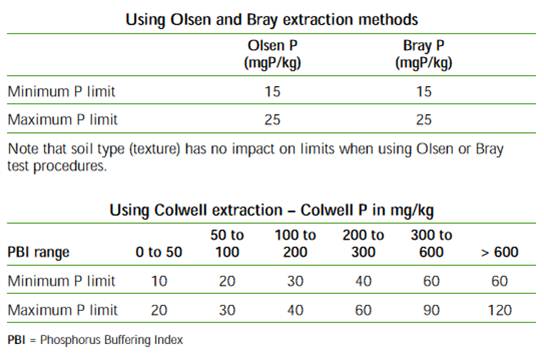
The following tables provide minimum and maximum limits for pastures that have been improved by the introduction of exotic perennial grasses. Raising P levels in native grasslands to above the levels described below may increase the risk of loss of species such as Danthonia.
Recent research has demonstrated that it is increasingly difficult on soils with a moderate phosphorus buffering index to retain native perennial grasses once phosphorus levels exceeded 20 Colwell P. At this point legumes and annual grasses started to replace native grass species. Grazing management, involving pasture rest at critical times, can lessen the rate of loss.
Producers wishing to optimise pasture productivity while retaining native grass species should seek advice from agronomists to establish grazing management strategies and minimum and maximum P limits for their region and soils.
PBI typically increases with soil texture as it moves from sands through to heavy clays. NATA laboratories now routinely supply a Phosphorus Buffering Index with all analysis reports.
P is a relatively immobile nutrient once it has entered the soil, usually remaining within a few centimetres of where it was applied. Losses of P by fixation and leaching depend on soil type and rainfall and are generally greater as rainfall increases. Well fertilised pastures are generally protected from P loss associated with soil erosion as they retain high levels of ground cover throughout the year.
Extractable sulphur
KCL40 test
• Minimum limit – 6mg/kg
• Maximum limit – 16mg/kg

Soil pH
The following two tables supply limits for soil pH (soil acidity) and aluminium concentrations for commonly introduced pasture species. Each species achieves optimum productivity and stability between the maximum and minimum limits. All will grow outside these limits, but productivity and persistence will be less than its potential.
Native species such as Danthonia and Microlaena are not included in the tables as they are rarely sown, and limits are not as well defined. It is known that Microlaena is able to tolerate soils with low pH. Danthonia, on the other hand, has many sub-species that vary in their most preferred range.
Most plants and micro-organisms have defined ranges of pH for optimal growth. The optimal range for plants is generally between 5.5 and 8.0 (pH in CaCl2) whereas most soil organisms function best between pH 6.0 and 7.0.