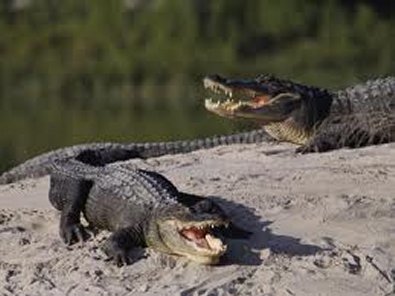
 Courtship and breeding activity is extremely important. Alligators appear to develop a social structure within a group.
Wild alligators which are captured and penned can be very aggressive toward each other during the breeding season.
Wild males have been known to kill rival males during the breeding season, and wild females will kill, or not breed with, unacceptable males.
Alligators raised in captivity are less territorial and aggressive towards each other, particularly if they have been penned together before they are 3 years old.
Courtship and breeding occur between April and July depending on temperature/weather conditions. Courtship is a time of heightened activity by both sexes. This activity includes vigorous swimming and bellowing.
Bellowing is the most common activity associated with courtship, although limited bellowing can occur at other times.
Most courtship and mating occurs just after sunrise in deep water, and repeated copulation is commonly observed. The mating sequence from precopulatory behavior through first copulation takes approximately 45 minutes.
Nest building and egg laying occur at night. The nest is built from natural vegetation (e.g., broomsedge, bullwhip, cutgrass, wiregrass and available annuals), hay (if provided), and soil. Nests are built into a round, mound-type structure. A female may start several nests before a single nest is successfully completed.
Eggs are deposited at the top of the mound and then sink to the center forming layers with vegetation. Finally, the eggs are covered with approximately one foot of vegetation. All nesting activity usually occurs within a two week period.
The female guards and protects the nest but predation from raccoons and other animals is common. Nests can also be destroyed by other females trying to build nests if pen density is too high or if vegetation for nest building is scarce.
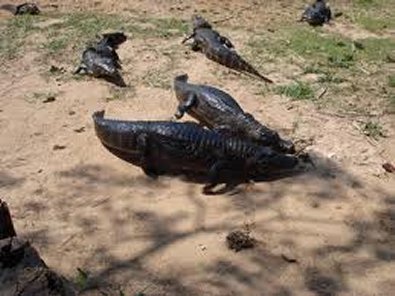 Farm-raised females have been known to lay eggs in the same nest, again demonstrating the breakdown of territoriality that is common to wild alligators. Nesting success in captive alligators has been highly variable.
Wild versus farm-raised origin, pen design, density, development of a social structure within the group, and diet all impact on nesting success. Nesting rates for adult females in the wild average around 60 to 70 percent where habitat and environmental conditions are excellent.
Nesting rates in captivity are usually much lower, depending on the management skill of the farmer. If farm raised animals are selected and grouped together at an early age, pens are constructed properly, sex ratios are near three females to each male, densities are around 20 alligators per acre or less, and stress is eliminated, then diet becomes the most important factor in reproductive success (see section on diets).
A few good managers have achieved nesting rates of 70 percent of the adult females nesting each year. Clutch size varies with age and condition of the female. Large and older females generally lay more eggs. Clutch size should average 35 to 40 eggs (range 2 to 58). Egg fertility can vary from 70 to 95 percent.
Embryo survival can also vary from 70 to 95 percent. Hatching rate varies from 50 to 90 percent. Egg fertility, embryo survival, and hatching rate of eggs taken from the wild and incubated artificially are 95, 95, and 90 percent, respectively. Captive reproduction can and should approach these values.
Reproductive success of captive alligators has been the most difficult problem for producers to overcome and is probably the greatest obstacle to face prospective breeders.
Author:
Michael P. Masser


