Korvan Coffee harvester
Coffee harvesters, like many other fruit and nut harvesting machines, incorporate vibration to remove the cherry. The efficiency of these harvesting systems is directly related to both the way the fruits are attached to the branch (e.g. singly or in clusters) and the force needed to pull the fruit from the lateral or branch, known as the fruit removal force (FRF).
Fruit removal force (FRF) of coffee:
The FRF of coffee depends on cherry maturity, cultivar, environmental conditions under which it is grown and, to a lesser extent, the environmental conditions at harvest time. Unfortunately, the FRF of coffee is many times greater than other fruit of similar size, so coffee is significantly harder to harvest mechanically.
The Maturity Index below shows FRF measurements for some varieties in different growing areas against a 10 point maturity index.
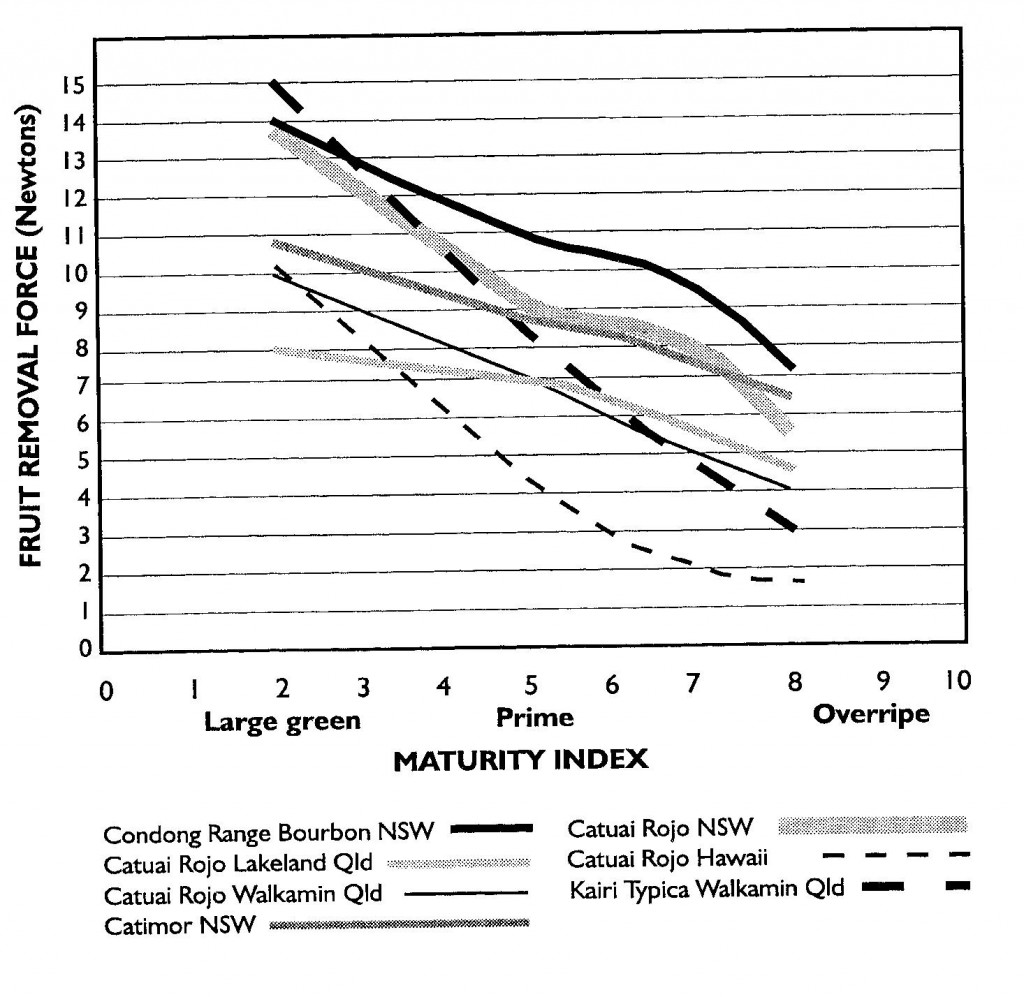
Effect of variety, location and stage of maturity on fruit removal force of coffee cherry
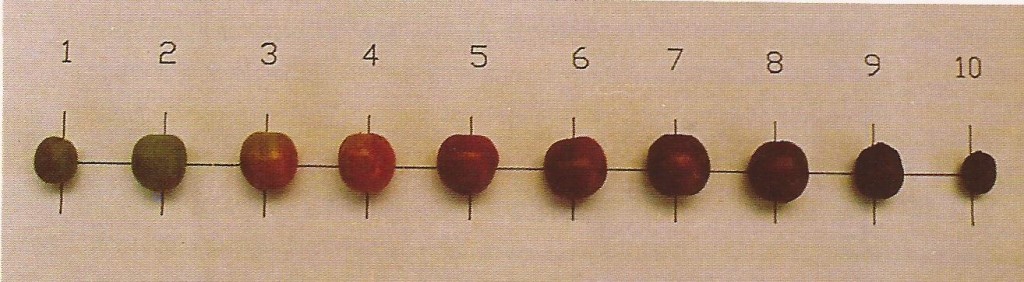
The ten stages of cherry ripening from immature green to overmature (mbuni) The prime ripe state necessary for maximising cupping quality includes stages four to eight.
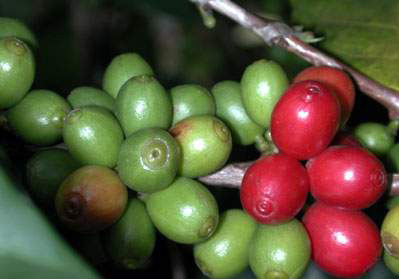
Cultivars with a very high FRF for mature cherry are difficult to harvest without causing excessive tree damage
This data shows that the cultivar Condong Range Bourbon has a higher FRF than Catuai Rojo or Kairi Typica and that the FRF of Catuai Rojo is lower at some sites, e.g. Hawaii compared with New South Wales. The reasons for the differences are not known, but the FRF can have a significant impact on the ability to machine-harvest coffee in some environments. Research has also shown that cherry on young coffee trees has higher FRF than cherry on mature trees, which is important to consider when developing management and harvesting strategies for young trees.
Like many other fruits, as coffee cherry progresses from immature (green), to mature (red), to overmature (brown-black) (see ten stages of ripening above) it becomes easier to remove from the lateral. The Maturity Index illustrates the drop in FRF with cherry maturity. A low FRF for mature cherry and a high FRF for immature cherry is necessary if the harvester is to be selective. Cultivars with a very high FRF for mature cherry are difficult to harvest without causing excessive tree damage.
In coffee, there is less difference in the FRF between immature and mature cherry than in other berry crops which have been developed for machine-harvesting. This means that the degree of selectivity in coffee harvesting will not be as great as can be achieved in other machine-harvested crops.
Source
Chris Norris