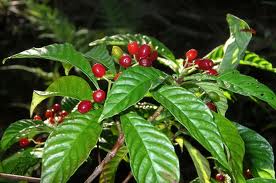
Ready to harvest coffee cherries
Coffee is not a new crop for Australia; a viable industry existed in the 1890s and 1920s in Queensland and Northern New South Wales. Coffee quality was reported as excellent. The industry declined for several reasons, including the high cost of hand-harvesting, and competition with the sugar industry for cheap harvesting labour.
Around 1980, commercial interest in coffee growing in Australia regenerated due to high world prices and, more importantly, the development of a mechanical harvester in Brazil. Two overseas growers independently selected the Mareeba irrigation area on the Atherton Tablelands in North Queensland as a suitable site to grow coffee for machine-harvesting. These growers had a wealth of overseas experience which needed to be modified for local conditions. They encouraged Queensland Department of Primary Industries to undertake a research program.
The newly established coffee industry has faced problems due to a worldwide lack of knowledge about suitable production, harvesting and processing techniques for coffee grown intensively and harvested by machine. The methods of cultivation and associated technologies used to grow coffee in Third World countries where there is plentiful, low cost labour, have limited application in Australia.
Traditionally, coffee is grown under low intensity cultivation and harvested by hand, which allows selection of coffee cherry at the correct stage of maturity for the production of high quality coffee. For a coffee system to be economically viable in Australia, intensive production over a large area (10-50 ha) using mechanical harvesting is necessary. Due to limited cherry life on the coffee tree, uneven cherry maturity and the limited selectivity of the machine-harvester (for example its ability to harvest only ripe cherry) harvesting and processing difficulties have been encountered.

Coffee beans
Harvesting cherry of various degrees of maturity has resulted in reduced quality and yields through wastage.
In 1981 Queensland Department of Primary Industries initiated a research program to determine the potential for a mechanised coffee industry in Australia, and in 1988, in conjunction with the Rural Industries Research and Development Corporation, a large scale research program into the development of a mechanised coffee industry began a large scale research program into the development of a mechanised coffee industry.
By 1995, 150 ha were planted on 10 properties in the Mareeba area, and 30 ha in the northern rivers of New South Wales.
The Australian coffee industry is still very much in its infancy with production of only 100-300 tonnes/year compared with imports of 32,000 tonnes (Hosegood et al., 1988).
The information and guidelines contained in the Informed Farmers Coffee articles look at this extensive research program and the experiences of Coffee growers in Australia.
New production practices, harvesting practices and processing systems have had to be developed to allow machine-harvesting to be economically successful in Australia.