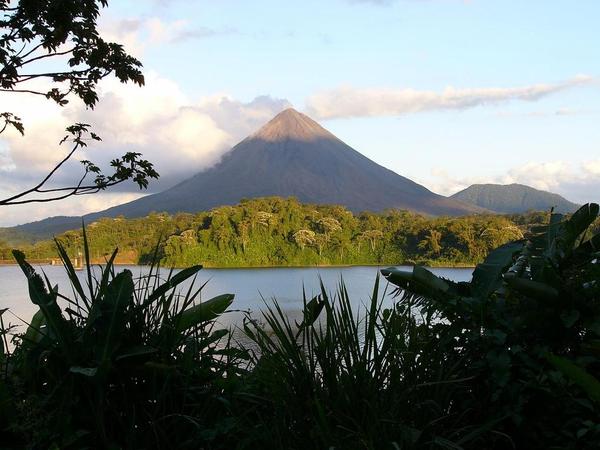
The history of Costa Rican coffee began in 1854
Caturra is a higher yielding mutation of Coffee Bourbon variety discovered in 1935 near the town of Caturra in Brazil, it later spread around Central America and Colombia. It is a mutation with high production and good quality, but requires extensive care and fertilization. It is a dwarf varietal with good cup quality (bright acidity, low-to-medium body, less clarity and sweetness than Bourbon).
Caturra Rojo grown in Australia, sourced from Costa Rica is described as a ‘semi- dwarf and compact’ in tree shape. The Caturra higher yield is caused by a single gene mutation, which has reappeared in other instances, creating the Pacas variety of El Salvador and the Villa Sarchi variety of Costa Rica. It is short with a thick core and has many secondary branches. It has large leaves with wavy borders similar to Bourbon but smaller. It adapts well to almost any environment, but does best around 1,500 masl (5,500 ft) with annual precipitation between 2,500-3,500 mm. At higher altitudes quality increases, but production decreases.
Australian Coffee Research
In 1982-83 Queensland DPI researcher Ted Winston planted more than 70 cultivars (arabica and robusta) along with promising local lines at Kamerunga Research Station near Cairns in Northern Queensland. A second trial was planted in 1983 in the shallow granitic soils of the Atherton Tablelands at Walkamin. In the mid 1980s this evaluation program was extended into northern New South Wales where 18 of the most promising cultivars from North Queensland and locally adapted selections were planted.
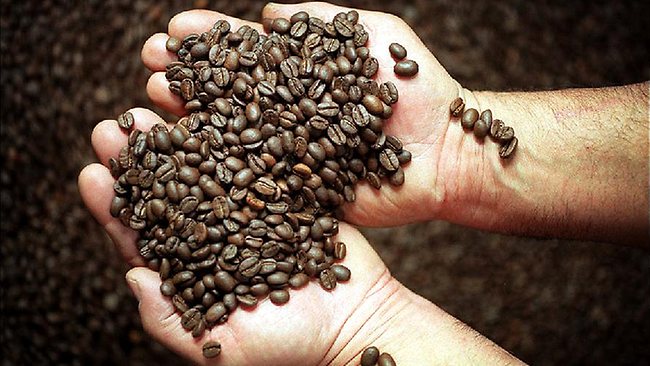
Scientists have discovered Australia has it's own "native" coffee bean growing on Cape York
The program in both states was designed to evaluate the cultivars in a range of microclimates and on differing soil types, also to simulate a machine-harvest planting, with trees one metre apart and rows four metres apart forming hedgerows (2500 plant/ha), with grass cover in the inter-rows. All plants were grown in full sun and trained to a single stem. The Queensland trials were irrigated. Cultivars were assessed on their commercial yield over three to five years, including total cherry yield, cherry to dry green bean ratio, bean size and appearance, cupping quality and suitability for machine harvesting. Time of maturity, ripening pattern on the tree, resistance to pests and diseases, plant adaptability and growth rates were also evaluated. All trials were harvested by hand every three to four weeks to determine yield progress and maturity pattern or profile, information vital for machine harvesting. In later years the trials were machine harvested.
Australian Research Findings for Caturra Rojo
A comparison of mean coffee yields was conducted at three North Queensland locations, with the 10 cultivars evaluated being three years old at first harvest. At the Walkamin location (1990-2) Caturra Rojo yield was 2323 kg green bean/ha (the mean being 2567 kg/ha). At Kamerunga (1985-8) it yielded 2274 kg/ ha (the mean being 2973 kg/ha) and at Mareeba (1985-8) 1338 kg/ha (the mean being 1316kg/ha).
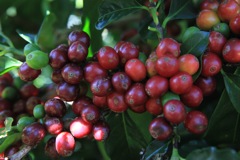
Caturra Rojo (Red) cherries
Yields from 19 cultivars were evaluated in northern New South Wales, the mean of three locations for Caturra Rojo was approx 1400 kg green bean/ha. Caturra Rojo, as a dwarf cultivar did not rate as a recommended cultivar for northern New South Wales due to slow growth, susceptibility to ant, scale and mealy bug infestation, plus difficulty in harvesting the tight cherry clusters selectively. Yields and quality have been lower on these cultivars than the taller cultivars.
Source
David Peasley and Ted Winston, The Courier Mail, Compassionate Coffee


