General Information:
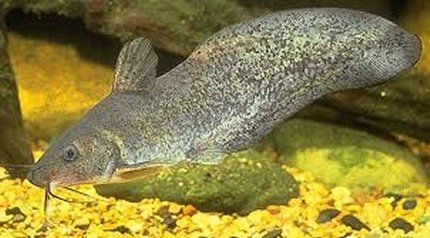 The catfish is native to the Murray-Darling system and prefers sluggish or still waters. Due to habitat destruction and overfish it is considered to be endangered in South Australia and therefore is a protected species.
Catfish are a relatively hardy fish and can withstand extreme conditions for short periods of time. They can reach sizes of 900mm (6.8kg) however a good sized catfish which can be caught is around 500mm (2kg).
Presently there has been limited attempts in commercially culturing catfish. This may be due to the reasonably slow growth rates that are attained in the wild and the unusual appearance of the fish.
Reproduction:
Both male and female catfish reach sexual maturity after 3 – 5 years at a length of around 350 – 400mm. A water temperature greater that 240 C is necessary for spawning to occur however flooding does not seem to be involved in reproduction. Spawning therefore occurs during spring to early autumn.
Catfish possess quite elaborate reproductive behaviours with the formation of male and female pairs. Catfish couples will construct a nest out of pebbles or excavate a depression in the mud up to 2m in diameter around 1 – 2 weeks before spawning occurs.
Spawning is often preceded by elaborate courtship behaviour with the male swimming rapidly back and forth over the nest to attract the female. The pair position themselves above the nest, the male nudging the ventral region of the female. The female then lays a few eggs which sink into the nest. This process is repeated several times before the female leaves the nest.
Male catfish remain to guard and protect the nest.
Up to 20,000 eggs are laid by each female depending on the size of the fish. The eggs are spherical, non-adhesive, light greenish-yellow in colour and have a diameter of 2.3 – 3.1mm. Hatching will occur after approximately 7 days.
Currently hormone injection techniques to induce spawning have not been developed for catfish. Commercial hatcheries usually rely on natural spawnings in ponds or dams to obtain their fingerlings.
Diet:
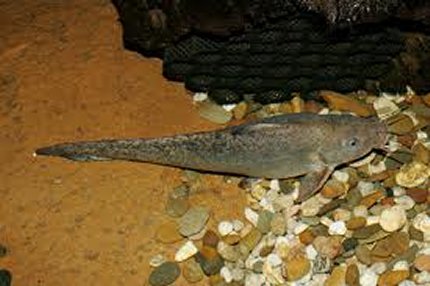 The catfish is a benthic species living and feeding mainly on the bottom. Young fish from 25mm – 100mm feed on zooplankton and earthworms. The adult fish are essentially carnivorous consuming molluscs and crustaceans. .
As their nature of feeding causes water into become muddy, feeding appears to be assisted more by odour perception rather than by sight.
Presently there is no artificial diets developed for the catfish. However is has been indicated that they will take a sinking commercial pellet.
Growth:
Catfish are produced extensively in dams usually for personal angling and consumption. Newly hatched fry are approximately 7mm long and have no barbels or pectoral fins. The barbels appear as tiny buds three days after hatching and are well formed after 7 days when the larvae is 12mm in length. It takes approximately 3 weeks for the young catfish larvae to reach juvenile status at a size of 15mm in length.
It has been reported that catfish will grow to about 60mm in 100 days and have attained 30 – 34cm in ponds without supplementary feeding in approximately16 months.
Marketing:
It appears surprising that there has not been a reasonable development into the aquaculture of catfish especially considering the huge channel catfish industry in the United States of America.
The channel catfish in the USA is not unlike the Australian native catfish where approximately 275,000 tonnes are farmed each year. Due to its unusual appearance there has not been a great market acceptance for catfish in Australia. The catfish also has a very low percentage of meat recovery when filleted however the catfish is considered to be excellent eating with sweet, white flesh.
Information Sourced From;



