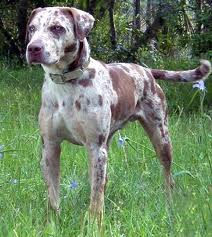
 The Louisiana Catahoula Leopard Dog or Catahoula cur is an American dog breed. It is named after Catahoula Parish in the state of Louisiana in the United States. The Catahoula is believed to have occupied North America the next longest after the dogs descended from Native American-created breeds. The breed is sometimes referred to as the “Catahoula Hound” or “Catahoula Leopard Hound”, although it is not a true hound, but a cur. It is also called the “Catahoula Hog Dog”, reflecting its traditional use in hunting wild boar.
History
One theory as to the origins of the breed states that the Catahoula is thought to have descended from molossers and greyhounds, brought to Louisiana by Hernando de Soto in the 16th century. Dogs left behind by the explorer’s party were interbred by the local natives with their domestic dogs.
Appearance
The breed’s size ranges from 20–26″ and weighs between 50–90 lbs, with a few individuals larger. Most males average 30-50 lbs in lean working condition and are about 24″ tall. As a working dog, Catahoulas have been bred more for temperament and ability than for appearance. As a result, the physical characteristics of the Catahoula are somewhat varied.
Coat
Catahoula leopards have a single, short, dense coat in a variety of colors; red and blue merle, as an example, although the colors are also black, grey, brown, red, white solid, as well as tri-colored. They can also come in a “wooly” coat, which can be longer and shaggy. (Feels & looks like the coat of a American Staffordshire Terrier or an American”Pit Bull” Terrier)
Colors
Catahoula Leopard Dogs come in many different colors. They can be Leopard (Merle) Solid colors, such as; Brown, black, tan and white. Solids may have small splashes of other colors such as white on their face, legs or chest. There are also Brindle leopards. These dogs are solid-colored dogs that may carry the merle gene, which dilutes a normally dark coat. This merle gene combines with solid colors to create merle patterns in patches of white and colored hairs intermingled with patches of solid colors.
Catahoulas may be solid black, but can also appear with patches of blue or gray. Likewise, Catahoulas with red and brown coats will appear with lighter patches of red or liver. This occurrence is referred to as a leopard (merle)-colored dog. The merle gene does not normally affect the entire coat of the dog, but dilutes the color only in areas that randomly present the characteristic of the gene. Visually, white coats seem unaffected.
 Texture
The texture of a Catahoula leopard coat can be as varied as the colors and can be coarse, slick/painted-on, or woolly/shaggy. (Don Abney)
Temperament
“You must be ready to teach and exercise a Catahoula. If not, he will eat your house. The Catahoula will not let you forget that you own a dog.” -Don Abney
Catahoulas are highly intelligent and energetic. They are assertive but not aggressive by nature. They have a need to take charge of their pack whether other dogs or humans. Catahoulas in general are very even tempered. Males tend to be more obnoxious than females, but Catahoulas are very serious about their job if they are working dogs. They make a good family dog but will not tolerate being isolated, so interaction with the dog is a daily requirement. When a Catahoula is raised with children, the dog believes that it is his or her responsibility to look after and protect those children. Many owners will say that the Catahoula owns them and they can be insistent when its time to eat or do other activities. Catahoulas are protective and a natural alarm dog. They will alert one to anything out of the ordinary.
Hunting
The Catahoula is a common working dog of the region and is seen on farms and ranches across North America. These dogs are outstanding tracking and hunting dogs, commonly used for hunting feral pigs, squirrel, deer, raccoon, mountain lion, and black bear. They often track silently and only begin to make their distinctive baying bark, eye to eye with the prey, once it is stopped.
Catahoulas have been introduced in the Northern Territory of Australia where they have been found to be a superior hunting dog for pigs by breeders. They have been introduced in New Zealand as well as Australia, but the number of Catahoulas there is unclear.