 Castration
To castrate or not to castrate – that is a question that must be answered by the individual producer. There are many conflicting opinions on this topic. The purpose of this section is to provide producers with all the options. If you do decide that it is necessary to castrate, it is critical that you are certain of your ability to successfully perform this procedure by using proper technique and equipment. Also, anyone performing this technique should take all precautions to avoid unnecessary pain or distress to the animal during the surgery and recovery period. Castration should be done as early as management procedures will allow (after the lamb has received colostrum and before 7 days of age). Castration of rams after the age of 3 months should be done by a veterinarian using appropriate analgesics and anesthetics.
Reasons to Castrate
The primary reason to castrate is to prevent indiscriminate breeding and subsequent pregnancies in young sheep. Some producers feel that any attempt to run large numbers of intact males on a property, along with females of the same species is difficult. In the sheep industry, it is quite common to run both females and males together, and therefore, a percentage of the industry feel that it is necessary to castrate. In addition, there is thought to be a higher incidence of male fighting, which can cause injury and loss of productivity. It has also been suggested that if done at a young age, it may enhance pelt removal and meat quality.
Reasons not to Castrate
It is felt by some that castration is unnecessary if lambs are to be marketed for slaughter prior to puberty, which generally occurs between 3 and 5 months of age. Increased male fighting, change in flavour of the meat, and indiscriminate breeding are not seen in animals that are less than 4 months. In addition, studies have shown entire (un-castrated) male lambs show better growth rate, efficiency of feed utilization and carcass yield than castrated lambs. Some markets, particularly ethnic markets, prefer intact ram lambs.
Castration Methods
If the decision is to castrate, there are a number of methods that can be used. The following is a list of methods with their advantages and disadvantages.
1. Rubber Ring - Basically the rubber ring is designed to constrict blood flow to and from the testes and scrotum, thus causing them to slough off after approximately 3 to 6 weeks, leaving a sealed scar behind.
It is important to ensure that both testes are present and there is no scrotal hernia (intestines extending into the scrotum due to a hole in the gut wall). The ring should be placed below the rudimentary teats while ensuring that both testes are trapped in the scrotum. Only when everything is correct should the ring be gently released off the elastrator. Avoid placing the ring directly on the teats or the testes as this may increase discomfort. If the ring is placed too high (i.e. between the teats and the body wall, the urethra may become trapped, thus preventing the bladder from emptying. This will not only cause great discomfort but will prevent urine from being passed, which will lead to the death of the lamb.
Advantages: Cheap, quick, no blood loss, effective with care, modest level of skill required for safe use. Less irritation by flies then with an open wound.
Disadvantages: painful, infection may occur around ring, risk of trapping urethra, in very small lambs the testes are so small that they can actually pass back from the scrotum through the central hole in the ring after the ring has been correctly applied. May be an increased risk of tetanus.

Burdizzo used for castrating animals
2. Surgical (Open) castration
Burdizzo used for castrating animals
This is the complete removal of testes via surgery. This procedure requires good hygiene if infection and delayed healing are to be avoided. With this procedure an open wound is left. As assistant is required to catch and restrain the lamb thus leaving the operator’s hands free and clean. Only a very sharp knife or scalpel designated for the purpose should be used for castration.
Check to be sure there is no scrotal hernia and that both testes are present. The scrotum should be cleaned and swabbed with dilute Pevidine or Hibitane. The bottom of the scrotum is drawn downwards (leaving the testes behind) and cut off with one smooth stroke of the scalpel. The open scrotum is then pushed up towards the abdomen causing the testes to appear. The testes are grasped one at a time and drawn steadily downwards until the cord breaks. The remaining part of the cord recoils into the inguinal canal and the blood vessels in it contract and thus are much less likely to bleed than were they to be cut.
However, some testicular arteries fail to seal despite this traction and severe haemorrhage can result causing a serious setback or death. Although, by leaving an open wound there is less chance of abscessing to occur because the wound is draining, there is a chance of infection. Furthermore, should any loops of bowel travel down either of the inguinal canals there is nothing to prevent them prolapsing and becoming damaged with usually fatal consequences.
Advantages: Can be used in lambs up to 3 months of age; cheap; effective; quick; modest level of skill required.
Disadvantages: Risk of severe haemorrhage; risk of potentially serious infection; risk of prolapse of intestinal loops; two people required to maintain good surgical asepsis; not suitable during fly season; painful.
3. Bloodless castrators (emasculators)
The purpose of these instruments is to damage irreversibly the blood vessels to each testis by crushing the spermatic cords without cutting the skin of the scrotum. Thus deprived of their blood supply, the testes shrivel within the scrotum, and the scrotum itself is retained. This is the crux of the method and it’s main advantage – there is no open wound by which infection could gain access.
It is essential that the scrotum is not crushed across its full width. Were this to happen then it too would be likely to atrophy (due to all the small blood vessels in the skin of the scrotum being crushed) and fall off leaving a gaping wound, which would be unlikely to heal over. Such a wound would cause considerable suffering and could allow infection to gain access into the abdominal cavity via the inguinal canals resulting in peritonitis and death.
For many years the Burdizzo emasculator has been available. It is important to use the small version for lambs as the larger cattle model would crush too much of the scrotum. Lugs or “cordstoppers” on the ends of the lower jaw help prevent failures (see below). It can be difficult to manoeuvre the cord, apply the instrument and restrain the lamb at the same time (often the lamb will struggle vigorously when the crush is applied, if not before) so ideally a handler and an operator are required to do the job safely and effectively. More recently a new lamb emasculator, the Little Nipper, has become available which is designed to be easier to use with one hand. Both of these instruments are precision made and must not be used for other purposes. They should be stored carefully, oiled and with the jaws open.
Each testis gives off a spermatic cord (containing an artery, a vein, a nerve and a vas deferens which is the tube that carries sperm from the testis to the penis), which can be felt running in the neck of the scrotum from the top of the testis towards the inguinal canal in the abdominal wall. Doing one side at a time, the spermatic cord is manoeuvred to the outer edge of the neck of the scrotum (in order to minimise the amount of scrotal skin that will be bruised by the jaws of the instrument) before being crushed. It is vital that the skin in the middle of the scrotum is not damaged but essential that the cord is crushed.

When the second cord is being crushed the instrument should be applied slightly lower so that the left and right crushes are not directly opposite one another but staggered in order that a greater width of skin in the middle of the scrotum is undamaged. This undamaged area of skin will contain sufficient small blood vessels to keep the scrotum viable (alive).
Care must be taken to ensure that the cord does not slip from between the jaws as they are closed. The lugs help to prevent this but were it to happen then the blood supply to that testis would be undamaged and the testis would develop in the normal way. This is arguably the major drawback with this method as such failures will not be apparent for some weeks. Skill and care are therefore required.
Traditionally two crushes are applied to each cord for good measure, the second one below the first as this area should by then be numb. However, a single crush on each cord maintained for 6 to 10 seconds may be as effective with some instruments. The instrument should be applied below the teats (to avoid the urethra as in the rubber ring method) but away from the testis to avoid unnecessary pain. Ensure there is no scrotal hernia present before applying the instrument. Crushing a loop of bowel would usually result in leakage of gut contents and death.
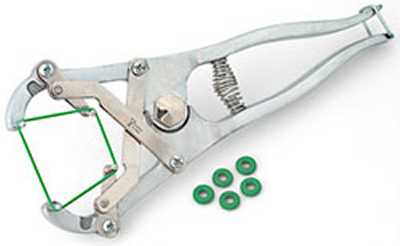
elastrator and rubber rings
When the cord is crushed, the main nerve to the testis is also destroyed and so the testis quickly becomes insensitive. So although the crush itself is painful there is not the build-up of the type of pain one gets with the rubber ring. However, there is usually some subsequent swelling and stiffness of gait.
The method relies on the instrument being in good working order and the operator being possessed of a considerable level of skill in its use. The high number of failures (i.e. lambs not effectively castrated) sometimes encountered with this method is its main criticism. Hence, application (missing the cord) and hasty removal (failure to apply the crush for 6 to 10 seconds) are the major contributing factors. Another factor is the instrument itself. If the hinges or the jaws of the instrument are worn then it may not exert enough pressure to crush the cord effectively. Furthermore, if the jaws of the instrument have become roughened by rust or abuse (being used as a pliers, etc) then they will cut the skin of the scrotum in places and serious infection may follow.
Variability in the pressure exerted by different instruments has been studied and prototypes of powered instruments which always exert the same pressure have been developed. Advantages: no open wound or focus for infection or flies; no blood loss; can be used on lambs up to 3 months of age; cheap once instrument purchased; scientific evidence suggests it is not as painful as other methods at least in the first few hours after castration.
Disadvantages: Comparatively high level of skill and care required; failure rate can be considerable; failures not easily detected at the time; ideally an assistant is required to hold the lamb; risk of damaging urethra; comparatively slow; effectiveness of instruments varies with manufacture; wear and abuse; cost of instrument.
Adapted from: ‘Tail Docking and Castration of Lambs’ By. Manus Graham (Moredun Foundation, Scotland)


