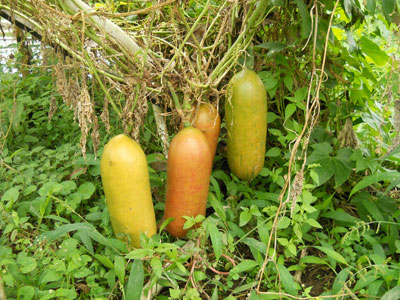
Ripe Fruit
Very large fruit (up to two feet long), with orange, yellow, purple, or black colored skin, looking a lot like a cucumber. Flesh is orange yellow and cantaloupe like.
The fruit is long and cylindrical. Think overgrown cucumber, with a very tough skin and what is said to be a lovely aromatic smell. In fact, many people use the long-lasting fruit to freshen the smell of a room.
Cassabanana is native to the New World tropics and cultivated as an ornamental plant and for its sweet-smelling, edible fruit.
The sicana odorifera or cassabanana is a member of the Cucurbitaceae family. Brazil native, and cultivated in parts of Central and South America. Sicana is a perennial vine, herbaceous and fast growing.
This plant is heavy, requiring a strong trellis. It can climb trees up to 50 ft (15 m) high or more by means of 4-parted tendrils equipped with adhesive discs that can adhere tightly to the smoothest surface.
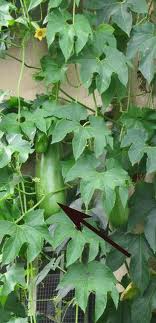
Cassabanana Vine and Fruit
Description:
Cassabanana Vine and Fruit
Very fast growing, climbing vine to 50ft.
Growing Environment:
Needs warm to hot temperatures for fruit to ripen. Grow like a melon, provide ample water and full sun. It can be grown as an annual in most climates during warm months.
Propagation:
By seeds.
Germination:
Germination First, you need to soak the seeds in tepid water for 24 hours. Then sow them in a mixture made up with 50% of horticultural compost, and 50% sand or pearlite.
Place the mix in the sun. Do not water too much. The best period for sowing is March/May. Germination takes anywhere from 4 to 6 weeks.
Uses:
Eaten raw and made into preserves.
Native Range:
Native to Brazil. Cultivated in parts of Central and South America.


