
Heavy Duty Stunner
A captive bolt stunning gun kills the animal and reduces it instantly unconscious without causing pain. A captive bolt gun has a steel bolt that is powered by either compressed air or a blank cartridge. The bolt is driven into the animal’s brain. It has the same effect on the animal as a firearm with a live bullet. After the animal is shot the bolt retracts and is reset for the next animal. A captive bolt gun is safer than a firearm.
There have been some questions about whether or not a captive bolt actaully kills an animal. Practical experience in slaughter plants indicates that cattle shot correctly with a penetrating captive bolt have irreversible damage to their brain and they will not revive. If a non-penetrating captive bolt is used the animal may revive unless it is bled promptly.
There has been renewed interest in the use of non-penetrating captive bolt due to concerns about BSE (Bovine spongiform encephalopathy). The elimination of stunners that injected air into the brain greatly reduced the amount of brain or spinal cord tissue that could be spread to other parts of the body. However, research has shown that even when air injection had been removed, small amounts of brain tissue may enter the body and brain tissue may contaminate plant equipment. The effective use of non-penetrating captive bolt requires much more accurate aim than a penetrating captive bolt. This will require the use of equipment to hold the animal’s head. Mushroom head non-penetrating captive bolt stunners inflict varying degrees of damage to the skull.
Non-penetrating captive bolt that fractures the skull is more effective than a stunner that does not fracture the skull. Effectiveness increases as the degree of skull fracturing increases. It is likely that reducing the spread of at risk brain material is reduced when fracturing is minimized. Unfortunately, effective stunning and reducing skull fracturing are two opposite goals. As the amount of damage to the skull is reduced, placement of the shot must become more and more precise to achieve instantaneous insensibility. Shooting on a slight angle may result in failure to induce instantaneous insensibility. A mushroom head with a larger diameter may be more effective with less fracturing than a mushroom head with a small diameter.
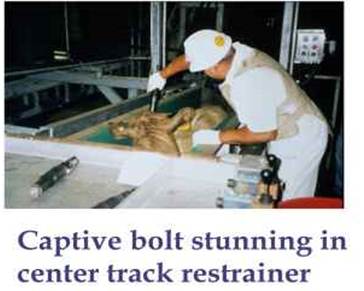 Recent observations of the Jarvis pneumatic mushroom head non-penetrating stunner showed that it was effective on Zebu type cattle with very short hair. The plant had a head holding device to hold the bovine’s head. The stunner fractured the skull but did not break the skin. Observations indicate that non-penetrating stunners may be less effective on cattle with wooly heads such as herefords compared to short haired cattle.
In plants using a non-penetrating captive bolt animal welfare should be evaluated with the American Meat Institute scoring system in the same manner as penetrating captive bolt. The plant must be able to stun 95% or more of the cattle correctly with a single shot. They must be able to attain an acceptable score of 75% of the cattle moved with no electric prod and 3% or less of the cattle vocalizing. If a head restraint is used, a vocalization score of 5% is acceptable.
Heavy mature bulls are more difficult to stun with captive bolt compared to cows or fed beef. Practical experience in plants indicates that heavy bulls are most effectively stunned with either a perfectly maintained cartridge fired penetrating captive bolt stunner, a fire arm with a free bullet, or one of the new powerful pneumatic penetrating captive bolt stunners. Stunning mature bulls correctly has been a continuous problem that has repeatedly shown up in restaurant audits. The stunning of bulls with a non-penetrating stunner will need to be carefully monitored and audited to maintain a high standard of animal welfare.
For large bulls and other heavy livestock such as bison, some plants routinely shoot them twice with a captive bolt. To verify that 95% or more are rendered insensible with one shot, the auditor or inspector should check for signs of return to sensibility BEFORE the second shot is done. A stunner shot that shoots in the air and does not touch the animal does not count. If the bolt of the stunner touches or partially penetrates the animal it is counted as a missed shot.
Some European regulations require that animals be bled within 45 to 60 seconds after captive bolt stunning. This is especially important after non-penetrating captive bolt. There have been questions on how to interpret this regulation that need to be clarified. If the first shot fails to render the animal completely insensible and the animal has to be shot a second time, how should the interval be timed? It should be timed AFTER the second shot. An animal showing signs of return to sensibility must NEVER be hung on the rail. This is a direct violaton of USDA regulations and hanging a sensible animal would cause suffering.
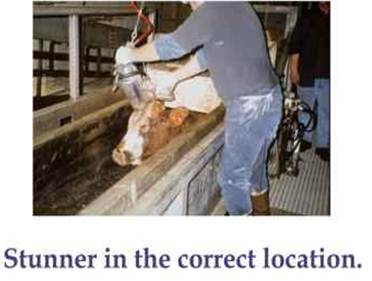 The issue of stunner problems with brain tissue contamination must be kept in perspective. The carcass splitting saw also spreads spinal cord tissue on the carcass. Splitting saw contamination may possibly be worse than contamination from a standard penetrating captive bolt.
Studies done under good commercial conditions show that contamination from brain proteins is low. A study done by Rovira et al (2007) at Colorado State University indicated that only one animal out of 360 had a positive GFAP immuno assay for brain protein in the blood after penetrating captive bolt. Thirty cattle were sampled in 12 commercial plants. In 10 out of the 12 plants, the animals were shot with a single shot. The one positive sample occurred in a plant where the kill floor layout made it impossible to verify that the animal was shot with a single shot. A study done at the University of Bristol by Coore et al (2005) showed much higher levels of contamination. They used methods that may have confounded their results. The cattle were anesthetized and a catheter with a balloon was inserted into the jugular vein. There is a possibility that this device may have slowed down bleedout and changed blood flow patterns in the brain. Another study done under commercial conditions had results similar to the Colorado State study (Lucker et al, 2005).


