Introduction:
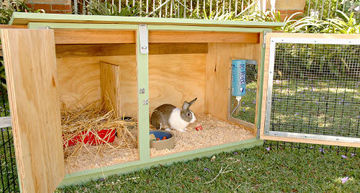
Well thought out rabbit housing should keep him happy and safe
Your rabbit’s basic requirement is a home and a hutch is the perfect bunny place. It must be high enough for your pet to stand and clean itself, and long enough for it to hop four successive times without hitting the end wall.
We’ve used untreated exterior-grade plywood for our hutch, which is non-toxic to rabbits. Two screened openings exist for ventilation and protection against predators. They also fend off nasty mozzies, which carry the Calici and Myxomatosis viruses. The hutch contains a central divider which creates a sheltered sleeping quarter for your bunny, and as rabbits tend to chew through wood, it is installed with screws so it can be replaced.
Setting up home:
After you make the hutch, give the paint a week to dry and find it a spot in the shade before you introduce Peter, Warren or Stew to their new home. For a contained exercise area, surround the front of the hutch with puppy fencing. Remember, always supervise your bunny when it’s outside the hutch.
Use a heavy ceramic food bowl that will not topple when rabbit sits in or on it. It also helps to keep food cool. Add a drip water dispenser at one side and clean straw or hay in the sleeping area as bedding. In hot weather, a frozen soft drink bottle and a piece of wet indoor or outdoor carpet will also help keep your rabbit cool.
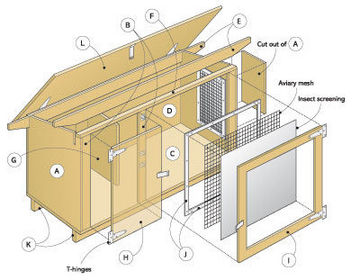
Diagram for the rabbit hatch project
Gather your DIY hutch supplies:
- A Sides (2), 600 x 581 x 19mm exterior plywood
- B Front panel (3) 581 x 50 x 19mm exterior plywood
- C Base 1200 x 600 x 19mm exterior plywood
- D Back 1200 x 500 x 19mm exterior plywood
- E Handles (2) 70 x 19 x 1500mm hardwood decking
- F Front top rail 1200 x 50 x 19mm exterior plywood
- G Partition 400 x 280 x 19mm exterior plywood
- H Solid door 575 x 350 x 19mm exterior plywood
- I Mesh door 575 x 655 x 19mm exterior plywood
- J Metal cover strips (total) 25 x 3 x 3740mm aluminium
- K Feet (2) 70 x 35 x 1200mm treated pine
- L Lid 1400 x 900 x 19mm exterior plywood
You’ll also need:
PVA and construction adhesive; 6 x 150mm T-hinges or gate hinges; 2 x 75mm strap hinges; aviary mesh (600 x 520mm and 400 x 300mm); aluminium insect screening (600 x 520mm and 400 x 300mm); 3 small hasp and staple latches for doors; 1 long hasp and stable latch for lid; 4 small padlocks (common keyed); Paint - Delux Lady Fern; Cabot’s Crystal Clear.
Your rabbit’s basic requirement is a home, and a hutch is the perfect bunny place. It must be high enough for your pet to stand and clean itself, and long enough for it to hop four successive times without hitting the end wall.
Your rabbit’s basic requirement is a home, and a hutch is the perfect bunny place. It must be high enough for your pet to stand and clean itself, and long enough for it to hop four successive times without hitting the end wall.
Build a rabbit hutch:
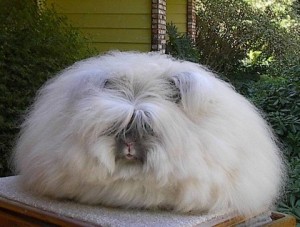
English Angora Rabbit
English Angora Rabbit
STEP 1
If you can, order plywood panels pre-cut to size, otherwise use a power saw along a straight edge to cut materials to size. Measure up 500mm from back bottom of each side (A); join to front top corner; cut off to form a roof slope.
STEP 2
Mark a 70 x 19mm notch in the top back edge of the roof slope and another (same size) 50mm in from the front corner. Use a jigsaw to cut. Also lower the roof in front of the front notch by 19mm.
STEP 3
Cut or plane a slope matching the roof at the top of the front panels (B) and glue and screw 2 of them to the inside front edges of the sides (A).
STEP 4
Screw the 2 side assemblies to base (C) so the front panel is flush with the front of the base. Then add the back (D).
STEP 5
Cut handles (E) to length and cut a 140 x 30mm taper at each end on the underside. Glue and screw them into the slots at top edges of side panels (A).
STEP 6
Glue and screw the front top rail (F) to the lowered section at the front top of the side panels, and also screw from the handle into the rail. Measure 353mm from the left inside edge of front panel along the base and the underside of the top rail, and screw the third front panel in place.
STEP 7
Screw partition (G) into the hutch, 420mm from the left-hand end. This gives bunny a partitioned-off area for security and protection from the elements. However, as your pet is likely to chew the edges, you may want to replace this part in the future. Use screws, not glue.
STEP 8
Cut the solid door (H) to size. It should leave a millimetre or so all around to make closing easy. Fix 2 T-hinges to the doors, with the end of the barrels flush with the top and bottom of the door. Place door on 2mm spacers, then screw hinge to the front panel. Insert 1 screw top and bottom first, check operation, then put in the rest of the screws.
STEP 9
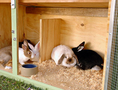
Rabbits tend to enjoy company
Mark a 50mm border around the perimeter of the larger mesh door (I). Plunge a power saw into the lines by pivoting on the front of the saw base. Start saw and slowly feed it into the plywood about 80mm in front of the back line. Run along line as normal, stopping short of the end. Repeat for each line, then finish cuts with a jigsaw into each corner.
STEP 10
Cut both aviary mesh and aluminium insect screening to a size of 600 x 520mm. Place offcut from Step 9 back in the hole, align the meshes so they are even all around, then cut 4 lengths of aluminium cover strip (J), 2 at 520mm and 2 at 550mm long. The aviary wire goes on the inside to provide extra protection against rabbits trying to scratch the fine mesh. The coarse mesh protects against foxes and cats, while the insect screening keeps the mozzies out. Predrill for 4 screws in each strip, then secure the layers of mesh with cover strips. Fit the door to the hutch with T-hinges.
STEP 11
Cut an extra hatch in the right-hand side. This door is 350 x
250mm and spaced 50mm from the bottom edge and front of the side panel. Stand hutch on blocks so you can cut on the flat. Use plunge cuts (see Step 9), then flip it over on the bench. In the same way as before (Step 10), screw 2 meshes and aluminium cover strips – 350mm and 300mm long – inside the panel. The hatch allows extra breeze through on warm days. When it’s cooler, close the door. Screw on door using 2 smaller strap hinges.
STEP 12
Add a small hasp and staple lock at each door (for padlocks).
STEP 13
Add 2 feet (K) to the underside of the hutch to provide ventilation and stop the hutch from rotting early when on damp ground. Locate feet 50mm in from the front and back. Screw on from the inside.
STEP 14
To fit the roof or lid (L), chisel a housing for the hinge barrel in the back of the hutch back, 100mm from ends. Chisel out until the T of the hinge is flush with the back and the strap flat on the top edge. This is necessary as the hinge fits on the inside of the lid and on the outside of the back.
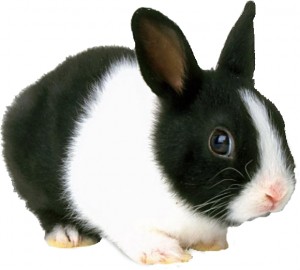
A cared for rabbit
A cared for rabbit
STEP 15
Paint the inside of the hutch with 2 coats of water-based acrylic to make surfaces easy to clean. Use exterior acrylic on the outside but avoid mesh and hinges.
More about rabbits:
There are few rules that govern keeping rabbits. However, in Queensland, it’s not legal to own a rabbit as a pet – choose a guinea pig instead, perhaps.
Looking after a rabbit means keeping it secure, providing it with shelter and food, handling and exercising it, and looking after its health needs. Make sure the kids are supervised when caring for, and handling, their bunnies. Bear in mind that a few unintentional scratches from a rabbit’s hind legs are the norm. Their claws are sharp and their hind legs are very strong.
The best time to buy a bunny is when it’s about eight weeks old and has been weaned. Prices start from $50.



