Background information
Genetic decisions have long-term impacts on your flock. Take a longer term view of the market when planning your flock structure and production targets. Considerations include the opportunities for premiums or adding to the relative value of wool and meat. These considerations need to be part of a 10-year time frame as it can easily take 7-10 years to see change in your flock.
Key decisions, critical actions and benchmarks
In general, the more traits you select, the slower the rate of progress on each trait. Therefore it is important to identify those traits that are most important in your business. This involves:
- Determining target markets. This is likely to include consideration of:
- Fibre diameter, staple length and staple strength
- Lamb markets (export, domestic or finisher)
- Breeding ewe replacements.
- Using feedback from your wool, lamb and sheep sales to evaluate performance.
Objectively quantify your flock’s current productivity, eg, kilograms of wool or liveweight of lamb or surplus sheep per hectare to highlight what might be genetic limitations or a mismatch between your current genetics and your market opportunites.
- Participating in formal or informal benchmarking programs to identify the strengths and weaknesses in your enterprise and align your breeding objectives accordingly.
- Designing the breeding program to meet production targets and fit physical production capability. This involves consideration of the:
-Breeding system: straight-bred Merino or dual-purpose maternal breeds? Composite maternal flock, first or second cross prime lambs?
-Design of your breeding program to account for your on-farm resources, eg, consider the number of replacement ewes required annually.
The Australian Sheep Industry Cooperative Research Centre (Sheep CRC) has developed tools to help answer these questions, including:
-Tool 9.1: a ‘wether calculator’ to help determine the economic consequences of varying the portion of wethers in a Merino flock, and -Tool 9.2: a ‘Merino versus terminal sire flock’ model to help assess the balance of self-replacing Merino and terminal sire matings.
- Identify key traits essential for achieving production targets. In this module a ‘trait’ is defined as a production characteristic that you may select for, eg, fibre diameter, fleece weight, growth rate, eye muscle depth or number of lambs weaned.
The traits to identify, and relative importance may include:
-Reproduction: weaning rate, mothering ability
-Growth traits: weaning, post weaning, yearling or adult weight
-Fleece traits: fibre diameter, fleece weight, staple strength, staple length
-Carcase traits: fat and eye muscle depth, yield
-Disease resistance: worms, footrot
Another useful Sheep CRC tool ‘Selection assist’ enables advisers or classers to help sheep producers decide on a breeding direction that is applicable to their flock (see http://www.sheepcrc.org.au/index.php?id=354). It provides additional information on the likely outcome of a breeding objective. It also shows the impact of reproductive rates and where progress can be achieved within a flock.
Table 9.1 illustrates the relative importance of the key traits for a range of enterprises. For example, a medium wool Merino producer may want to maintain fibre diameter while increasing fleece weight, growth rate, reproduction rate and worm resistance.
Feedback from wool and lamb sales will help sheep producers prioritise the traits to focus on. However, when interpreting market feedback remember:
a) To take a longer-term view of the market, and
b) That flock genetics is only one contributing factor.
Signposts
View
The Sheep CRC:
Technology, tools and know-how to assist the sheep industry to deliver, in a profitable and sustainable manner, products highly desired by domestic and export customers. Visit: www.sheepcrc.org.au
Maternal Central Progeny Test:
Compares the merit of maternal sires where it counts - their ability to produce crossbred lambs and ewes that have superior production and are efficient and profitable for the sheep producer. Visit: www.sheepgenetics.org.au/lambplan/mcpt/start.htm
Selection Demonstration Flock:
Proving the effect of alternative selection strategies and increasing the rate of adoption of genetic technology in South Australian Merino sheep by establishing demonstration flocks that become a focus of education programs.
Visit: http://www.sardi.sa.gov.au/dhtml/ss/section.php?sectID=130&tempID=1
QPLU$: over the last decade, this program showed that sheep producers can significantly boost returns from existing Merino flocks if they breed from animals selected on the basis of measured fleece weight and fibre diameter. Visit:
http://www.dpi.nsw.gov.au/agriculture/livestock/sheep/sheep/qplus-merinos-opendays
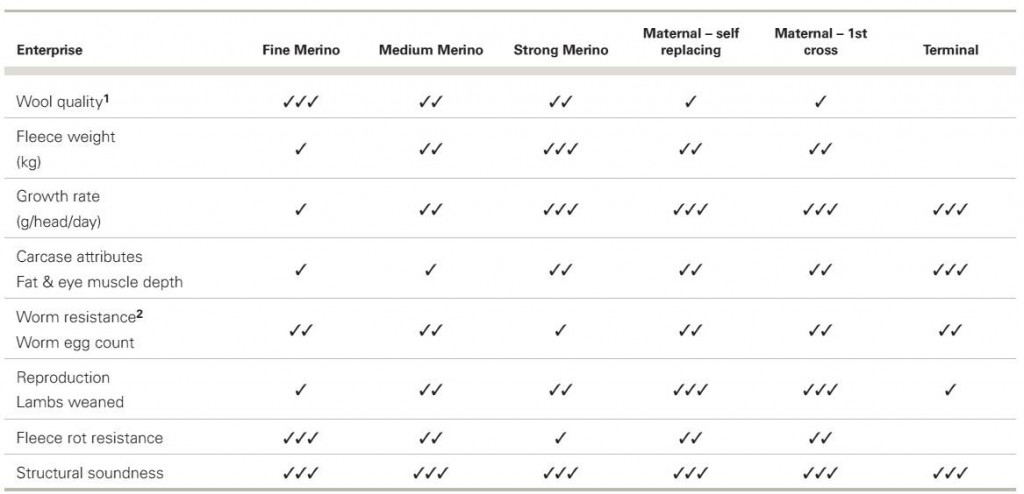
Table 9.1: Example of relative emphasis of traits when selecting rams for a range of enterprises 1 Includes characteristics such as fibre diameter, staple strength, crimp, style. 2 May vary noticeably across regions.


