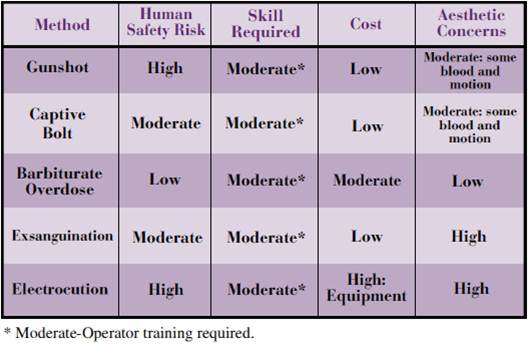
 Details of Table
1) Gunshot:
The firearm should be held 2-10 inches from the intended point of impact, and the bullet should be directed perpendicular to the front of the skull to prevent ricochet. The point of entry should be at the intersection of two imaginary lines, each drawn from the inside corner of the eye to the base of the opposite horn (slightly above the ear in polled animals).
A .22 caliber long rifle bullet is sufficient for most animals, but a .22 magnum or 9mm round should be used on bulls. Use of a hollow-point or soft-nose bullet increases tissue destruction. If performed skillfully, gunshot induces instantaneous unconsciousness, is inexpensive and does not require close contact with the animal.
This method should only be attempted by individuals trained in the use of firearms and who understand the potential for ricochet. Care must be taken to minimize danger to the operator, to bystanders, and to other animals. In addition, since some cities have laws prohibiting the discharge of firearms in certain areas, the operator should be aware of local ordinances that may apply.
2) Captive Bolt:
Captive bolt “guns” are either penetrating or non-penetrating. Penetrating captive bolt guns are meant to produce immediate brain tissue destruction. Both types (penetrating and non-penetrating) will consistently cause stunning of an animal. A stunned animal will “drop” but will still exhibit respiration and sudden quick limb movements. An additional procedure (exsanguination, chemical agents) MUST be used to insure death after the use of the non-penetrating captive bolt and is RECOMMENDED after use of the penetrating captive bolt.
The captive bolt gun must be placed firmly against the skull at the same entry point previously described for a gunshot. Since use of the captive bolt gun requires close proximity to the animal, good restraint and prior sedation or tranquilization may be required. Operator safety must be considered in the use of this technique.
Maintenance and cleaning of the captive bolt gun as described by the manufacturer must be followed exactly. In addition, selection of cartridge strength may vary among manufacturers and the appropriate strength for the size of the animal must be used.
3) Barbiturate:
When properly administered by the intravenous route, barbiturate overdose (60-80 mg/kg sodium pentobarbitol IV) produces rapid unconsciousness and anesthesia fol-lowed by respiratory depression, hypoxia, and cardiac arrest. The barbiturate selected should be potent, long acting, and stable in solution. Tissue residues of the barbiturate can be high. Care should be exercised to limit access of scavengers to the carcass.
4) Exsanguination:
This method can be used to ensure death subsequent to stunning, anesthesia, or unconsciousness. It must not be used as the sole method for euthanasia.
There are several methods for exsanguination. The most common method in the bovine is to lacerate one or both carotid arteries. A long 6 inch sharp knife is fully inserted behind the point of jaw, just below the neck bones, and directed downwards until blood is freely flowing. Brachial vasculature can be lacerated by lifting a fore limb, inserting the knife deeply at the point of the elbow and cutting skin and vasculature until the limb can be laid back against the thorax of the animal. The aorta can be transected via the rectum, by a trained individual, so that blood pools within the abdominal cavity.
5) Electrocution:
This method should only be attempted using specialized slaughter plant equipment that applies a minimum of 2.5 amp across the brain. A 120 volt electrical cord does not apply sufficient amperage to induce unconsciousness.
Electrocution does involve current as well as violent involuntary reactions by the animals. Therefore, this method does involve some danger to the operator.
Confirmation of Death
Confirmation of death is absolutely critical regardless of what method of euthanasia is chosen. Keep personal safety in mind when confirming death because animals can make sudden involuntary limb movements.
The following can be used to evaluate consciousness:
• Lack of a heartbeat.
• Lack of respiration.
• Lack of corneal reflex.
The presence of a heartbeat can be best evaluated with a stethoscope placed under the left elbow. Movement of the chest indicates respiration. (Note: breathing can be very slow and erratic in unconscious animals.) The corneal reflex can be tested by touching the eyeball and noting whether the animal blinks. A lack of heartbeat and respiration for more than five minutes should be used to confirm death.
Euthanasia of Calves and Bulls
Calves and bulls require special consideration in selecting the proper method of euthanasia. Ethical considerations do not change for the calf because it is small or more easily handled. Calves can easily be euthanized with a penetrating captive bolt gun. Barbiturate overdosing also works well, but legal restrictions must be followed.
Bulls require special considerations because of their size, attitude and physical thickness of their skull. Operator safety is of primary concern in euthanasia of bulls, and for certain techniques, proper restraint is critical. Bulls may be euthanized with specialized heavy duty captive bolt guns, firearms using a 9mm shot, or by barbiturate overdose.
Unacceptable Methods of Bovine Euthanasia
Ethical and humane standards of euthanasia DO NOT permit the following methods of euthanasia in the bovine:
1) Manually applied blunt trauma to the head.
2) Injection of chemical agents into conscious animals (e.g. disinfectants, electrolytes such as KCl and MgSO4, non-anesthetic pharmaceutical agents).
3) Air embolism (e.g. injection of large amount of air into the vasculature).
4) Electrocution with a 120 volt electrical cord.
Conclusions
Personnel at sites that routinely handle animals should at all times have the ability and facilities to carry out emergency euthanasia. Penetrating captive bolt and gunshot are the only two methods available to non-veterinarians for emergency euthanasia. Animal transporters should also be appropriately trained and should have phone numbers to contact appropriate personnel in case of an emergency.
Market and sale yards should have a written procedure to follow in case of emergency and should have personnel trained in emergency euthanasia during all shifts. When practical, choose a location where the carcass can be easily reached by removal equipment. An action plan for routine and emergency euthanasia should be developed and followed wherever animals are handled.



