 Name:
Name:
Blackberry (Rubus fruticosus aggregate)
Description
Blackberries are mostly evergreen, but sometimes partially deciduous, sprawling woody shrubs, often forming mounds.
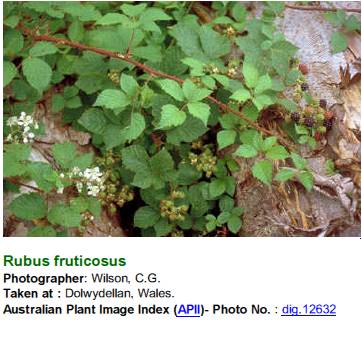
First year canes (primocanes) are usually distinctly angled, the faces of the angles furrowed or flat, and the angles usually bearing prickles. These canes are mostly reddish-purple where exposed or green when not exposed, and may be with or without hairs. Its leaves mostly consist of 5 distinct leaflets, arranged as in a hand (palmately). The lower surfaces of the leaflets are variable but often felt-like and there are down-curved spines on the main veins. Flowering canes (floricanes) are similar to primocanes and develop from primocane in the second year. Flowers are formed at the apex of the floricane. The flower stalks are less than 1.5 cm long. Flowers are white or pink. Blackberry fruits are initially green, ripening black.
For further information and assistance with identification of Blackberry species in general and species of the Rubus fruticosus aggregate in particular, contact the herbarium in your state or territory.
Distribution:
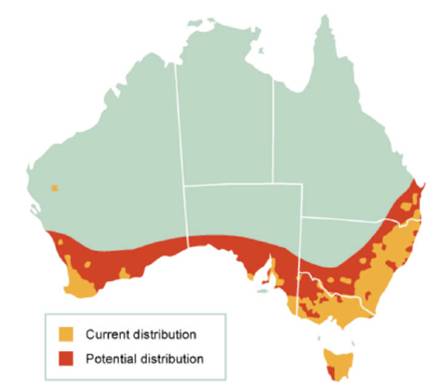
Blackberry is found throughout temperate Australia, from just north of the Queensland-New South Wales border across southern Australia in areas where the annual rainfall exceeds 700 mm. It is thought to have reached the limits of its potential distribution. However, it may still spread further within its climatic limits.
Habit:
Shrub
Key points:
- Blackberry (Rubus fruticosus aggregate) is a Weed of National Significance impacting on agriculture, forestry and natural ecosystems.
- Seeds, usually identical to the mother plant, are spread by birds, animals and water. Rooting from cane tips each year also results in new plants.
- In Australia Blackberry is an aggregate of up to 20 microspecies which all look very similar but react differently to herbicides and control measures.
- Biological control measures (rust) are being attempted. New strains of rust species are now being tested.
- Care is needed not to impact on the Blackberry fruit industry as well as native species of Rubus.
Blackberry weed
How it spreads:
Blackberry is dispersed by fruit (sexual or asexual) and also by vegetative (asexual) means. At the end of each season the tips of the canes turn over and reach to the ground where they root and produce new plants. Fruits may contain as many as 80 seeds which are easily are dispersed by birds, mammals (especially foxes) and water. Bushwalkers and other recreational users can also spread seeds, as can moving soil from one place to another. Blackberry roots can be spread to clean areas by cultivation.
Members of the aggregate are usually apomictic (genetically identical from one generation to the next) while pollination is needed to get the fruit to form there is no fusion of egg and sperm cells and so the seeds produced are identical to the mother plant. Occasional species such as Rubus ulmifolius reproduce sexually in Europe but this needs to be investigated for Australian conditions.
Where it grows:
Blackberry grow in wetter areas of Australia where rainfall exceeds 700 mm, often in disturbed areas.No particular habitat requirements seem to apply, apart from that of rainfall.
Flower colour:
White, Pink
Distribution map:
Impacts:
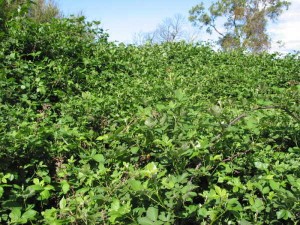
Blackberry is a Weed of National Significance. It is regarded as one of the worst weeds in Australia because of its invasiveness, potential for spread, and economic and environmental impacts. Blackberry forms impenetrable thickets and mounds that fill gullies, block access to waterways and alienate productive pasture, orchards and forestry land. These thickets can also reduce the natural attraction of the bush as well as hindering recreational opportunities by preventing access to natural features. Urban areas may also be affected.
Thickets can pose a fire hazard because of the dry material contained within them. Larger animals may become trapped in the thickets while smaller animals, native and feral, use these thickets as shelter.
Blackberry fruits produced are edible and attractive to birds and animals, accounting for the spread of the species. However on the positive side, Blackberry plants are also used for fruit and honey production. Control costs are high and a sustained effort is needed to attain success.
Origin:
Blackberry is a native of Europe where there are hundreds of microspecies recognised. Recent workhas matched Australian species with at least 15 European species but there is still further work needed to decide whether the Australian species have a similar genetic content to their European counterparts or whether they have evolved further in Australia.