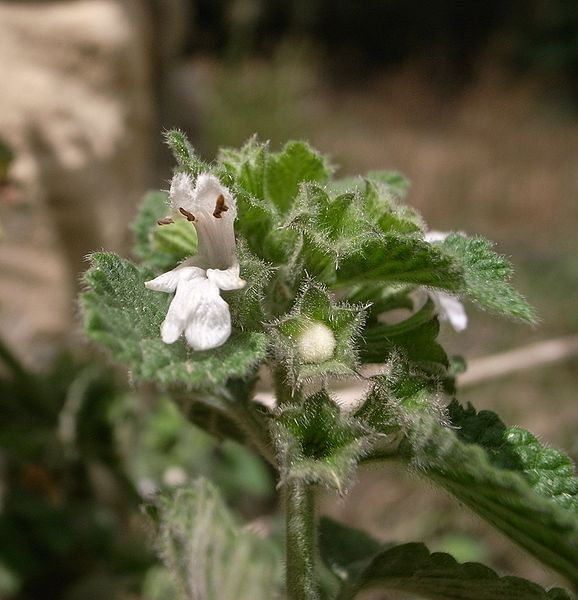
Black Horehound Photo by Denis Barthel on Wikimedia Commons
Ballota nigra
Common Name: Black Horehound
Family: Lamiaceae or Labiatae
Habitats: Waste ground, hedgerows, woods and shady places, preferring nitrogen-rich, moist, rather loose soil.
Range: Most of Europe, including Britain, south and east from Scandanavia to N. Africa and E. Mediterranean
Physical Characteristics
Ballota nigra is a PERENNIAL growing to 0.9 m (3ft) by 0.8 m (2ft 7in). It is hardy to zone 8 and is not frost tender. It is in flower from Jun to October. The flowers are hermaphrodite (have both male and female organs) and are pollinated by bees.
The plant prefers light (sandy), medium (loamy) and heavy (clay) soils, requires well-drained soil and can grow in nutritionally poor soil. The plant prefers acid, neutral and basic (alkaline) soils. It can grow in full shade (deep woodland) semi-shade (light woodland) or no shade. It requires moist soil.
Medicinal Uses
Plants For A Future cannot take any responsibility for any adverse effects from the use of plants. Always seek advice from a professional before using a plant medicinally.
Medicinal Actions: Antiemetic; Antispasmodic; Stimulant; Vermifuge.
Black horehound has a long history of herbal use, though is not widely employed in modern herbalism because of its unpleasant flavour. Nonetheless, it does have a range of medicinal virtues, being especially effective in its action as an antiemetic. In the past it was often used for treating problems connected with the respiratory system, convulsions, low spirits and the menopause, but present-day authorities differ over whether it was effective in these applications.
The whole plant is antiemetic, antispasmodic, expectorant, stimulant and vermifuge. It is taken internally in the treatment of nervous dyspepsia, travelling sickness, morning sickness in pregnancy, arthritis, gout, menstrual disorders and bronchial complaints. The plant is harvested as it comes into flower and is dried for later use. It should not be stored for longer than a year. The fresh herb is sometimes used to make a syrup.
Cultivation
Prefers a well-drained soil in full sun or partial shade. Avoids acid soils in the wild but tolerates a pH down to 5 in cultivation. This species is not hardy in the colder areas of the country, it tolerates temperatures down to between -5 and -10°c. This species is widely grown in herb gardens, but little employed because of its strong flavour. Its essential oil is used to adulterate the oil of white horehound (Marrubium vulgare). The leaves emit a most unpleasant smell when bruised, somewhat like stale perspiration. Plants can self-sow freely when well-sited. There is at least one named variety selected for its ornamental value. The whole plant has an offensive odour.
Propagation
Seed - sow spring or autumn in a greenhouse. The seed usually germinates in 3 - 6 weeks at 15°c. Prick out the seedlings into individual pots when they are large enough to handle and plant them out into their permanent positions in the summer or following autumn. Divide in spring. Larger divisions can be planted straight into their permanent positions whilst smaller clumps are best potted up and kept in a cold frame until they are growing away well.
References available from source website.