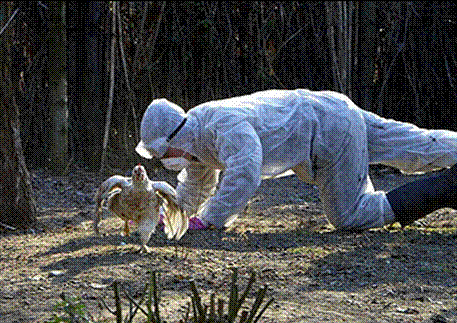
 PERSONNEL.
Producers and their employees should not have contact with other poultry, emus, ostriches, pigeons, caged birds or poultry manure from other farms in the 24 hours before arriving at the farm. Such contacts may result in the introduction of a serious disease onto the farm.
Farm employees should complete a personnel quarantine declaration.
PERSONNEL QUARANTINE DECLARATION FORM
(FARM EMPLOYEE)
I _______________________________________ hereby agree to abide by my employer’s
biosecurity rules and standards.
I understand that the following quarantine rules/standards apply:
• No avian species are to be kept at my place of residence without the knowledge of my employer – i.e. no poultry or birds of any type (e.g. ostriches, aviary birds, or pigeons).
• No untreated poultry manure from other farms is to be used at my place of residence.
• I will not visit poultry shows or poultry processing plants, unless approved by my employer and unless appropriate quarantine measures are taken.
Signature ____________________________________Date________________________
Residential Address________________________________________________________
Backyard flocks have the potential to introduce a number of diseases into a commercial flock, including Salmonella enteritidis, egg drop syndrome 76, infectious bursal disease, tuberculosis and Newcastle disease. Pigeons and cage birds are significant potential sources of psittacosis.
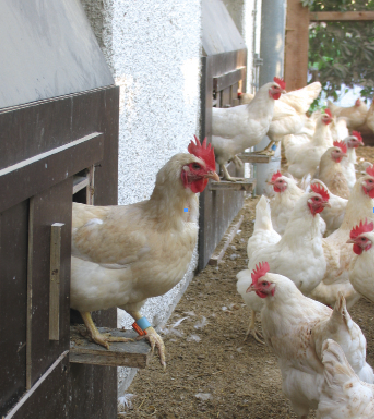 In the case of valued employees who have been working on the farm for some time and who keep caged birds at home, an acceptable alternative would be for these employees to shower and completely change their clothes before entering the shed.
The farm’s biosecurity must be evaluated in the context of the potential risk, and what risk the farmer is prepared to accept. The disease risk from a caged bird that has been with the household for some time and is housed in a secured area would, under most circumstances, be minimal. The presence of aviary birds on a property – if kept away from the house and serviced by other members of the family rather than the employee – may also be acceptable as a low risk.
Farm clothing, particularly boots, should not be worn off the farm; nor should street clothing be worn on the farm.
AIRBORNE INFECTION.
Very little can be done to mitigate the airborne spread of infection on most farms, apart from the original placement of a farm at a safe distance from other poultry enterprises, and the planting of trees and large shrubs to filter and block some of the airborne spread. Proper management of free range pastures could, however, reduce the airborne spread associated with dust.
Effective airborne spread of infections usually requires a large transmitting flock and a large receiving flock. Two elements mitigate the airborne risk to free range farms: their small size compared with conventional enterprises, and the fact that most free range enterprises are located in districts with a low-density poultry population.
HIGH RISK BIOSECURITY.
High risk biosecurity measures are recommended during outbreaks of significant diseases, such as Newcastle disease, avian influenza, virulent infectious bursal disease (IBD), Salmonella enteritidis, and egg drop syndrome 76.
In cases such as avian influenza, Newcastle disease and virulent IBD, specific designated risk areas will be declared, and biosecurity measures in these areas will be decided through consultation between governments and industry.
Farms outside the officially designated risk area are advised to upgrade their biosecurity to a higher level than normal.
Visits to the farm for any reason should be discontinued, unless absolutely necessary for the purpose of surveillance or emergency repairs. Any vehicle that must enter the farm should be thoroughly disinfected before entering.
Movement of birds, equipment and eggs between farms should cease.
Movement of manure off farms should be discontinued.
The above is recommended not only to stop potential disease spread but also to ensure that farms outside the designated risk areas do not become unnecessarily tangled in surveillance as part of movement trace operations.
Author.
George Arzey and Ian Littleton.