Description:

The Bergamasco is a breed of dog with its origins in the Italian Alps near Bergamo, where it was originally used as a herding dog.
Appearance:
The Bergamasco should be a medium size dog, well proportioned and harmonious having a rustic appearance. It is a solidly compact dog with a strong, powerful build that gives it great resistance without taking away any of its agility and speed of movement.
Coat and color:
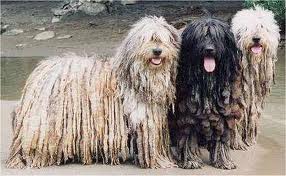
The breed’s most distinctive feature is the unusual felted coat, a normal and healthy characteristic of the breed. The coat is characterized by three types of hair; these are abundant, and form mats or flocks. The mats start from the spine and go down the flanks, growing every year to reach the ground. The color of the coat can be anything from an appearance of gray or silver gray (in fact a merle) to a mixture of black to coal, with brown shades also intermixed. These colors may have served as a camouflage when working in the mountains.
Bergamascos are born with short, smooth fur, which slowly develops the characteristic mats as the dog grows.
Origin:
The Bergamasco has ancient origins. In fact it comes from that stock of shepherds and cattle dogs that spread from the Orient to the Western world after migrations of the nomad populations and their herds. The exchange of the dogs took place when the sheep were sold. The progenitor of the Bergamasco Shepherd found its most suitable cradle in our country in the territory of the Alpine Arc, where sheep herding was much developed, and in the Po Basin of Piedmont and Lombardy, where they went for wintering. The Bergamasco was selected exclusively for its work aptitudes and for a long time its bloodlines were kept a secret by the shepherds.
Life Expectancy:
About 13-15 years.
Activities:
Bergamasco can compete in dog agility trials, obedience, showmanship, flyball, tracking, and herding events. Herding instincts and trainability can be measured at noncompetitive herding tests. Bergamasco exhibiting basic herding instincts can be trained to compete in herding trials.
Health:
Health information for this breed is sparse. The only health survey appears to be a 2004 UK Kennel Club survey, which had a sample size of 0 deceased dogs and 10 living dogs, far too few dogs from which to draw any conclusions.