 How can a new or upgraded cattle handling system improve safety and efficiency?
Every year there are a number of casualties to both men and cattle from working with faulty handling systems. These risks can be reduced through planning and designing a good handling system. Further more, an efficient handling system could cut down money spent on labour as well as saving time handling the cattle.
Risk factors when handling Beef Cattle
Professor Neel, Professor of Animal Science and Extension Beef Cattle Specialist at The University of Tennessee, warns that producers should be aware of the risk of injury when working with cattle, particularly if the facilities are not in a good state of repair.
In the field: cows with young calves or bulls can be a risk to the handler when carrying out tasks such as checking, herding and ear tagging young calves. Where possible more than one person should be present. When public rights of way cross the land, there is danger to the public, especially when walking dogs. After recent deaths and attacks on the public in the UK, farmers have been encouraged to put up signs giving a clear reminder to walkers using public footpaths: ‘Your dog can scare or harm farm animals - Keep it on a lead around livestock, but let go if chased by cattle.’
In the home pen: Threats include being kicked or knocked to the ground and subsequently trampled or being crushed. Use a handling system that allows maintenance to be performed from a passageway. Where possible Simon Turner, Alistair Lawrence and Basil Lowman, Scottish Agricultural College (SAC) recommend:
• minimising the need to enter the pen to perform maintenance tasks;
• having facilities which allow separation from the animal and handler;
• having protection from crushing;
• ensuring there are easy escape points.
Purposes/Benefits of a Good Handling System
A good handling system will increase performance, reduce labour expenses, improve safety and improve animal welfare.
Increase performance
Handling cattle correctly will reduce stress allowing them to perform better. Having adequate handling equipment (non-slip floors, no sharp corners) in place will also reduce injuries such as broken bones, bruises and cuts - all of which may reduce feed intake. Mr Ellington estimates that bruising costs the US cattle industry $22 million each year. Edward Penty, who supplies Squeeze-Crush cattle handling equipment, says that the squeeze crush enables the animal to be held fast in the crush, which reduces bruising and stress but also protects the farmer.
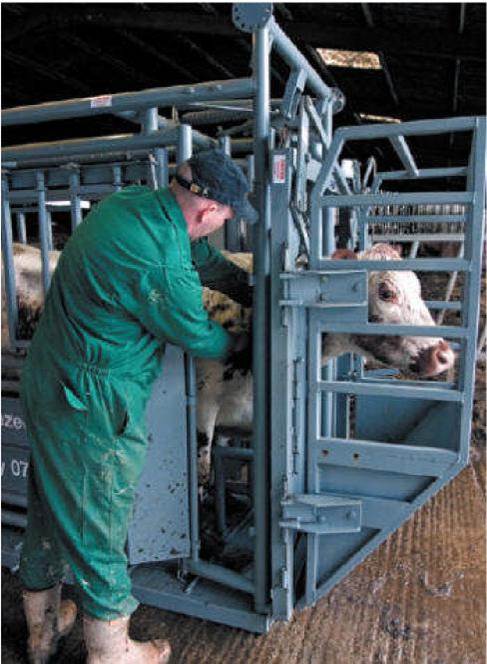
Squeeze-Crush Handler able to work on cattle safely.
A lack of proper facilities will make it difficult to effectively manage the herd. Adequate facilities can have huge benefits for a herd health plan. For example, if facilities are in place to restrain cattle correctly, dehorning and castrating can be carried out easily and efficiently. Vaccinations can also be administered allowing prevention of disease.
Reduce labour expenses
For smaller, medium sized herds having a well-designed handling facility may allow producers to work alone, reducing labour requirements. An efficient handling system will also allow easier movement and flow of animals, so less time will be spent chasing animals into pens or preventing them turning - reducing handlers stress! Mr Penty, says that Squeeze-Crush will save the producer time, for example when fostering on calves, the crush prevents the cow from kicking (which many standard crushes wouldn’t allow) and a small access gate allows the calf to easily access the teat, the farmer can then leave the cow and calf in confidence that both are safe and do other duties.
Improved safety
As already identified, there are a number of dangers to those working with cattle. A good handling system will protect the handler from crushing and falling by ensuring that cattle move calmly. It will also allow the handler safe access to work on the animal. Mr Penty, stresses that although Squeeze-Crush may be slightly more expensive than other handling facilities, many of his sales are too people who have been previously injured when working with cattle or who have staff insurance or health and safety issues to consider.



