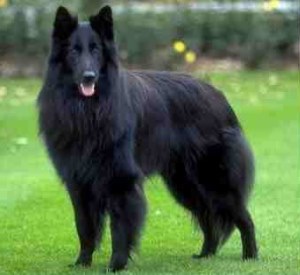
 The Belgian Shepherd (also known as the Belgian Sheepdog or Chien de Berger Belge) is a breed of medium-to-large-sized herding dog. It originated in Belgium and is similar to other sheep herding dogs from that region, including the Dutch Shepherd Dog, the German Shepherd Dog, the Briard and others. Four types have been identified by various registries as separate breeds or varieties: Groenendael, Laekenois, Tervuren, and Malinois.
Breed creation and recognition
In the late 1800s a group of concerned dog fanciers under the guidance of Prof. A. Reul of the Cureghem Veterinary Medical School gathered foundation stock from the areas around Tervuren, Groenendael, Malines, and Laeken in Belgium. Official breed creation occurred around 1891, when the Club du Chien de Berger Belge (Belgian Shepherd Dog Club) was formed in Brussels. The first breed standard was written in 1892, but official recognition did not happen until 1901, when the Royal Saint-Hubert Society Stud Book began registering Belgian Shepherd Dogs.
By 1910, fanciers managed to eliminate the most glaring faults and standardize type and temperament. There has been continued debate about acceptable colors and coat types. Structure, temperament and working ability have never been debated in regards to the standard.
Structure
The Belgian Shepherd Dog is a medium-to-large size dog. All varieties share a similar underlying musculoskeletal structure, closely resembling the popular German Shepherd breed save for the hindlegs. All variants also share a close cranial features, having a domed forehead, a long, square-cut muzzle and black noses with their ears pointed and fully erect. One of the identifying characteristics of the breed is that it is square, with its height from the ground to top of the withers being equal to its length.
Groenendael
The Groenendael is characterized by a long double coat in solid black. Fanciers consider that white marking are to be confined to a small patch on the chest (not to extend to the neck) and white toes. Coat texture is stiff, tight, and thick, developed to withstand the elements.
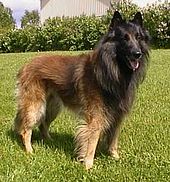 Tervuren
Like all Belgian Shepherds, the Tervuren is a medium-sized, square-proportioned dog in the sheepdog family. Males stand between 24 and 26 inches, and weigh approximately 65 pounds. Females are finer and smaller. It is recognized by its thick double coat, generally mahogany with varying degrees of black overlay (fanciers consider that completely missing overlay on males is a serious fault), including a black mask. A small patch of white on the chest is permissible by club standards, as well as white tips on toes. The Tervuren may also be sable or grey, but this may be penalised in the show ring in some countries according to the standard of the registering body.
Temperament
Belgian Shepherd Dogs are described as highly intelligent, alert, sensitive to everything going on around them and form very strong relationship bonds. They are said to be loyal, intelligent, fun, highly trainable and well suited to family life. They should receive plenty of socializing as puppies and will benefit from regular activity and close interaction with people throughout their lifespan. Their herding heritage gives them a comparatively high energy level, and mental as well as physical exercise is necessary to keep a Belgian happy and healthy.
Belgian Shepherds do well in sports such as obedience training and dog agility. They are used as assistance and search and rescue dogs, as well as police, military and narcotics dogs.
Health
There have been few health surveys of the individual Belgian Shepherd varieties. The UK Kennel Club conducted a 2004 health survey of all Belgian Shepherd varieties combined. The Belgian Sheepdog (=Groenendael) Club of America Health Committee has a health registry questionnaire, but it is not clear whether or when results will be reported. The American Belgian Tervuren Club conducted health surveys in 1998 and 2003. Only the 2003 report included longevity information.