Introduction
Beeswax has been used for many purposes, including the manufacture of comb foundation, as a base for cosmetics (particularly lipsticks and face creams), candles, as a waterproofing agent, and as a base for polish. An unusual use for a beeswax-based polish occurred during World War II when hundreds of thousands of kilograms were used for polishing metal aeroplanes, coating shells, waterproofing ignition apparatus, and coating canvas tents. A more traditional use of beeswax is in a polish for wood — one of the oldest wood polishes known is made of beeswax and turpentine.
Commercial waxes may be divided into three groups:
- Animal wax, of which beeswax is the most familiar product
- Mineral wax, including paraffin, a by-product of petroleum
- Vegetable wax, including a wide variety of substances scraped from leaves or obtained from plants in other ways.
Beeswax is exuded as a glandular secretion from the lower abdomen of worker bees. It is a fatty acid composed of 16% hydrocarbons, 31% straight chain monohydric alcohols, 3% diols, 31% acids, 13% hydroxy acids, and 6% other substances. The oxidation of beeswax is so slow as to be negligible – pieces taken from Egyptian tombs have been still pliable. Beeswax washed ashore from wrecks and long buried on ocean beaches has been reclaimed, none the worse for wear. Beeswax has a specific gravity of 0.960–0.972 at 15OC, and a melting point of 62O–66OC. For its ductility, it has the highest melting point of any wax known. It is a non-crystalline wax, impervious to moisture. It binds well into a solvent and is by far the best wax for forming an emulsion. It gives a soft, satiny sheen to wood.
Recipes for Beeswax Polish
There are a number of recipes for polishes with beeswax as their major ingredient. The final product can be a liquid, cream/paste or a solid block depending on the proportions of each ingredient. The exact proportions in each recipe mentioned are not critical. Vary the amounts of each ingredient to suit yourself. Remember, the more solvent you add, the more liquid will be the final product.
Mixing the ingredients
Warning. Wax is highly flammable. Do not heat it over a direct flame. Use a couple of old pots or saucepans, one inside the other. Partly fill the larger pot with water and place the smaller pot in this water bath. This prevents the ingredients from overheating. In case of fire, do not try to extinguish it with water. Use sand, a large damp cloth or a fire extinguisher. If the beeswax is not clean then it may be necessary to heat the wax to 70O–75OC and pass this solution through a fine filter. Coarse filter paper is satisfactory as is a piece of fine cloth. All the ingredients listed should be obtainable from woodcraft suppliers.
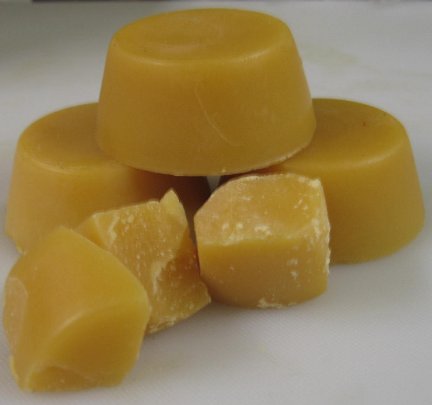
Blocks of Beeswax
Liquid beeswax furniture polish
To make liquid beeswax furniture polish you will need the following ingredients:
- 50 g pure soap flakes
- 100 g beeswax
- 500 mL turpentine
- 250 mL water
Dissolve the soap in the warm water in one pan, put the shaved wax into the turpentine in another pan and warm gently until the wax is thoroughly melted and dissolved. Then pour the soap mixture into the turpentine, stirring with a wooden stick. When dissolved and well mixed, pour into the storage jars. When mixing ingredients ensure they are of the same temperature.
Cream or paste beeswax furniture polish
This recipe is simply a mixture of beeswax and a suitable solvent. The less solvent used, the more stiff the mixture. The traditional solvent is pure turpentine and this gives to beeswax polish the scent reminiscent of gleaming old mahogany. The solvent can be replaced by mineral turps or white spirit. Use:
- 100 g beeswax
- 250 mL solvent
Heat solvent in a pan and the beeswax in a separate pan to the same temperature. Pour solvent into wax and stir thoroughly. Pour into prepared containers.
Pine oil beeswax furniture polish
Another recipe adding soap and pine oil can give a far more liquid cream product with a distinctive aroma. Use:
- 100 g beeswax
- 250 mL solvent
- 50 g pure soap flakes
- 150 mL warm water
- 50 mL pine oil
Dissolve the soap in the warm water and mix well. Set aside to cool. Mix the beeswax and solvent as described above. Allow to cool. When both are cool, mix the pine oil, beeswax/solvent and soap/water together. If you have difficulty in mixing, heat slightly.
Solid beeswax furniture polish
Use equal parts of:
- beeswax
- turpentine
- linseed oil
Heat the beeswax and add warm turpentine and linseed oil. Stir thoroughly. If this mixture is not solid enough, then either decrease the quantity of turpentine or linseed oil or increase the quantity of beeswax.
Solid furniture polish
- 100 g Carnauba wax
- 300 g beeswax
- 400 mL turpentine
Melt the Carnauba wax and the beeswax together, heating to 85O–90OC. Carnauba wax can be added to any of the previous recipes in small proportions to give great hardness with a high gloss finish. With the addition of Carnauba wax, the slightly tacky feel of beeswax is removed. Note: Carnauba wax, with a melting point of 83O–86OC, is the world’s hardest known wax. It has the unique quality of being able to harden other waxes when added in small quantities. It is extracted from the leaves of a palm tree which flourishes in Brazil.
Containers for Polish
Some plastics can be used to contain the various preparations or mould the solid polishes. Open glass jars are suitable for containing the liquids, creams and paste preparations. Avoid tins. With time a tin will corrode and detract from the preparation. Thoroughly wash all containers to be used in very hot water.
Applying Polish to Wood
Lathe application
Apply wax in the hard form by wrapping a piece of cloth around it and holding it against the revolving work. Friction will melt the wax and spread it evenly over the surface. Buff lightly with a soft cloth.
Normal application
Apply polish in a paste or cream form with a soft cloth. Buff to a high lustre.
Author
Doug Somerville District Livestock Officer (Apiculture) Goulburn


