 Puberty is defined in heifers as the time when they first ovulate and show an oestrous or heat period. The process involves sensitivity to hormones and receptors in the brain (specifically the hypothalamus) and the ovaries in females.
Heifers born early in the calving seasons are usually heavier at weaning and reach puberty earlier than heifers born late in the calving season. Heifers must reach puberty by 13-14 months of age to calve as two-year-olds. Puberty is influenced by age, weight and breed.
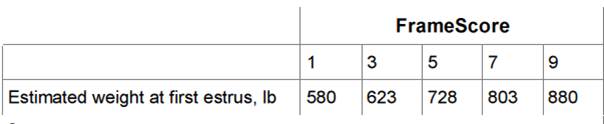
Yearling beef heifers conceiving early in their first breeding season, will have increased lifetime production and efficiency. It is critical that these heifers attain enough weight to initiate their first estrous cycle before the onset of the breeding season. Puberty occurs when heifers reach about 65-67% of their mature weight. Montana research indicates that conception rate is higher on the third oestrous compared to the first. Getting heifers to target weights a month prior to the breeding season may increase the percentage conceiving early in the breeding season. The following weights should be attained for puberty about a month prior to breeding.
Relationship of frame score to estimated weight at first oestrous.
Puberty
Individual Weights vs. Group Weights: Individual weights rather than group weights should be considered for replacement heifers. If a group of similar breed-type heifers averages 650 pounds, that may mean some only weigh 500 pounds and are not ready for breeding. Heifers born in a short calving season should be relatively uniform in weight and would not need to be fed in different groups to reach the desired weight. North Dakota data suggests that deworming can improve uniformity of performance.
Scrotal Circumference
Research shows that bulls with a larger scrotal circumference tend to sire heifers that reach puberty at an earlier age than bulls with a smaller scrotal circumference. In those breeds that have a scrotal circumference EPD, breeder should use them to improve age at puberty.
Breed
Numerous studies have reported both between-breed and within-breed differences in age and weight at puberty as well as subsequent reproduction in beef cattle. To achieve optimum production levels, it is important to know the relationships between puberty traits and measures of productivity for effective use of selection, heterosis and complimentarity. Breed differences, sire and dam effects within a breed, and heterosis, or hybrid vigor, contribute to genetic control of age at puberty.



