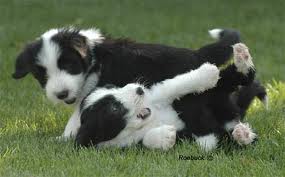
These dogs ARE ACTIVE AND OUTGOING DOGS TO LOVE .
The Bearded Collie, or Beardie, is a herding breed of dog once used primarily by Scottish shepherds, but now mostly a popular family companion.
Bearded Collies have an average weight of 40–60 pounds (18–27 kg). Males are around 21–22 inches (53–56 cm) tall at the withers while females are around 20–21 inches (51–53 cm) tall.
As pets
The Bearded Collie ranks 104 out of 155 breeds in popularity in the United States, according to the American Kennel Club’s yearly breed ranking. A Bearded Collie is best obtained from a reputable breeder or a dog rescue. Bearded Collies make excellent pets for those willing to accommodate their high energy level and grooming requirements. Weekly brushing is mandatory for keeping their long hair mat-free. Some Bearded Collie owners opt to keep their pets in a “puppy cut” haircut, which reduces (but does not eliminate) the need for brushing. Bearded Collies are an energetic breed, originally intended to work in the Scottish Highlands herding sheep; they also excel at dog agility trials. A loyal and family-friendly dog, the Beardie can add years of pet-ownership enjoyment to the home. They have keen problem-solving abilities, and are entertaining to watch.
Female Beardies are often more outgoing and headstrong than males. In training, males are more likely to follow instructions and females are more independent. Females often become the alpha dog if there is a male and female Beardie in the household. Regardless of the Beardie’s sex, they are a very active breed. One of the most common problems for new Beardie owners is the breed’s advanced age of maturity; standard puppy issues last longer, and Beardies frequently fail “puppy school” if entered at the same age as other breeds.
Adopting a Beardie should be done through an authorised breeder. The pup’s parents should have pedigree papers. There are Beardie rescue associations, such as Beardie Collie Rescue and “Rescue Me”. These organisations attempt to place unwanted puppies and dogs into appropriate, loving homes.
Working life
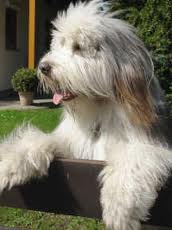
The Bearded Collie is used to herd both sheep and cattle. It is essentially a working dog—bred to be hardy and reliable, able to stand up to the harshest conditions and the toughest sheep. The working Bearded Collie has become less common in the last few decades and might have died out; however, thanks to the efforts of a few shepherds like Tom Muirhead and Peter Wood (and breeders like Brian Plummer) the “working Beardie” has survived and is becoming more popular. It has been exported to Australia and the United States, and finds favour among those looking for an independent and intelligent sheepdog. The Working Bearded Collie Society’s mission is to preserve the working abilities of non-registered working dogs from “bearded” ancestors. The website Shepherds with beardies has much valuable information on the small population of working Beardies.
The KC-registered Bearded Collie has fallen into disfavour with the shepherds of Wales, Scotland and elsewhere because of the show-breeding community’s lack of interest in producing “hardy and reliable” animals; show-bred lines tend to develop excessive coats, in particular. However, in some countries (notably Sweden and the United States) herding programmes have been developed for the breed. The breed organisations in those countries now actively encourage breeders to emphasise qualities other than appearance.
The Bearded Collie may have earned its nickname “bouncing Beardie” because the dogs would work in thick underbrush on hillsides; they would bounce to catch sight of the sheep. Beardies also have a characteristic way of facing a stubborn ewe, barking and bouncing on the forelegs. Whatever the reason, a typical Bearded Collie is an enthusiastic herding dog which requires structure and care; it moves stock with body, bark and bounce as required. Very few Beardies show “eye” when working; most are upright.
Herding instincts and tractability can be assessed in noncompetitive herding tests. Beardies exhibiting basic herding instincts can be trained to compete in herding trials.