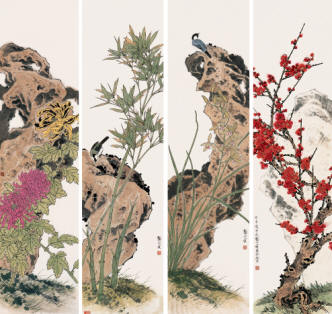
The Four Gentlemen
Bamboo’s long life makes it a Chinese symbol of longevity, while in India it is a symbol of friendship. The rarity of its blossoming has led to the flowers’ being regarded as a sign of impending famine. This may be due to rats feeding upon the profusion of flowers, then multiplying and destroying a large part of the local food supply.
The most recent flowering began in May 2006 . Bamboo is said to bloom in this manner only about every 50 years .
In Chinese culture, the bamboo, plum blossom, orchid, and chrysanthemum (often known as méi lán zhú jú ) are collectively referred to as the Four Gentlemen. These four plants also represent the four seasons and, in Confucian ideology, four aspects of the junzi (“prince” or “noble one”). The pine tree, the bamboo, and the plum blossom (sang zhú méi ) are also admired for their perseverance under harsh conditions, and are together known as the “Three Friends in Winter” ( suì hán san yau). The “Three Friends” is traditionally used as a system of ranking in Japan, for example in sushi sets or accommodations at a traditional Ryokan (inn). Pine (matsu ) is of the first rank, bamboo (také ) is of second rank, and plum (ume ) is of the third.
In Japan, a bamboo forest sometimes surrounds a Shinto shrine as part of a sacred barrier against evil. Many Buddhist temples also have bamboo groves. In northern Indian state of Assam, the fermented bamboo paste known as khorisa is known locally as a folk remedy for the treatment of impotence, infertility, and menstrual pains.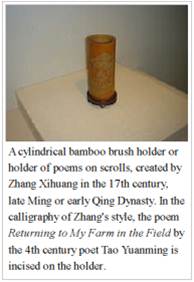
Bamboo plays an important part of the culture of Vietnam. Bamboo symbolizes the spirit of Vovinam (a Vietnamese martial arts):. Bamboo also symbolizes the Vietnamese hometown and Vietnamese soul: the gentleman like, straightforwardness, hard working, optimism, unity and adaptableness. A Vietnamese proverb says: “When the bamboo is old, the bamboo sprouts appear”, the meaning being Vietnam will never be annihilated; if the previous generation dies, the children take their place. Therefore the Vietnam nation and Vietnamese value will be maintained and developed eternally.
Traditional Vietnamese villages are surrounded by thick bamboo hedges. The ethnic group known as the Bozo of West Africa, take their name from the Bambara phrase bo-so, which means “bamboo house”.
The Song Dynasty (960-1279 AD) Chinese scientist and polymath Shen Kuo (1031–1095) used the evidence of underground petrified bamboo found in the dry northern climate of Yan’an, Shanbei region, Shaanxi province to support his geological theory of gradual climate change.
Other Cultures
The bamboo is the national plant of St. Lucia.
Myths and legends
Several Asian cultures, including that of the Andaman Islands, believe that humanity emerged from a bamboo stem. In the Philippine creation myth, legend tells that the first man and the first woman each emerged from split bamboo stems on an island created after the battle of the elemental forces (Sky and Ocean). In Malaysian legends a similar story includes a man who dreams of a beautiful woman while sleeping under a bamboo plant; he wakes up and breaks the bamboo stem, discovering the woman inside.
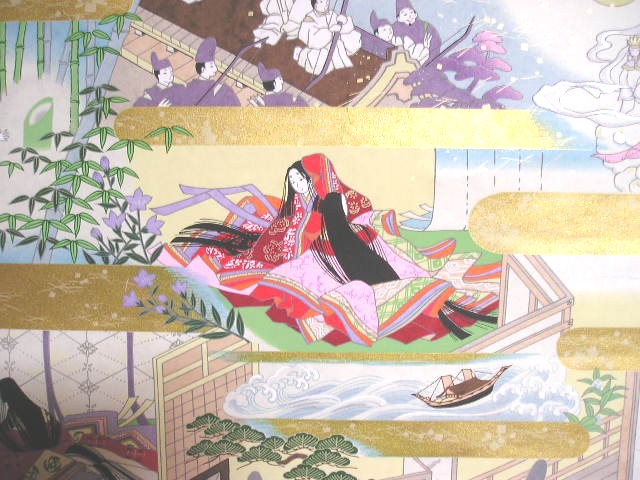
Japanese tapestry of The Tale of the Bamboo Cutter.
The Japanese folktale “Tale of the Bamboo Cutter” (Taketori Monogatari) tells of a princess from the Moon emerging from a shining bamboo section. Hawaiian bamboo (‘ohe) is a kinolau or body form of the Polynesian creator god Kane.
Bamboo cane is also the weapon of Vietnamese legendary hero Saint Giong- who had grown up immediately and magically since the age of 3 years old because of his national liberating wish against Ân invaders. An ancient Vietnamese legend (The Hundred-knot Bamboo Tree) tells of a poor, young farmer who fell in love with his landlord’s beautiful daughter. The farmer asked the landlord for his daughter’s hand in marriage, but the proud landlord would not allow her to be bound in marriage to a poor farmer. The landlord decided to foil the marriage with an impossible deal; the farmer must bring him a “bamboo tree of one-hundred nodes”. But Buddha appeared to the farmer and told him that such a tree could be made from one-hundred nodes from several different trees. Budda gave to him four magic words to attach the many nodes of bamboo: “Khac nhap, khac xuat”, which means “joined together immediately, fell apart immediately”. The triumphant farmer returned to the landlord and demanded his daughter. Curious to see such a long bamboo, the landlord was magically joined to the bamboo when he touched it as the young farmer said the first two magic words. The story ends with the happy marriage of the farmer and the landlord’s daughter after the landlord agreed to the marriage and asked to be separated from the bamboo.
In China, there is a legend that the Emperor Yao gave two of his daughters as a test for his potential to rule to the future Emperor Shun. Shun passed the test of being able to run his household with the two emperor’s daughters as wives, and thus Yao made Shun his successors, bypassing his unworthy son. Later Shun drowned in the Xiang River. The tears that his two bereaved wives let fall upon the bamboos growing there explains the origin of spotted bamboo. The two women later became goddesses.
Bamboo as a writing surface
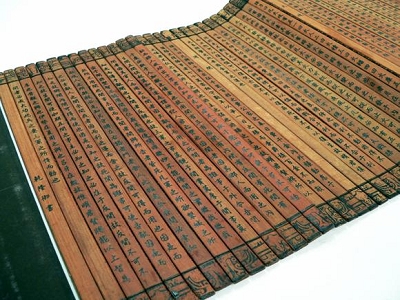
Bamboo writing strips
Bamboo was in widespread use in early China as a medium for written documents. The earliest surviving examples of such documents, written in ink on string-bound bundles of bamboo strips (or “slips”), date from the 5th c. BC during the Warring States period. However, references in earlier texts surviving on other media make it clear that some precursor of these Warring States period bamboo slips was in use as early as the late Shang period (from about 1250 BC).
Bamboo or wooden strips were the standard writing material during the Han dynasty and excavated examples have been found in abundance.
Subsequently, paper began to displace bamboo and wooden strips from mainstream uses, and by the 4th c. AD bamboo had been largely abandoned as a medium for writing in China. Several paper industries are surviving on Bamboo forests. Ballarpur (Chandrapur, Maharstra) paper mills uses bamboo for paper production.
Bamboo as a weapon
 Bamboo is used in several East Asian and South Asian martial arts.
- In the ancient Tamil martial art of Silambam, fighters would hit each other rapidly with bamboo sticks.
- In the Japanese martial art Kendo, bamboo is used to make the Shinai sword.
- A bamboo stick can be made into a simple spear by sharpening one of the ends
- Archery longbow and recurve bow limbs are commonly crafted with flat ground bamboo, and make superior weapons for bowhunting and target archery.