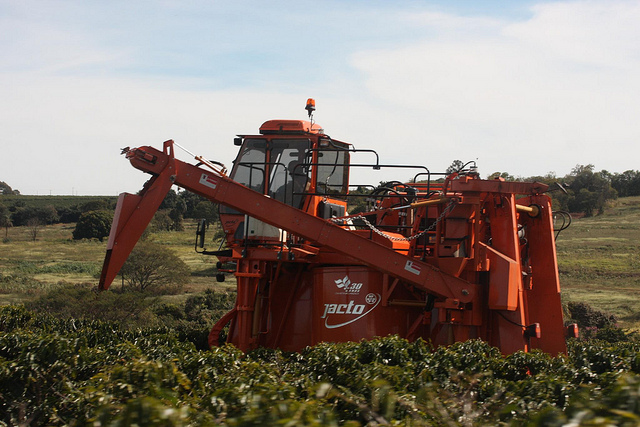
Coffee Harvester
Pre-Harvest Strategies
To maximise cherry recovery and minimise negative effects of harvesting on coffee trees, a number of pre-harvest operations are worthwhile. These aim to condition the trees (usually by manipulating fruit removal force or maturity profile) to enhance the operation of the harvester.
Irrigation
Local experience and Hawaiian research have found that cherry is easier to remove following rain. Rain or irrigation one or two days before harvest improves cherry removal and harvester selectivity, which can reduce tree damage and leaf loss.
Ripening agents
Australian and Hawaiian researchers have trialled the ripening agent ethephon. In Hawaii low rates of Ethrel® (ethephon @ 100 to 200 ppm) reduced FRF of red cherry by 25% and increased selectivity of mechanical harvesting. Recent trials in Australia have shown a worthwhile increase in prime cherry recovery by using low rates of Ethephon, provided cherry development on the tree is reasonably uniform.
Ethrel should not be used if any of the cherry is still immature. Ripening immature cherry prematurely may adversely effect liquor quality. Ethrel has sometimes given variable results, often including defoliation, when used at higher rates. It is not yet commercially recommended. To evaluate Ethrel on-farm, apply it at low rates to a small part of the plantation six weeks before the anticipated final harvester pass.
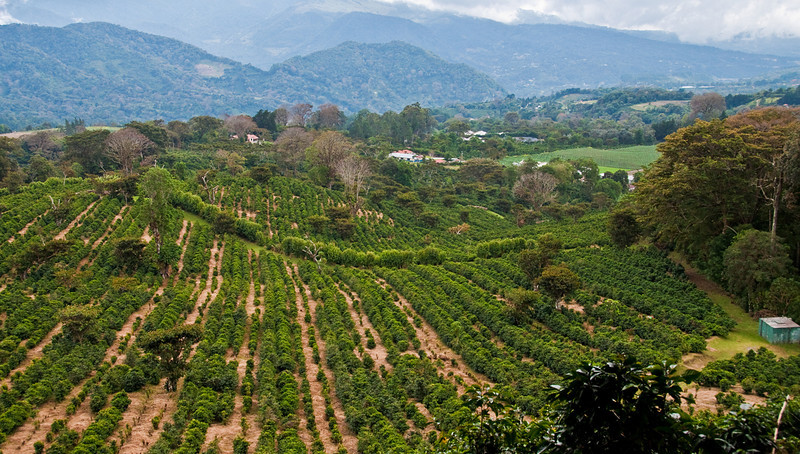
Panama coffee plantation
Multiple passes
Accelerated ripening occurs in cherry remaining on the tree after the first harvester pass. The accelerated ripening allows higher cherry recovery and less tree damage in subsequent passes.
Harvester Damage to Trees
When correctly adjusted and driven by a semi-skilled operator, harvesters cause very little tree damage compared with hand-picking where tops are often pulled over to access cherry and are often broken.
Leaf removal
The main adverse effect of machine-harvesting is removal of leaves. The amount of leaf removal is determined by the vibration frequency of the shakers, the cultivar and plant health at the time of harvest. Usually, only older leaves are removed and leaf loss is typically less than 15% per pass.
Losses can be more serious if trees are water-stressed at harvest or in poor health. Semi-dwarf and dwarf cultivars appear to hold leaves more strongly than tall varieties in periods of stress and appear to recover more quickly from leaf loss. Extra nitrogen applied just before harvest has improved leaf retention on machine-harvested plants.
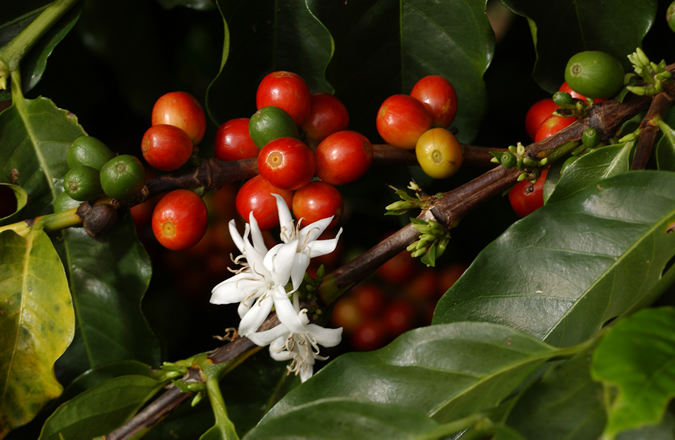
Havesting is usually completed well before buds become a problem
Ringbarking
Partial ringbarking of upright trunks can occur where finger contact occurs. The damage is more noticeable if aggressive shaker settings at low forward speeds are being used to remove cherry. No long term negative effect has been observed from typical levels of injury, but the ringbarked area could be a point of entry for fungal and bacterial disease. If severe ringbarking occurs, some suckering may occur below the site, particularly if leaf loss has been severe.
Bud removal
Flower buds in advanced stages are easily removed by finger contact so machine-harvesting should not occur when flower buds are in this stage. Harvesting after the pinheads have formed is not considered to be a problem. Harvesting is usually completed well before interference with flower buds becomes a problem.
Source
Chris Norris