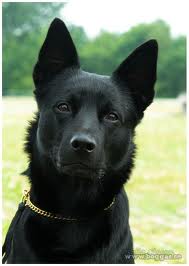
 The Kelpie is an Australian sheep dog successful at mustering and droving with little or no command guidance. They are medium-sized dogs and come in a variety of colours. Kelpies have been exported throughout the world and are used to muster livestock, primarily sheep, cattle and goats.
The breed has been separated into two distinct varieties: the show or bench Kelpie and the working Kelpie. The show Kelpie is seen at conformation dog shows in some countries and is selected for appearance rather than working instinct. Working Kelpies are bred for working ability rather than appearance.
Appearance
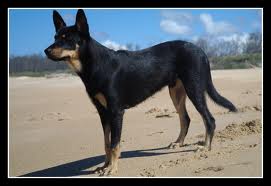
The variety of colouration and coat types puts the Kelpie in a select group, as it is not possible to look at an unidentified dog and classify it as a Kelpie. Kelpies referred to as Red Cloud Kelpies have red features with white markings on the face, chest, and feet.
Breed standards
In Australia, there are two separate registries for Kelpies. Working Kelpies are registered with the Working Kelpie Council (WKC), which is the primary authority on the breed standard, and/or the State Sheepdog Workers Association. The WKC encourages breeding for working ability, and allows a wide variety of coat colours. The wide standards allowed by the WKC mean that Working Kelpies do not meet the standard for showing. Show Kelpies are registered with the Australian National Kennel Council, which encourages breeding for a certain appearance and limits acceptable colours. Only Show Kelpies may be shown in Australia.
Working Kelpies
The working Kelpie comes in three coat types: smooth, short, and rough. The coat can be almost every colour from black through light tan or cream. Some Kelpies have a white blaze on the chest, and a few have white points. Kelpies sometimes have a double coat, which sheds out in spring in temperate climates. Agouti is not unusual, and can look like a double coat.
Working Kelpies stand about 50 centimetres (19.5 inches) at the withers for females, 55 centimetres (21.5 inches) for males, and weigh between 14 and 21 kilograms (31-46 pounds). Ears are pricked, but some dogs have one or both ears flopped; the tail will often follow the coat type, and will vary betw
een smooth and bushy. The dog’s working ability is unrelated to appearance, so stockmen looking for capable working dogs disregard the dog’s appearance.
A working Kelpie can be a cheap and efficient worker that can save farmers and graziers the cost of several hands when mustering livestock. The good working Kelpies are heading dogs that will prevent stock from moving away from the stockman. This natural instinct is crucial when mustering stock in isolated gorge country, where a good dog will silently move ahead of the stockman and block up the stock (usually cattle) until the rider appears. The preferred dogs for cattle work are Kelpies, often of a special line, or a Kelpie cross. They will drive a mob of livestock long distances in extremes of climates and conditions. Kelpies have natural instincts for managing livestock. They will work sheep, cattle, goats, pigs, poultry, and other domestic livestock. The Kelpie’s signature move is to jump on the backs of sheep and walk across the tops of the sheep to reach the other side and break up the jam. A good working Kelpie is a versatile dog—they can work all day on the farm, ranch, or station, and trial on the weekends. Kelpies compete and are exhibited in livestock working trials, ranging from yards or arenas to large open fields working sheep, goats, cattle, or ducks.
Herding instincts and trainability can be measured when introduced to livestock or at non-competitive herding tests. Kelpies exhibiting basic herding instincts can be trained to compete in herding trials.
 Health
Kelpies are a hardy breed with few health problems, but they are susceptible to disorders common to all breeds, like cryptorchidism, hip dysplasia, cerebellar abiotrophy and luxating patella. Current research is underway to find the genetic marker for cerebellar abiotrophy in the breed.
History
Sign at Ardlethan, New South Wales, claiming the town as “The home of the Kelpie”
The ancestors of the Kelpie were simply (black) dogs, called Colleys or Collies. The word “collie” has the same root as “coal” and “collier (ship)”. Some of these collies were imported to Australia for stock work in the early 19th century, and were bred to other types of dogs (possibly including the occasional Dingo), but always with an eye to working sheep without direct supervision. Today’s Collie breeds were not formed until about ten or 15 years after the Kelpie was established as a breed, with the first official Border Collie not brought to Australia until after Federation in 1901.