Coffee Planting in Australia:
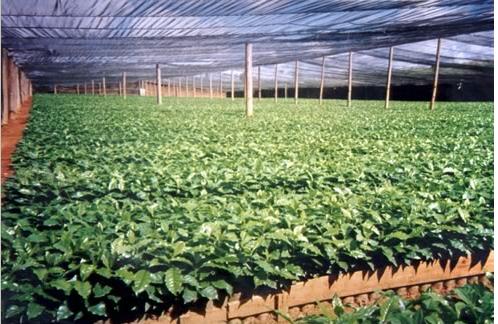
When planting time approaches (five months after site preparation) the mounds will be well covered by grass and/or ground cover.
In January, a month before planting;
Spray a non-residual herbicide such as glyphosate, 50 cm each side of the planting line to kill off this cover.
To facilitate planting, particularly if using a mechanical planter, rotary hoe the metre-wide strip to chop up vegetative matter which can interfere with planting machinery.
The soil should still be friable from the mounding operation, but if it is compacted you can rip the planting row 30 to 50 cm deep.
In shallow soils deep ripping is strongly recommended to avoid soil compaction.
Planting depth is critical with coffee;
Planting too deeply will cause bark damage while shallow planting will allow plants to fall over.
Plant the trees so that the soil is at the same level as the top of the planting mix in the cell.
Compact the soil around the young plant to ensure close contact of soil with the roots and to remove air pockets. It is also important that this compaction is not so severe that it will bend or distort the root system.
Even though planting is done in the wet season, watering in plants immediately after planting, particularly bare-rooted seedlings, is essential for successful establishment.
Occasionally plant positions will be missed by the mechanical planter or some may fail to establish. It is important to check the planted rows as soon as practicable after planting and plant the missing trees manually.
Irrigation:
Recommended irrigation systems for coffee vary, depending on site requirements,farm size, climate and water supply;

Overhead irrigation system
Any irrigation system must be flexible enough to allow different cultivars to be irrigated differently.
Large, tall trees require more water than dwarf trees.
Early maturing cultivars require earlier water-stressing and rewatering to synchronise flowering than late maturing cultivars.
In Australia growers have had experience with three types of irrigation systems and each has its advantages and disadvantages.
Advantages of Overhead Irrigation systems:
Overhead or solid set systems are permanent and provide overhead sprinkler irrigation every four to five rows of coffee. These systems are low maintenance and have been used in areas with temperature extremes.
In frostprone areas the systems can be designed to irrigate the plantation to reduce the frost hazard, while in times of high temperatures, overhead irrigation can be used to reduce plant stress.
These systems are ideal for establishing coffee and cover crops between the rows. Other advantages include being able to water in fertiliser, and trigger good flowering.
The major disadvantages of overhead irrigation:
During cherry ripening can cause high levels of cherry drop and may reduce the final yield by 30% to 40%.
As well, the system is expensive to install and set up; is susceptible to interference by wind, resulting in uneven irrigation; and requires much more water than drip or microjet systems.
The sprinklers can be blocked by tall trees; inter-row grass covers require more frequent mowing; and the risers and main lines get in the way of harvesting and other operations.
Drip and microjet system advantages:

Drip irrigation system
Drip and microjet systems are permanent and provide irrigation directly to the roots of the coffee trees. The foliage and cherry remain dry, reducing disease problems and cherry drop. These systems are ideal where irrigation needs to be closely monitored. Irrigation can be varied to manage the stress on the coffee trees either to promote flowering or facilitate harvesting. Fertilisers can be easily injected into the irrigation water for ready uptake by the trees. These irrigation systems use water efficiently, are cheaper to set up than overhead irrigation, and do not get in the way of farm machinery operations.
However some of the problems encountered using Drip and Macrojet systems are;
They do require high quality water and efficient filtration to prevent blockages. Chlorine is regularly injected into the system to prevent algal build-up. Drip irrigation is installed on top of the ground and damage from ants, rodents and machinery is common.
Soil moisture must be regularly monitored to ensure that trees receive adequate water, particularly in sandy soils. It is difficult to detect operating problems in these systems. As well, they offer no frost control, and are slower to apply high volumes of water to trigger flowering.
Lateral moving systems advantages and disadvantages:
Lateral moving irrigators have been used on large plantations. These moveable systems can provide large quantities of water over short periods of time, need little maintenance and have comparatively low running costs.
A major limitation shared with other overhead systems is the large level of cherry drop caused by irrigation during cherry ripening.
Unlike overhead systems, lateral moving systems cannot control temperature extremes as they usually require several days to pass over the plantation. They are also expensive to set up and don’t have the exact control over irrigation that drip and microjet systems offer. Otherwise the advantages and disadvantages of these systems are similar to those of overhead irrigation.