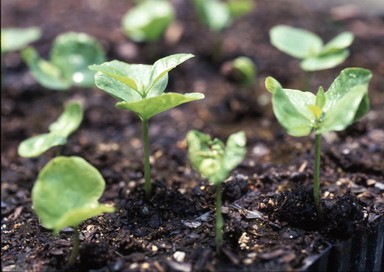
Transplant seedlings before they've reached the "butterfly" stage
A supply of good quality plants at the right time of year is essential for establishing a successful coffee plantation. This involves knowing when to establish the nursery, selection of good seed, and proper nursery maintenance.
Establishing a Nursery:
The target date for field planting in northern New South Wales is February/March when soil moisture, temperature and cloud cover conditions are generally ideal for seedling establishment. Planting in spring or early summer is not recommended unless the site is protected from hot, drying winds and strong sunlight, and irrigation is available. Experience in northern New South Wales has shown that seedlings do not establish as well if planted later than the end of March when cooler nights and slower growing conditions prevail.
In the hotter climate of North Queensland, late autumn (May) and early spring (September) plantings have also been successful with good irrigation.
In northern New South Wales seedlings can be planted earlier than February/March with irrigation, but experience has shown it is difficult to have seedlings ready before this time, even when rapid germination and growing-on techniques are used.
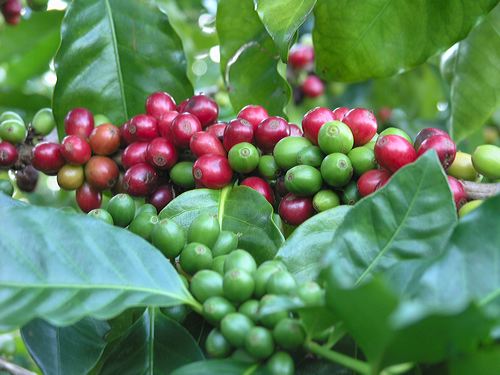
Use cherries from high yield plants when propogating seedlings
Fresh seed is available in North Queensland from June to September and in northern New South Wales from July to October. Traditional seed-raising and nursery practices take 12 months from germination to field planting, making it impossible to meet the February/March planting target. However, there are ‘fast-tracking’ techniques which use bottom heat to germinate seed and produce potted nursery plants under controlled temperature and light conditions by February/March, that is, in six to eight months.
Seed selection:
Arabica cultivars are predominantly self-pollinated, so seedlings are uniform and will remain true to the parent tree. Take cherry from high yielding trees, pulp, ferment and wash. Air-dry the seed under shade, not in direct sun. If the seed is to be used immediately, skip the drying process and plant seed after washing. Reject small, damaged or misshapen seeds.
Coffee seed loses its viability in two to three months if not stored under controlled temperature and moisture conditions. It can be stored for six months when dried to 40% moisture and kept at 15°C (Van der Vossen, 1979; Clarke and Macrae, 1985). Experience has shown a germination rate of over 90% is commercially achievable from fresh seed.
As a rough guide there are 2000 seeds in a kilogram of fresh washed coffee and up to 4000 seeds in a kilogram of dried parchment coffee. When calculating the number of seedlings required for planting, add an extra 25% to have enough plants to replace seedlings which die.
Germination:
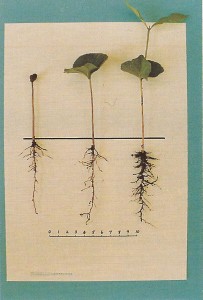
Coffee seed germination and early seedling growth
Successful quick germination has been achieved by planting fresh seeds one centimetre apart in heated (28°C) germination beds containing washed river sand, vermiculite and perlite in equal parts. Standard polystyrene fruit trays 15 cm deep, each holding about 200 to 500 seeds, are also ideal. Bottom heat can be provided by running heating cables underneath the trays. Spread seed on the surface of the sand, vermiculite and perlite mix, and cover with the mix no deeper than one centimetre. The seed does not have to be oriented in any particular way. Place a single layer of hessian on top of the tray and keep it moist to maintain adequate moisture for germination.
Avoid overwatering as this can result in damping off in seedlings. Remove the hessian when the seeds begin to germinate. Avoid direct sun during germination. Best results are produced under 50% shade cloth.
Coffee seed is slow to germinate. Germination takes three to four weeks under ideal conditions and a further two to three weeks before seed leaves (cotyledons) have fully emerged (butterfly stage) and seedlings are ready to transplant into nursery cells. Seedlings emerge with the seed coat intact. The seed coat then splits and the leaves appear. Under non-heated winter conditions, up to ten weeks may elapse before seeds germinate.
Transplant seedlings before they have passed the butterfly stage and developed extended taproots. To transplant, lift seedlings from the trays using a fork under the root system. There should be no damage to the root system if the seedling mix is light and open. Minimising disturbance of roots is important to reduce transplanting shock and gain successful establishment and quick growth. Plant each seedling into a nursery cell. There are several nursery cell systems available which are suitable for growing-on of coffee seedlings. Bare-rooted plants do not establish as successfully in the field as container-grown seedlings.