Australia has one of the richest collections of freshwater crayfish in the world. All of our species belong to the family Parastacidae, which is found in Australia, New Guinea, New Zealand, Madagascar and South America.
Our freshwater crayfish range from the largest to some of the smallest in existence. The giant Tasmanian crayfish (Astacopis gouldii) grown to 6.3 kg and the Murray River crayfish (Euastacus armatus) grows to 2.7 kg. These species and spiny crayfishes in general, are considered to have little aquaculture potential because of their slow growth and low meat yield.
Three species of the genus Cherax are considered to have aquaculture potential. These are the yabby (Cherax destructor), which is found throughout much of New South Wales, Victoria, South Australia and Queensland; the marron (C. tenuimanus), which is native to south west Western Australia; and the redclaw (C. quadricarinatus), which is native to northern Queensland and the Northern Territory.
This information compares the potential of the two Cherax species for semi-intensive aquaculture within New South Wales yabby and redclaw.
The industry status:
The only other established freshwater crayfish industry in the world is based on the red swamp crayfish (Procambarus clarkii, family Cambaridae), which is cultured in the southern United States, Spain and several other countries.
Reproduction:
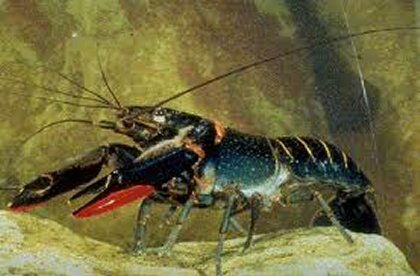 Both species of Cherax breed naturally in ponds. Berried crayfish (those with eggs) are kept in a separate pond or tank and the adults removed (trapped) once they have bred. When the juveniles have reached 1-2g the pond is harvested and the juveniles stocked into grow-out ponds.
Many farms however do not regulate breeding size animals and crayfish will breed readily in culture ponds, leading to large size variation in stock.
Redclaw and yabbies are able to breed in their first year. All three species produce similar numbers of eggs; as the crayfish grow they become capable of producing more, to a maximum of about 1000. Yabbies and redclaws may breed several times in any one season.
Redclaw are thought to require a period of cooler water temperatures (16-22° C) followed by a temperature increase to stimulate spawning. Over the following 4-6 weeks the female nurtures the eggs, which hatch 6-10 weeks after spawning.
The newly hatched juveniles remain close to the female for several weeks before becoming independent.
Yabbies breed when water temperatures exceed 15° C. Incubation of the eggs, at normal summer temperatures of 23-24° C, takes about 3 weeks. As in the redclaw, the juveniles remain with the female for a further 2-3 weeks and are then recruited into the general population.
Growth and production:
Yabbies grow only when temperatures exceed 15° C. Consequently, at Narranderra (in the Riverina of New South Wales) yabbies will grow for only 6 months of the year, but at Grafton (in northeastern New South Wales) yabbies will grow for 11 months of the year. Yabbies grow fastest at 22-28° C.
At juvenile (1-2g) stocking rates of 5-10/m2 (in a grow-out pond), yabbies show 50-70% survival. Yabbies can average 40-60g in 6 months in summer conditions (above 20° C); growth rates can vary and individuals will range from 5-100g after 1 year. Redclaw show rapid and relatively uniform growth in the wild, reaching 150-300g in 2 years; under semi-intensive culture they reach 50-60g in 9 months, and growth is more variable.
Yabbies are the most suitable for farming in NSW. Well-managed ponds may yield up to 1 tonne/ha/yr. However most semi-intensive pond-based farms in NSW achieve rates of approximately 500 kg/ha/yr.
Feeding:
Adult crayfish are opportunistic feeders but are primarily detritovores (that is, they feed mainly on broken down organic matter). Their main sources of nutrition are the microbes (including bacteria and fungi) that break down leaf matter.
It has been found that microbes colonise food more quickly on earth-lined ponds, which are better than concrete tanks.
Although crayfish will survive and grow without supplementary feeding, best growth rates are achieved with an augmented food supply. The amount of supplementary feed required is dependent on water temperature, stock density and the type of food given.
Studies suggest that a wide range of pellets (including cheap commercially available pellets such as Lucerne or pig starter rations) can be used successfully; however, the more expensive formulated diets will generally provide slightly better growth rates.
Alternatives such as the planting of forage crops may be cheaper and worth experimentation.
Juvenile crayfish are carnivores and catch small organisms in the water (zooplankton) as their main food source. If good growth rates are to be achieved nursery ponds need to have good zooplankton blooms.
Behaviour:
Yabbies can be aggressive and cannibalistic under certain conditions. High survival and good growth can still be achieved when some form of shelter (for example, onion bags for juveniles) is available in the ponds.
Although redclaw are less aggressive, shelter is still required to achieve uniform growth rates, as large crayfish dominate small crayfish. Regularly trapping the larger crayfish from the pond also helps to ensure more uniform growth rates.
Unlike redclaw, yabbies are known to burrow into dam walls. Research suggests that burrowing is a survival response to a declining water level.
Information Sourced From:


