Description:
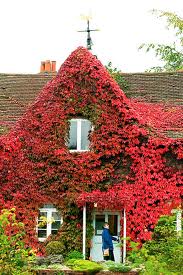
American Virginia Creeper shown in Autumn.(Reason Flowers are Red).
It is a prolific climber, reaching heights of 20 to 30 m in the wild. It climbs smooth surfaces using small forked tendrils tipped with small strongly adhesive pads 5 mm in size. The leaves are palmately compound, composed of five leaflets (rarely three leaflets, particularly on younger vines) joined from a central point on the leafstalk, and range from 3 to 20 cm (rarely 30 cm) across. The leaflets have a toothed margin. The species is often confused with Parthenocissus vitacea, which has the same leaves, but does not have the adhesive pads at the end of its tendrils.
Characteristics:
The flowers are small and greenish, produced in clusters in late spring, and mature in late summer or early fall into small hard purplish-black berries 5 to 7 mm diameter. These berries contain oxalic acid, which is only moderately toxic to humans and other mammals. The berries provide an important winter food source for birds.
The flowers aren’t much to look at, but Virginia creeper berries are a pleasing dark blue.
Habit:
Parthenocissus quinquefolia is a deciduous, woody vine.
Distribution Map:
(Distribution of American Virginia Creeper shown in Green).
Control Measures:
Some folks dislike its aggressive growth habits and are intent on killing Virginia creeper. Since it grows so high, it’s impractical to try killing Virginia creeper (a mature plant, that is) by spraying its leaves. Instead, cut the vine’s trunk (near ground level), then apply the strongest concentrate of glyphosate (Roundup) you can buy to the fresh wound. An organic method of killing Virginia creeper is to dig it out, but this is easier said than done, as the plant spreads via rhizomes.
Caution:
Is Virginia Creeper Poisonous?
Since Virginia creeper is one of the plants mistaken for poison ivy, many people wonder if it is “poisonous” in the sense that poison ivy is poisonous. The sap flowing through Virginia creeper vines does contain oxalate crystals, which can be an irritant for a small percentage of people. If you’re unsure as to whether you’re one of those people, don’t touch Virginia creeper, since the result of contact could be a nasty skin rash. Nor should you eat Virginia creeper berries.
Close up of American Virginia Creeper in Summer.
Problems and Solutions to Growing American Virginia Creeper:
If you live in eastern North America, you probably don’t need to grow Parthenocissus quinquefolia in your yard, because chances are good that it’s growing nearby anyway, perhaps along a road you drive every day (where you can get your fill of it!).
But if you live somewhere where Parthenocissus quinquefolia is not a native plant, perhaps you’ve considered growing it (many have). If so, keep some Problems about this vine in mind:
- Parthenocissus quinquefolia is a vigorous grower and may get out of hand if not kept in check with equal vigor.
- Sticky, disk-like appendages on its tendrils adhere to wall siding, making it difficult to remove. Don’t grow this on walls unless you wish it to be permanent!
- Virginia creeper will climb trees and cast shade on their leaves, thus depriving them of needed sunlight. Don’t allow it to grow on specimen trees!
Possible solutions to the above problems (in order):
- Grow Engleman’s ivy; this cultivar is considered less vigorous.
- If you want the look of a wall covered with Virginia creeper, but without the risk, install a trellis near the wall and grow Parthenocissus quinquefolia on the trellis (keeping it well trimmed).
- Don’t allow Virginia creeper to grow on specimen trees! Instead, grow it on garden arbors or on fences.


