The Evaluation and Selection of Current Varieties:
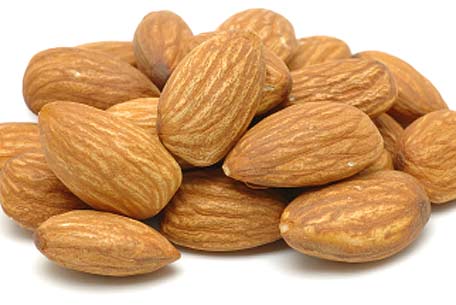
Almond nuts
For a grower, variety selection is key to both establishing and replanting orchards. Because few almond varieties are self-fertile, combinations of varieties rather than single varieties should be selected. Several at least partly self-fertile varieties have been introduced, but in California none has been extensively planted due to uncertainties about their productivity because of unfavorable characteristics. Major varieties planted in California include Nonpareil, Carmel, Mission (Texas), Merced, Ne Plus Ultra, Price, and Peerless. These seven varieties made about 90 percent of the state’s acreage in 1989.
CHARACTERISTICS TO CONSIDER:
Important characteristics to consider in almond variety selection include time of bloom; pollen compatibility; time of maturity and ease of nut removal; yield; freedom from pests, diseases, and other disorders; and marketability (including kernel quality). This chapter provides information about most of these characteristics for certain varieties.
Bloom Time:
When determining a variety’s susceptibility to frost damage, bloom time is important. Early-blooming varieties may be more subject to frost conditions and inclement pollination weather. Coincidence of bloom among varieties is important in selecting satisfactory pollenizers. Almond varieties are grouped by their bloom periods in table 8.1. Usually, varieties within the same bloom group (for example, Nonpareil and Carmel) or from adjacent bloom groups (for example, Nonpareil and Sonora, or Nonpareil and Monterey) will overlap and cross-pollinate satisfactorily, except in the case of incompatible combinations(table 8.2). However, the closer that varieties bloom together, the better the opportunity for cross-pollination and the setting of a crop. The reasons for this are better overlap of flower receptivity and the tendency of bees to fly between trees at a similar stage of bloom.
Almond tree in bloom
Early- and late-blooming varieties (such as Ne Plus Ultra and Mission) will not have sufficient bloom overlap, and therefore will not provide adequate cross-pollination for each other. Even the overlap of mid- and late-blooming varieties (for instance, of Nonpareil and Mission) is usually inadequate.
Besides coincidence, the relative order of bloom time between varieties can be important, particularly between the main producing variety and its pollenizers. Assume, for example, that Nonpareil is the main variety. Overlap with the early Nonpareil bloom is particularly important, because the earlier bloom of a variety usually has a higher-percentage set than does the later bloom on the same tree. From this standpoint, even though Ne Plus Ultra’s bloom may peak 6 days earlier than Nonpareil’s does, it is a much better pollenizer for Nonpareil than is Mission, which blooms 5 to 7 days later than Nonpareil. Ne Plus Ultra is regarded as a relatively good pollenizer for Nonpareil; however, the reverse may not be true, because of their sequence of bloom.
The time of almond bloom may change somewhat from year to year, and in a given year may even differ between locations. The sequence of bloom among varieties seldom changes greatly, but some crossover between adjacent groups can occur in some years and locations. Differences depend on temperature sequences—both cool and warm—during the winter prior to bloom and during the bloom itself.
Pollen Incompatibility:
Almond varieties fall into specific groups within which cross-pollination will not occur. Tables 8.2 and 8.3 summarize our knowledge of such incompatibility between varieties. Varieties listed within the same group(table 8.2) are cross- incompatible and will not cross-pollinate each other. However, any variety in one group is cross-compatible with any variety in other groups. The exception is Jeffries, which is reciprocally incompatible within certain groups.
*Jeffries is a mutation of Nonpareil and should belong to the Nonpareil incompatibility group. However, field experience combined with controlled tests in 1984 and 1985 show that Jeffries possesses unilateral incompatibility. All varieties—including the parent Nonpareil—can fertilize Jeffries. But Jeffries is unable to fertilize Nonpareil, Carmel, Solano, Monterey, and all varieties in these incompatibility groups, as well as Butte. On the other hand, Jeffries can fertilize all varieties in the Mission, Ne Plus Ultra, and Thompson groups, as well as Fritz.
*If a variety in a known incompatible group is listed as compatible, then any other variety in that group should also be compatible.
Time of Maturity and Ease of Nut Removal:
Blanched Almonds
Time of maturity and ease of harvest(tables 8.4 and 8.5) are two other major factors in variety selection. Knowing when—and in what order—varieties mature is important for efficiently managing harvest labor and equipment. Harvest must be prompt to minimize quality deterioration. It is likewise critical to minimize exposure of the newly matured crop to navel orangeworm and to fall rains, which can lead to mold and concealed damage. Planting cross-pollenizing varieties that mature close to the same time makes possible a well-timed final preharvest irrigation (which minimizes water stress to later-maturing varieties) and orchard-floor preparation. Late-maturing varieties are more subject to inclement harvesting weather.
Although the time of almond harvest may change from year to year and will vary according to location, the sequence of maturity for varieties usually does not change. Ease of knocking is a requisite for efficient harvesting. The complete removal of nuts without causing tree injury is essential. Nuts left on the trees represent lost income and an added expense to remove later. Remaining nuts can harbor navel orangeworm, leading to a more serious infestation the following season. The excessive shaking required to dislodge stubborn nuts can damage the tree to the point of causing limb or tree loss, either directly from injury or indirectly from subsequent Ceratocystis canker.
Yield:
Although the yield potential of a variety is very important in variety selection, it can vary because of the year, the location, pollenizing conditions, orchard management, and other factors. A comparison of the yield potential of different varieties at one site and three specific years is shown by data from the Manteca Regional Variety Trial in table 8.6. (In trials such as the one reported here, there is an abundance of compatible pollen available because of the number of varieties being evaluated; therefore, yields may be somewhat higher than in conventional orchard plantings.)
Pest and Disease Susceptibility:
Navel orangeworm and peach twig borer are the principal insects that cause wormy kernels. The industrywide reject levels generally reflect worm damage, although other conditions such as gummy kernels are also included in these figures. Table 8.7 gives reject levels for a number of almond varieties. Noninfectious bud failure, a genetic disorder, has been prevalent in a number of almond varieties, though its severity varies among varieties. Table 8.8 provides information about which varieties are known to be affected and how seriously. This disorder is further discussed in chapter 12, “Genetic Disorders.”
Marketability:
Several categories of varieties are used by the industry for marketing nuts. It is important not to mix nuts of different varieties at harvest, because this may reduce their hullability, marketability, and value. Marketing categories can affect the price received by growers for their crop. A description of several marketing categories follows, which includes varieties generally marketed in each. Handlers may differ in how they categorize varieties; thus, it is important to consult your handler before selecting varieties to plant.
Nonpareil:
Nonpareil is used in products in which the kernel is visible. Nonpareil kernels are uniform, fairly flat, and light colored; they have the widest range of uses of all the categories. Kernels of only a few other varieties are similar. This category is therefore reserved mostly for Nonpareil, although Kapareil, Milow, and Jeffries may be included.
*Indicates approximate number of days after Nonpareil maturity. †LeGrand may harvest better at an earlier date (or a double harvest may be helpful).
*Fritz matures very late and is difficult to knock if harvest is attempted too early. †Mission is harder to knock as a young tree.
California:
The California group consists of varieties whose kernels differ significantly from those of the Nonpareil group. These kernels must be blanchable and are often used in manufactured products. Among the varieties included in this group are Merced, Thompson, Price, Harvey, Norman, and Carmel (though Carmel is sometimes marketed as a separate group).
Mission:
Varieties in the Mission group tend to have plump kernels that roast well but that may not be easily blanched; they frequently have a strong flavor. Butte and Padre varieties are often included in this category.
Ne Plus Ultra:
Varieties in the Ne Plus Ultra group have large, elongated kernels that are used for panning (covering the kernel with a candy glaze). Nuts in this group are also used in manufactured products. Jordanolo is included along with Ne Plus Ultra.
In-Shell:
The in-shell group consists of varieties that have uniform, well-sealed shells, are bleachable, and have little or no worm damage. Peerless is the main variety in this group.
Other Considerations:
Other characteristics to consider when selecting almond varieties include shelling percentage (percent kernel), tree growth habits, and sensitivity to salt damage. Varieties with poor shell characteristics are generally more susceptible to navel orangeworm damage.
*Peerless was shelled for these data, though this variety is normally sold in-shell.
*Insufficient data for rating.
TRENDS IN VARIETY PLANTINGS:
Varieties that have been or are becoming standard include Nonpareil, Carmel, Mission (Texas), Ne Plus Ultra, Price, Peerless, Butte, Monterey, Ruby, Sonora, Padre, and Fritz. Even within this group, trends are constantly shifting; however, Nonpareil continues to be the major variety grown in California. Carmel has been increasing to second in importance, but concerns about its susceptibility to noninfectious bud failure may change this trend. Mission, Peerless, and Ne Plus Ultra continue to be important, but trends are downward for plantings of these varieties.
Varieties that have been grown previously but are seldom planted due to specific problems include Merced, Harvey, Jordanolo, and Yosemite (noninfectious bud failure); Merced, Thompson, Drake, Le Grand, Davey, and Milow (difficulty in harvest); and IXL, Hasham, Jeffries, Sauret #1, Sauret #2, Kapareil, Milow, Carrion, Solano, and Norman (various reasons). Newer varieties with limited commercial acreage include Mono, Tokyo, Livingston, Aldrich, Woods colony, and Rosetta.
Many almond varieties have been planted commercially by growers since 1900. Table 8.9 lists varietiesthat have been grown recently in sufficient numbers to be recorded by the California Agricultural Statistics Service, and that are delivered to nut handlers.
ADDITIONAL INFORMATION ABOUT SPECIFIC VARIETIES
Nonpareil:
Nonpareil Almonds
Originated in Suisun, California, in 1879 by A. T. Hatch, Nonpareil continues to be the most important almond variety in California because of its consistently high productivity and high market demand. The tree is large, and upright to spreading, and harvests early. The nut has a paper shell that gives a high shelling percentage (65 to 70 percent). However, the nut is poorly sealed and this, with the paper shell, makes it susceptible to worm and bird damage.
Although noninfectious bud failure has affected trees within the variety, progress has been made in selecting away from this problem. Specific source clones are available that have been progeny tested in high-temperature growing areas for up to 13 years.
Nonpareil has a medium-size kernel (22 to 25 per ounce) and has been a high and consistent bearer, taking into account fluctuations due to adverse weather conditions in specific years. It tends to yield somewhat less in its earlier years of bearing than do some of its pollenizers, but at full bearing it produces well and continues to grow in size. The consistent yield reflects its bearing habit of producing on both spurs and long shoots, with good ability to renew fruiting wood. It is relatively resistant to frost damage and is vigorous but generally easy to train.
Mission (Texas):
Mission Texas Almonds
A chance seedling originating in Texas about 1891, the Mission variety, originally known as Texas or Texas Prolific, was brought to California, where it was first grown at Acampo. Its continued popularity is due to its late bloom (which reduces its frost susceptibility), high productivity, and market demand. The tree is vig-orous when young, but vigor decreases with age. It is upright in growth habit and easy to train. It may be short-lived, is quite susceptible to Ceratocystis (mallet wound canker), and is sensitive to salt injury. In sandy soils, Mission can also be susceptible to herbicide injury, but generally this is manageable. The hardshelled nut is resistant to navel orangeworm attack. Noninfectious bud failure has been detected in only a few scattered trees and is not considered a production problem.
Mission yields relatively small kernels (25 to 28 per ounce) and therefore needs to produce high numbers of almonds to compensate. It shows a pattern of bearing on spurs rather than on shoots, so very early production can be delayed slightly. However, its yield potential develops rapidly to a moderate to high level. Some decline in production often develops as the tree gets older.
Ne Plus Ultra:
This variety, selected along with Nonpareil and introduced by A. T. Hatch in 1879, is susceptible to frost, worm damage, and several diseases. In terms of market value, the kernel is generally considered inferior and is used primarily for manufactured products. It has a propensity to produce a high percentage (20 percent or more) of double kernels. The variety has been important because it is an early and good pollenizer for Nonpareil; it has also been a profitable producer for some growers. Trees have a spreading growth habit and are easy to harvest, though they tend to drop nuts prematurely. This variety is very susceptible to water stress, which is expressed as hull tights, nut and bud drop, and lack of shoot growth. The tree is also difficult to train. Noninfectious bud failure has not been detected in any trees or sources.
Source: California Fruit and Nut Acreage, 1990. California Agricultural Statistics Service, California Department of Food and Agriculture, Sacramento, CA 95812.
Ne Plus Ultra produces very large kernels (20 or fewer per ounce), which promotes yield. It produces nuts laterally on long, previous-season shoots, followed by heavy spur production. Consequently, it shows precocious bearing and potentially high yields on young trees—with good water management, it can outproduce Nonpareil. On the other hand, erratic bearing may result from pollination and disease problems at bloom.
Peerless:
Selected before 1900 as a chance seedling near Davis, California, Peerless is of unknown origin. It has been used as an early-blooming pollenizer for Nonpareil, but it is unfortunately susceptible to frost. It continues to be an important variety as a pollenizer and because there is a limited market for in-shell nuts. In an in-shell product, shell appearance is important, so rain staining can be a problem and care must be taken in hulling. The tree is of medium size, medium to upright in growth habit, and tends to drop nuts prematurely. Noninfectious bud failure occurs sporadically (symptoms can be pronounced); therefore, this disorder is a potential hazard. The yield of Peerless is dependent on its ability to produce good-quality in-shell almonds. Peerless is hard shelled and has a low shelling percentage, low susceptibility to worm damage, and a mediocre-quality kernel.
Merced:
Merced Almonds
Commercially introduced in 1958, Merced is a chance seedling of a Nonpareil-Mission cross. It has been valuable as a pollenizer for Nonpareil and produces heavy yields on young trees. Merced is very susceptible to navel orangeworm and is difficult to knock. Severe noninfectious bud-failure expression, particularly in the warmer growing areas, has become a factor in limiting plantings. Even without appreciable bud failure, a lack of tree vigor accompanied by declining production has become evident as orchards become older. The tree is small to medium in size and somewhat upright in its growth habit. The medium-size kernel is considered a standard for the California category, in market terms.
Thompson:
A chance seedling found in Clovis, California, Thompson is apparently a Nonpareil-Mission cross; it was introduced commercially in 1957. Thompson has been relatively important because of its late bloom (close to that of Mission, for which it is a pollenizer) and high productivity. However, with time several faults have become evident, including difficulty in nut removal, gummy nuts, susceptibility to navel orangeworm, and some noninfectious bud failure. Although bud failure in individual trees can be pronounced, it is not widespread and thus is not considered a serious problem in this variety.
Thompson has small kernels (25 to 30 per ounce) that fit well into the California marketing category. Thompson produces a medium-size upright tree that develops an extensive spur system and bears heavily when young. Its very high nut sets are generally considered to be the factor promoting yield.
Carmel:
This variety was discovered as a single tree in a commercial orchard near Le Grand, California. Although originally thought to be a mutation of Nonpareil, genetic evidence indicates that it is a seedling of Nonpareil-Mission. Carmel was introduced in 1966. It blooms just after Nonpareil does, and its crop matures ahead of that of Mission. The tree is more upright than a Nonpareil tree and is of medium size. The nuts are quite resistant to worm damage. The variety is susceptible to foamy canker. Brown rot can be a problem and should be properly controlled with fungicide sprays. Carmel has also shown great sensitivity to noninfectious bud failure, which has become particularly evident in recent years.
Carmel is a good pollenizer for Nonpareil and is highly productive when young, but its yields may decline along with tree vigor over time. Carmel has a large, elongated kernel, which is sometimes marketed in the California group, but some processors handle it separately because sufficient volume has developed, and because it has its own positive marketing attributes.
Price (Price Cluster):
A chance seedling discovered in a Durham, California, orchard, Price is apparently yet another seedling of Nonpareil-Mission. It was introduced commercially in 1965. The variety blooms within a day of Nonpareil, for which it is a popular pollenizer, and its crop matures shortly after that of Nonpareil. The tree generally has good vigor, and is somewhat spreading but more upright than a Nonpareil tree.
Price may have a low bloom density in alternate years and thus bear light crops in those years. During “off” years it may not be particularly satisfactory as the only pollenizer in a Nonpareil planting. To some extent, Price bears on long shoots as well as on spurs. Nut clustering occurs both toward the ends of shoots and on spurs. Apparently this clustering is a result of a higher-than-normal set of blossoms. This high density in the “on” year is what reduces blossom density the following year. Noninfec tious bud failure has been found periodically but is not considered a serious problem. Price fits into the California marketing category and tends to produce a moderately high percentage (10 to 20 percent) of double kernels, especially on younger trees.
Butte:
Originating from a controlled Nonpareil-Mission cross, Butte was introduced in 1963. This variety blooms relatively late and ahead of Mission; the crop also matures ahead of Mission crops. Butte is often planted as a pollenizer for Mission, though recently some growers have planted it as a main variety. The tree is spreading and has reasonable vigor. Noninfectious bud failure has not been detected. Brown rot can be a problem in Butte and should be properly controlled. Both early-bearing and mature Butte trees show a high yield, even though the kernels are relatively small. Its high yield appears to result from the combination of early bearing on long shoots, a marked tendency to produce spurs, and sufficient vigor to maintain tree size. The kernel fits with the Mission marketing category.
Ruby:
A chance seedling, apparently from Nonpareil-Mission parentage, Ruby was commercially introduced in 1958. This variety blooms late and after Mission, for which it is a pollenizer. As the tree gets older, bloom time may be later in relation to Mission bloom. Harvest is concurrent with, or slightly after, that of Mission. The tree is small, with an upright growth habit. Noninfectious bud failure has not been detected, and Ruby follows the Mission bearing pattern in developing large numbers of spurs. With age, its vigor may be reduced enough that there is some potential for yield decline.
Fritz:
A chance seedling, Fritz was probably a cross of Mission with Drake; it was commercially introduced in 1969. This variety blooms concurrently with Nonpareil and harvests late, often after Mission. Normally it is not difficult to knock unless the harvest is attempted too early. The tree is of medium size, upright, vigorous, and a prolific bloomer. Noninfectious bud failure has not been found in Fritz. In terms of the market, its kernel fits into the California classification. Like Butte, Fritz has shown a tendency for high, consistent yields despite its relatively small kernel size. This results from its tendency to bear early on long shoots, followed by spur formation; it also has sufficient vigor to maintain tree size.
Monterey:
Monterey was a chance seedling, apparently of Nonpareil-Mission parentage, that was commercially introduced in 1974. It blooms a little after Nonpareil does and is harvested about when Mission is. The tree is spreading. Noninfectious bud failure has not been found. Monterey is a very productive variety that has a large, elongated kernel with a rather dark pellicle. It has a propensity to produce a high percentage (20 percent or more) of double kernels. Growers should consult their handlers to determine the market classification of this variety.
Sonora:
A second-generation seedling from a cross of Nonpareil and Eureka, Sonora was introduced in 1983. This variety blooms with or ahead of Peerless and ahead of Nonpareil. The blossoms are more frost resistant than those of many other early-blooming varieties. The crop matures after that of Nonpareil but before that of Ne Plus Ultra. The tree is medium to round in shape and usually a little smaller than a Nonpareil tree. Sonora has not exhibited noninfectious bud failure. The kernel is large and elongated, and the skin is smooth and light colored. The blond color and smooth pellicle of this variety are considered positive marketing attributes. Sonora has a tendency to bear heavily on long shoots, especially as a young tree, with lesser development of spurs.
Apparently for that reason, the tree begins to bear early and produces excellent crops when young. The large kernel size of Sonora promotes a high yield. This productivity continues as the trees mature. Sonora needs special attention and good management to maintain vigor and subsequent fruitwood production. When exposed to drought stress during bud formation the previous season, or after heavy crops, Sonora tends to produce low bloom densities, but it usually sets a high percentage of that bloom. However, because it blooms early and may have years of light bloom densities, it should not be used as the only pollenizer in a Nonpareil planting.
Padre:
A seedling of a Mission-Swanson cross, Padre was introduced in 1983. The variety usually blooms with or slightly ahead of Mission. The crop matures just ahead of Mission’s and about the same time as Thompson’s. The tree resembles Mission but with more branching; it is of moderate size and vigor and is easy to train. Yields approximate those of Mission and are consistent, though production during the first few years of bearing may be less. Like Mission, Padre bears on spurs, but it also produces flower buds on longer shoots, which enhances production. Blossom densities on Padre are high. Noninfectious bud failure has not been found in any trees or sources. The kernel is similar to Mission’s but slightly smaller, and it fits into the Mission market classification.
Le Grand:
Introduced in 1972, Le Grand has been planted commercially. Although it is partially self-fertile, orchard experience and research have shown that it sets better crops when bees are placed in its orchards. Even bigger crops are produced when other varieties are planted with it for cross-pollination. It blooms just before Mission does. The variety tends to mature late (but before Mission), over an extended period. Le Grand is very difficult to knock, so double harvesting may be beneficial. This variety is susceptible to jacket rot, brown rot, and shothole, and its shell can be quite open, making it susceptible to worm damage. The tree is vigorous and upright. The bearing habit is quite similar to Padre’s, and this variety also has high blossom densities. The kernel fits into the Mission marketing category.
Authors:
W ESLEY K. ASAI, W ARREN C. M ICKE, DALE E. KESTER, AND DONALD ROUGH


