Description:
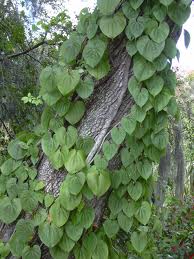
Dioscorea bulbifera around a tree.
Air potato is in the family Dioscoreaceae, or simply the Yam Family. It is an herbaceous twining vine, growing 70 feet or more in length. Leaves are broadly cordate (heart shaped) and alternately arranged on stems. A distinguishing characteristic of air potato is that all leaf veins arise from the leaf base, unlike other herbaceous vines such as smilax and morningglories. Flowers are inconspicuous, arising from leaf axils in panicles 4 inches long, and are fairly uncommon in Florida. Vegetative reproduction is the primary mechanism of spread. This is through the formation of aerial tubers, or bulbils, which are formed in leaf axils. These vary in roundish shapes and sizes. In addition, large tubers are formed underground, some reaching over 6 inches in diameter.
Dioscorea alata or winged yam can easily be mistaken for air potato, D. bulbifera. Winged yam gets it name from its winged internodes, a characteristic feature of the species. Another difference between D. alata and D. bulbifera is the arrangement of the leaves. D. alata has opposite leaves as opposed to the alternate leaves of air potato. Winged yam grows to 30 feet, roughly half the length of the invasive species. This species of Dioscorea does not produce nearly as many bulbils as D. bulbifera. However, this species can also be considered invasive and problematic, but to a lesser extent than D. bulbifera. Although considered to be a species of yam, these plants are very toxic and should not be consumed.
Impacts:
Air potato can grow extremely quickly, roughly 8 inches per day. It typically climbs to the tops of trees and has a tendency to take over native plants. New plants develop from bulbils that form on the plant, and these bulbils serve as a means of dispersal. The aerial stems of air potato die back in winter, but resprouting occurs from bulbils and underground tubers. The primary means of spread and reproduction are via bulbils. The smallest bulbils make control of air potato difficult due to their ability to sprout at a very small stage.
Management:
Leaves and bulb of Air Potato.
Preventative:
Prevention is a key step in the management of air potato. Bulbils are the primary mechanism of spread, and research has shown even minutely small propagules can sprout and form new plants. How these bulbils are spread is speculative, but it appears movement of contaminated brush, debris or soil is the primary mechanism. Mowers and other brush-cutting equipment may also disperse long distances, either through contaminated equipment or throwing of the bulbils during the mowing operation. Spread via birds and other animals may occur, but this has not been confirmed. Water is also a major means of dispersal, so care must be taken to first eliminate populations along water bodies where bulbils may be easily spread. In addition, extra time must be utilized after flood events, as spread may be extensive.
Mechanical:
Mechanical methods are limited for air potato, as control of the vines generally results in damage to the vegetation being climbed/smothered by the air potato. Burning also results in excessive damage to the native vegetation, as the fire follows the vines into the tree canopy. Mowing will help to suppress air potato, but as mentioned previously, this may increase the overall problem sue to spreading of the bulbils.
Chemical:
Chemical control is one of the most effective means of control for air potato, but single applications will generally not provide complete control. This is due to resprouting of bulbils or underground tubers. A dilution of triclopyr (Garlon 3A at 1 to 2% solution or Garlon 4 at 0.5 to 2% solution) in water can be an effective control for air potato when applied as a foliar application. Be sure to include a non-ionic surfactant at 0.25% (10 mls or 2 teaspoons per gallon of spray solution). A 2 to 3% solution of glyphosate
Close up of Air Potato(Dioscorea bulbifera) in the Wild.
(Roundup, etc.) can also be effective. These herbicides are systemic (move throughout plant tissue) so care must be exercised to minimize off-target damage. If air potato vines are growing up into trees or other desirable species, vines should be cut or pulled down to minimize damage to the desirable vegetation. Pulling the vines down without severing them from the underground tuber will allow the herbicide to move into the tuber and provide better control. The best time to apply an herbicide is in the spring and summer when air potato is actively growing. Be sure to allow adequate time for the plant to regrow from the winter to ensure movement of the herbicide back into the underground tuber. (As plants grow and mature, they begin to move sugars back into the roots and below-ground tubers). However, treat before the plants begin to form new bulbils. Persistence and integration of control methods will be the key to complete air potato management.


