As worms burrow through the soil, apart from breaking down the root mat they open up channels for oxygen and during rainfall for water to penetrate. As a result, worm-populated soil becomes wet faster and deeper and holds the moisture longer. Moreover, a reservoir is created deep in the soil fed by the tunnels of the intermediate and shallow burrowers working above, The effects of drought are lessened and crop and pasture growing time extended.
The tunnels are coated with mucus, which is rich in nitrates, and plant roots take advantage of the tunnels as easy-growth channels. The roots can extend quite quickly along these channels, taking nutrition from the nitrogen-rich mucus as they go. Rainwater also plays a major role in making this nitrate available to plants, dissolving it from the mucus as it runs through the channels and spreading it through the substrata,
Unlocking the Nitrogen
The litter produced by plants mostly has a carbon:nitrogen ratio greater than 20:1, If the nitrogen level is above 20:1 it cannot be absorbed by plants and the soil beneath and surrounding the litter could become acid, the soluble mineral locked up and the soil itself then becoming less fertile. Therefore, it is essential that the carbon :nitrogen ratio be reduced to 20:1 or less, and this is greatly assisted by worms feeding on the rotting litter. Although the rotting is started off by bacterial action, it is accelerated by worms eating the litter and excreting the castings. It can therefore be strongly argued that without the action of worms, the forests of the world might be very different. The same can be said of our fertile plains.
By means of the worm’s gut, nitrogen and carbon are partly separated. Most nitrogen is deposited in the soil as castings (some largely unchanged in plant tissue) with only a little in plant-available soluble form, as urea (and this is the greatest source of nitrogen for plants) and in the mucus lining the burrows, A proportion of the carbon is dissipated through the worm’s skin during respiration as carbon dioxide and the balance in the castings. Dead earthworms themselves are significant contributors of nitrogen, being 60 to 70 per cent protein (dry weight) and of a nitrogen content of around 12 per cent.
Worm Castings
The castings produced by worms act as a fertiliser. Worms have a very simple and unsophisticated digestive system, yet a proportion of insoluble minerals passing through it is converted into a plant-available soluble form and cellulose is partially broken down. This digestive process is carried out by enzyme-producing bacteria and, when the castings are excreted, the bacteria and enzymes are excreted along with them, The bacteria are soil benevolent and continue in the soil the work they carried out in the worm’s gut, i.e. converting minerals into a plant-available soluble form and breaking down cellulose, making humus.
The marriage between bacteria and worms is a good illustration of harmony in nature. The dense population of bacteria in the worm’s gut can exist only because of the worm’s ability to absorb oxygen readily. In return, the bacteria not only see to the digestion of their host’s food, but actually become worm food themselves as they die off. Then, after being deposited in the soil by the worms, they break down cellulose into a form in which it can be ingested by the worms as food.
Soil Versus Castings
An analysis of worm castings, when compared to the parent soil, reveals a huge increase in bacterial count. Research has shown that the numbers of bacteria contained in the ingested material increased by up to 1000 times while passing through the worm’s gut. The actual numbers of soil-benevolent bacteria in soils due to the presence of worms can exceed 2,500,000 per gram, in over 100 different soil types. intestines of The presence of bacteria in worm-worked soil can be better indicated by the following figures, which are a brief summary of a much larger table, in which
81 x 10³ = 81 x 1o x 10 x 10, 81,000, and so on.
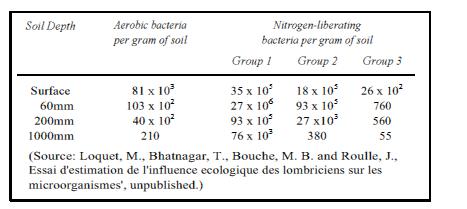
(Personal communication with Dr Ken Lee suggests these figures to be conservative.)
Reference to the table shows that at a soil depth of 60 millimeters, there are an incredible 27,012,770 bacteria per gram of soil. In addition are three groups of nitrogen-liberating bacteria, They arc grouped separately because they work in three different, but complementary ways.
Group 1 release the nitrogen in its most basic form;
Group 2 combine this pure nitrogen with oxygen to form an unstable compound, called nitrite;
Group 3 lock in more oxygen to transform the nitrite to nitrate, It is in this nitrate form that nitrogen is available to plant life,
J.N Parle demonstrated in laboratory tests on Lumbricus terrestris that there were 475 million bacteria in the foregut, 32,900 million in the midsection and 440,700 million in the tail section! That amounts to 474,075 million bacteria, all within one worm. This is just about one hundred times the population. of people on the face of this planet Earth!
As a result of the combined action of the worms and their bacteria, an analysis of worm castings when compared to the parent soil shows approximately:
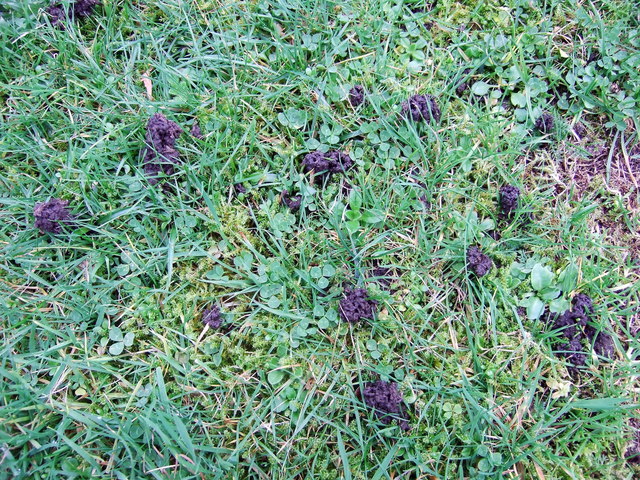
Worm Castings, Attribution Ceridwen
7 times the available phosphorous
6 times the available nitrogen
3 times the available magnesium
2 times the available carbon
1.5 times the available calcium
The key word here is available. There is no more of these minerals in existence, post-worm digestion, than pre-worm digestion. It is that their form has been changed so that there is more available as food to plants. The minerals have been changed from an insoluble form to a plant available soluble form.
Here is a typical analysis of cattle manure before worm ingestion and after, which clearly shows this increase in availability (ppm = parts per million):
The increase in nitrogen speaks for itself.
In case you need convincing, tests in France at the Sovadec Ectechnoliligie Montelimar produced the following results:
Test soil was rated a fertility index of 22
A mix of horse and cow manure was rated 24
Vermicast produced from the manure mix was rated 52
A mix of 10 per cent vermicast and 90 percent parent soil was rated 48
A 90 per cent dilution of the vermicast resulted in less than a 5 percent fall in the fertility index, as much because of the work of the bacteria which released the locked up minerals in the soil as the plant available nutrients already in the vermicast. An NPK analysis of the vermicast would show something like 1:1:1 always in the area-quite low in ratio


